Uncharted Waters: The IMF Tries to Make Sense of a Murky World
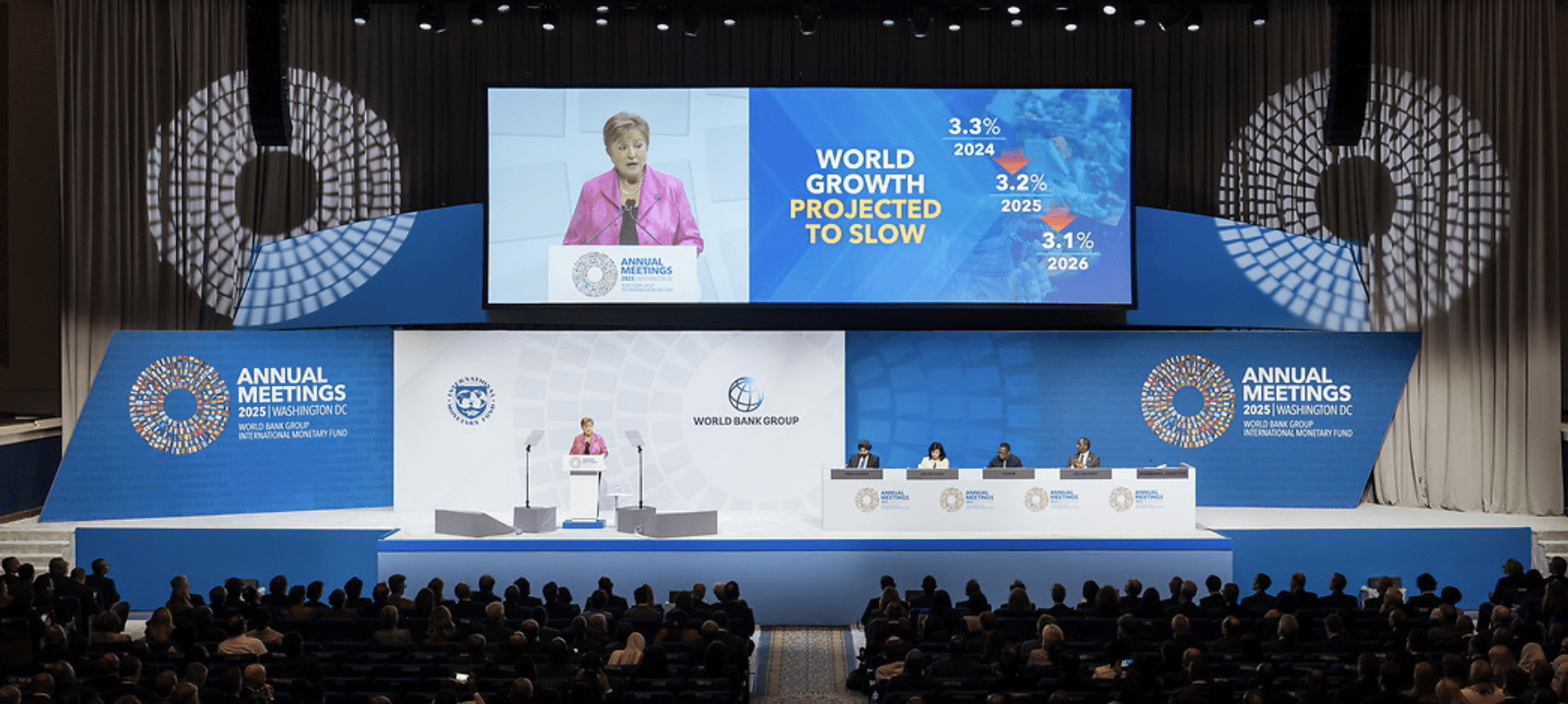 IMF Managing Director Kristalina Georgieva addresses the plenary of the IMF-World Bank Annual Meetings in Washington, October 17, 2025/IMF photo
By Kevin Lynch and Paul Deegan
October 17, 2025
Like the proverbial two-handed economist, the International Monetary Fund (IMF) sees both patches of light and swatches of gloom in its latest biannual World Economic Outlook, with both takes cloaked in a fog of uncertainty. Much of that uncertainty radiated from the White House, ironically just a few blocks from the site of this week’s IMF-World Bank Annual Meetings.
While the revised IMF Outlook unwound much of the downgrade of the U.S. and global outlooks embedded in its spring forecast – a downgrade that had reflected orthodox economic views on the implications of Trump’s tariffs – it flatly rejected any interpretation that the U.S. tariff barrage will have little-to-no effect on either American or global growth. Indeed, the IMF goes to great lengths to make sense of why Trumponomics has not had its anticipated impacts and argues that, while special factors account for it up to now, they have only raised the risks for the future.
The elephant in the revised IMF outlook is President Donald Trump. His predilection for tariffs, his volatility and unpredictability, his profligacy with regards to deficits and debt, his disdain for multilateral rules and institutions, and his assaults on the independence of the Fed and various regulatory agencies are the “known unknowns” that will impact the global economic and geopolitical environment for the foreseeable future. Yet, with the rules of the global economy in such flux, the IMF observed that global markets appear too comfortable with these risks and, combined with what the IMF believes are overpriced assets, particularly AI-related stocks, increase the chances of a disorderly market correction. The spectre of the dot.com boom and bust was never far from the IMF discussions.
So, what is the IMF now predicting for the world economy? Global growth is now expected to be little changed from 2024, averaging around 3.2%. American growth will lead the G7 both this year and next, clocking in around 2%. This is almost double the pace of the Eurozone countries and much higher than Canada, which is expected to eke out 1.2% growth this year and do a tad better next year at 1.5%. China is now experiencing sub-5% growth in response to both Trump’s tariffs and ongoing property sector problems. The growth champion in a world of subdued economic activity is India, expanding near 6.5% despite being hit with among the highest of Trump’s tariffs.
What accounts for the surprising resiliency of U.S. and global growth?
The IMF cites several, mutually reinforcing, factors. The shock of Trump’s Liberation Day tariffs was attenuated somewhat by a mixture of partial rollbacks, exemptions (CUSMA compliant goods are exempt for Canada and Mexico), bilateral tariff deals at lower rates with the EU, UK, Japan and others and, paradoxically, the fact that few countries retaliated. China benefited from a lower exchange rate and trade diversion to Asia and Europe, and many countries including Canada provided fiscal support to assist affected sectors. Many US companies stockpiled goods before the tariffs took effect, providing a short-term cushion, and a surprising number of importers have absorbed the tariffs, at least so far, rather than passing them on to their customers due to aggressive jawboning from President Trump himself.
But the biggest factor sustaining American growth was the AI boom. According to JP Morgan, in the first half of 2025, AI-related capital spending accounted for an extraordinary 1.1% of GDP growth, more than all American consumer spending combined. And the stock market, which reached record heights in 2025, was primarily driven by the so-called AI hyper-scalers (Meta, Apple, Nvidia, Google, Microsoft, Oracle, Palantir, Amazon, and Tesla) and these gains spurred spending by wealthy Americans while increasing wealth inequality. Ruchir Sharma, Chair of Rockefeller International and an FT columnist, argued recently: “America has become one big bet on AI. AI better deliver for the U.S. or its economy and markets will lose the one leg they are now standing on.” The IMF concurs, albeit in less colourful language: “Markets could reprice sharply, especially if AI fails to justify lofty profit expectations”.
While the IMF was careful not to criticize Trump directly, it certainly makes the point that the risks are on the downside for the US economy. Firms are likely to pass-through tariffs to customers in order to restore profits, thereby raising prices and inflation. Employment growth is weak as companies trim costs. Consumer spending will moderate further as higher prices hit less-affluent families hardest. U.S. tariffs, which are now roughly 19% versus 2.3% last year, are high and volatile, with further large increases coming on all exports from China.
While the IMF was careful not to criticize Trump directly, it certainly makes the point that the risks are on the downside for the US economy.
And the unknowns keeping forecasters nervous include whether the AI boom is a bust and rattles stock markets or a boom and launches a new productivity surge, as well as whether global financial markets continue to buy U.S. Treasuries given the massive U.S. federal deficit and a government debt-to-GDP ratio moving above 100%.
Since President Trump demands being the centre of attention, it is only fair to focus first on U.S.-specific risks. But no IMF World Economic Outlook would be complete without a healthy discussion of global risks. In addition to the pervasive risk of American tariff policy leading to fractures in the global trading system and all that entails, the IMF has flagged four areas that deserve particular attention by governments: the state of public finances, the undermining of institutional independence and credibility, the design and use of industrial policies, and the increasing interconnectedness between banks and nonbanks.
Why a particular focus on public debt now?
Besides the fact that government debt is both high and rising in most advanced countries, it is the intersection between this dynamic and the forecast of lower growth prospects, higher real interest rates, and massive new spending on defence and industrial support programs that should cause governments to rein in expanding deficits, shift to smart, targeted spending (e.g. infrastructure, R&D and human capital) which builds growth, and establish fiscal buffers against further global shocks according to the IMF. As well, the IMF is also flagging gross debt as a worry rather than focus solely on net debt – a relevant risk for Canada which, despite low government net debt relative to GDP, has a gross debt to GDP ratio for the general government sector of 114%.
Increasing political pressure on policy-setting institutions such as central banks, the IMF warns without specifically mentioning President Trump’s attacks on the Fed, could cause “the hard-won credibility gains achieved over many decades” to be lost. What anchors the public’s expectations about inflation or regulatory rules in such an environment other than political expediency? Institutional credibility matters for well-functioning economies and societies.
The IMF spotlight on industrial policy reflects its increasing use in today’s world of unilateral U.S. tariffs, possible disruptions to supply chains, slowing growth, and energy security. Not surprisingly, the IMF makes the case that industrial policy is neither all bad nor all good; it depends. And what it depends on are its purpose, design, implementation, targeted focus and fiscal cost. South Korea is typically cited as an example of successfully designed and implemented industrial policies, but the IMF analysis indicates more failures than successes in both advanced and emerging countries. Essentially, the IMF advice is industrial policy if absolutely necessary but not necessarily industrial policy if other mechanisms are available.
Nonbanks — insurance companies, pension funds, investment funds and private credit funds — have been on a growth streak recently, accounting today for half of the world’s financial assets and half of daily foreign exchange market turnover. The question is: has this massive shift in financial intermediation been accompanied by an equivalent shift in risk assessment by regulators or are we back in the early 2000s world of mortgage-backed securities and CDOs where transparency about asset holdings and interconnections was missing and liquidity was not what it seemed.
The IMF is worried about the potential for a market shock to nonbanks to be transmitted throughout the financial system, including banks and bond markets, and at scale. Not surprisingly, they are encouraging regulators to get ahead of the issue by broadening data collection, expanding financial system stress tests and updating liquidity examinations. Given the experience of the global financial crisis, this is timely advice, and they compliment UK and Australian regulators for their leadership. How the Trump administration responds to suggestions of more financial sector regulation and coordination is much less clear.
In her “curtain raiser” speech before the Annual Meetings, IMF Managing Director Kristalina Georgieva advised everyone to “buckle up: uncertainty is the new normal and it is here to stay.” She went on to say, “If we all pull together in this complex and uncertain world, we can deliver good policies that underpin free markets with smart regulations, strong institutions, reliable data, and robust safety nets — policies with the power to further increase resilience and accelerate growth.”
Left unsaid was what happens if we pull apart instead.
Kevin Lynch was Clerk of the Privy Council and vice chair of BMO Financial Group.
Paul Deegan is CEO of Deegan Public Strategies and was an executive at BMO and CN.