
Unreliable Boyfriends and Other Wicked Problems
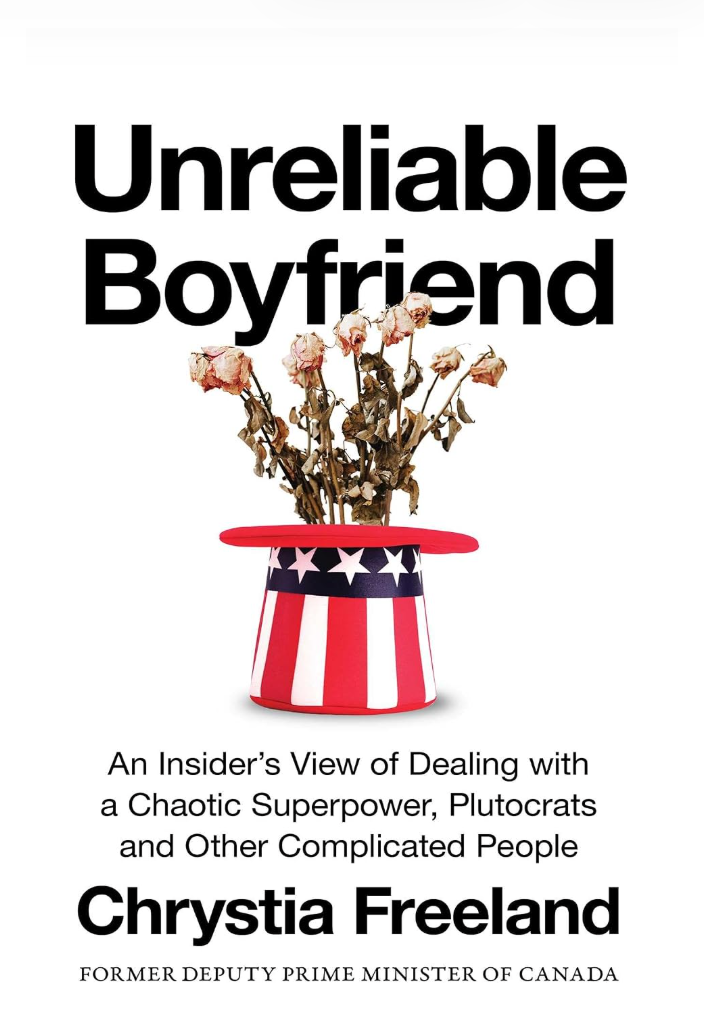
By Chrystia Freeland
Simon & Schuster, October 2026/416 pages
Reviewed by John Delacourt
November 4, 2026
Based on the title of this book, a reader picking it up off the bestsellers table at Indigo or their favourite indie “local” could be forgiven for assuming the unreliable boyfriend in question is former Prime Minister Justin Trudeau, who cajoled Chrystia Freeland away from a career in the financial media stratosphere only to fire her as finance minister in a Zoom call 12 years later.
Or perhaps it’s current Prime Minister Mark Carney, the longstanding friend whose purported recruitment as her replacement made him both the impetus for her firing and the guy who then beat her for the Liberal leadership.
It turns out, per the Uncle Sam figure on the cover of the U.S. edition of the book, that — notwithstanding the notorious 2014 political coining of the term “unreliable boyfriend” by UK MP Pat McFadden in referring to Carney’s opacity on interest rate policy as BoE governor — Freeland’s unreliable boyfriend is actually our volatile, reckless neighbour, Donald Trump’s America (seeming significantly more rational after last night’s midterm results).
Indeed, from the opening pages of Unreliable Boyfriend: An Insider’s View of Dealing with a Chaotic Superpower, Plutocrats and Other Complicated People, it is clear that one of the author’s great virtues as a parliamentarian and statesperson was her fearlessness in calling out abuses of power and accountability – core qualities of the Trump brand.
Freeland’s prologue has our former Deputy Prime Minister honoured as 2018’s Diplomat of the Year in Washington by Foreign Policy magazine. In her acceptance speech, Freeland was blunt about the need for the United States, under Donald Trump’s administration, to “renew their commitment to lead the free world.”
Such directness earned her the epithet “that nasty woman” from Trump, and it set back the progress of the CUSMA negotiations accordingly.
It is an effective opening scene for this amalgam of “memoir and polemic.” It tells us a lot about the integrity of Freeland as protagonist. Such boldness and speaking truth to power-gone-rogue reads as a thematic leitmotif of Freeland’s time before politics, where she earned strong bona fides on the international stage as a journalist in capitals around the world.
The prologue also positions her in stark contrast to the driving antagonistic force of this narrative: power and political capital devoid of accountability. Yet this dynamic also implies a corollary: there are consequences for speaking truth to power, and one must be prepared to accept them.
As she relates in the memoir portion of the book, Freeland came to Ottawa after decades of soaring at a rare altitude geopolitically, from her early days landing in Kyiv as a Harvard exchange student in 1988 through to her rapid rise as a journalist, starting as a stringer for the Financial Times (FT), the Washington Post and The Economist.
By the time she was working as an Eastern Europe correspondent for the Financial Times, Freeland had invaluable access to some of the sharpest diplomatic minds in both the UK and the US, including Richard Holbrooke, Pamela Harriman, Zbigniew Brzezinski, Jeremy Paxman and Michael Ignatieff.
She cultivated a learned and wise sense of upper-case H history from mentor-to-mentee conversations with George Soros and with seasoned correspondents like FT’s Quentin Peel. She was an early champion of Bill Browder’s efforts to have the anti-corruption Magnitsky Act (named after Putin whistleblower Sergei Magnitsky) passed in both the US and Canada.
Someone with Freeland’s bona fides, so clearly in evidence in Unreliable Boyfriend, should ideally play a significant role in this next phase of our shared history.
In the midst of a chaotic post-glasnost economic transition occurring in the former Soviet Union, Freeland witnessed how Francis Fukuyama’s famous thesis about the end of history, beginning with the demolition of the Berlin Wall in 1989, led to far more complex and troubling developments, and she reported on these unflinchingly.
As the memoir moves forward to her early years taking on more responsibilities and roles in Trudeau’s cabinet, it is clear Freeland made an elegant transition from journalist to parliamentarian. Indeed, if the Trudeau years were pitched as some cosplay version of a Canadian West Wing (and in hindsight they seem almost self-consciously presented as such), her bona fides would come close to straining credibility.
All too credible is Freeland’s eventual falling out with Justin Trudeau, as she grounds her narrative in the key incidents that led to her departure from the political stage. She provides some further insight into the Zoom call when she was notified, by Trudeau, that she would be losing her position as Minister of Finance so Mark Carney, not yet elected, could be installed in her place. Though this is not a dramatic revelation to anyone who follows Canadian politics, the callousness of this exchange is only more powerfully rendered when told in the first person.
There are other key moments in this memoir that Freeland’s first readers surely urged her to include: the master class chess moves of the CUSMA negotiations, where Freeland is admirably generous in her praise of the team around her, and Freeland’s meeting with Jean Chretien, where the master strategist spoke plainly and directly about the risk to Liberal fortunes in the next election if she didn’t distance herself from Trudeau, blowing her own whistle on a government on the ice well past overtime.
And yet, because the memoir is only one — albeit significant —part of this book, Freeland has to skate lightly over four decades of a remarkable journey from her Albertan childhood to her work and travels in Kyiv, Moscow, London and New York, while ensuring what’s covered are the choices that culminated in her resignation letter from Cabinet.
As for the polemic in Unreliable Boyfriend, which comes into the foreground in the latter part of the book, more substance is sacrificed to concision.
It covers Canada’s role in a global economy and a reiteration of her defence of “friendshoring” from the comms rollout of the government’s Fall Economic Statement in 2022. It is largely about the unfinished work of shared prosperity from the first wave of globalization due to some misconceptions, lies and omissions.
Unreliable Boyfriend might stand as an interesting problem book because of the blind spots in the polemic, of which one in particular stands out. When she speaks of what’s not negotiable when in trade dialogue, she affirms “that what we buy and sell is about more than money, the currency of economics. It is about values. We care about price. We also care about human rights, and we care about the environment. Trade has consequences for all three.”
The glaring omission in that list is culture, but there was no way she could have predicted, while writing the book, that when trade talks broke down recently with the U.S., that Carney would cite cultural issues, not least the French language, as a fundamental value question that could not be sacrificed in any trade transaction.
It was a “when push comes to shove” moment that served to underscore a truth about the non-negotiable aspects of Canadian identity.
But this is merely a wobble in Freeland’s policy footing as conveyed in the book. And it is perhaps indicative of this transitional period in Canadian multilateral relations when we’re moving away from the charms of one old boyfriend – America – and finding solace in various European friendships with benefits.
Someone with Freeland’s bona fides, so clearly in evidence in Unreliable Boyfriend, should ideally play a significant role in this next phase of our shared history. There will be much to look forward to in the next instalment of her memoirs.
Policy Contributing Writer John Delacourt is Senior Vice President of Counsel Public Affairs in Ottawa and a veteran Liberal strategist. He is the author of several novels, including The Innocent Canadian.