
‘We Will Not Give What They’ve Asked’: Mark Carney’s Havel Moment
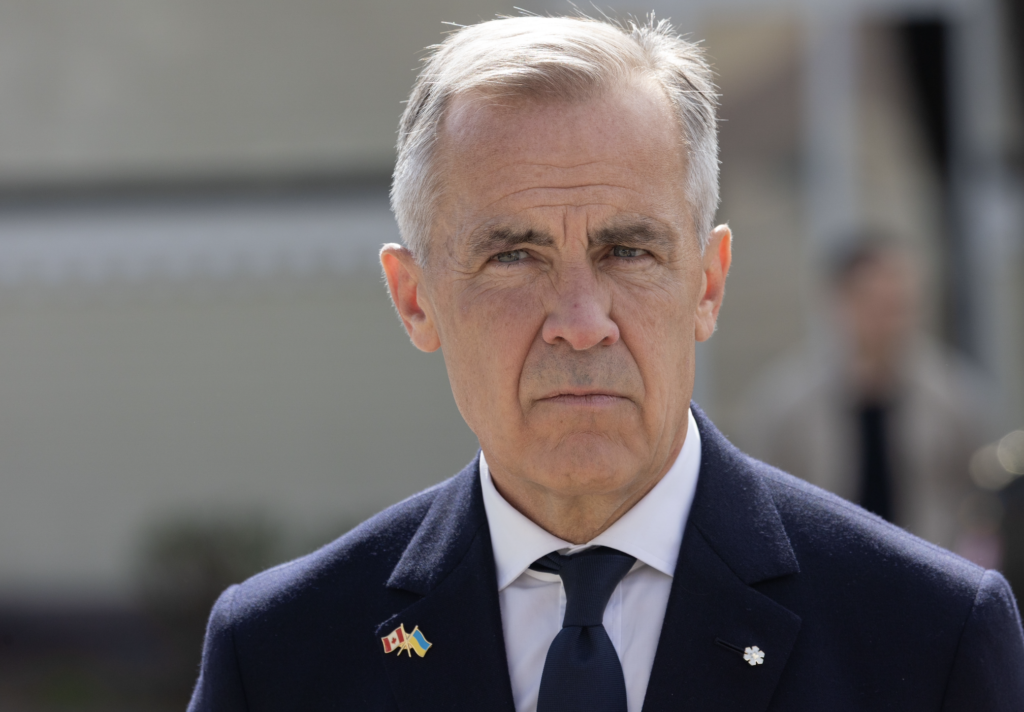 Mark Carney in Kyiv, August 24, 2025/Shutterstock
August 22, 2026
At the end of his news conference on Saturday following Canada’s 11th-hour withdrawal from bilateral trade talks with the Trump administration on Friday night, Prime Minister Mark Carney was asked the following question:
“Why does it feel like today, Mark Carney is going to war?”
“Because we were attacked,” Carney replied. “You’re at war when you’re attacked and we got attacked.”
At the same time, Carney was careful to characterize as a last resort Canada’s trend-bucking decision to reject Donald Trump’s rampant weaponization of trade — effectively, the culmination of months of due diligence and realism on the part of Canadian negotiators veiled in diplomatic suspension of disbelief as to the nature of a process whose coercive twists beggared belief.
“For over a year, Canada has worked intensively and in good faith with the United States to negotiate a new, comprehensive trade deal,” Carney said. “We’ve been pragmatic, patient and persistent. We pursued every opportunity to reach an agreement that protects Canadian workers and their families, that strengthens our economy and that respects Canadian sovereignty.”
At the end of the day, Carney intimated on Saturday, Trump’s 50% tariff deadline served not to reconcile bottom lines, but to underscore the ludicrousness of the process.
“We cannot accept what they’ve offered,” he said, “and we will not give what they’ve asked.”
As Carney pointed out, Canada already has a trade treaty with the United States and Mexico; it’s called CUSMA. Putting a tariff gun to our heads as a means of abrogating and weakening that treaty isn’t a negotiation.
While we may be in a trade war with this administration, it is important to point out that Donald Trump’s presidency has done more damage to the United States than to any other country in the world, so when Canada refuses to acquiesce to his thuggery, it isn’t just serving its own interests and adhering to its own values, it is serving the interests of — and adhering to the longstanding stated values of — the United States.
In his geopolitical urbi et orbi speech to Davos and the world in January, Carney invoked the late Czech playwright, dissident, and statesman, Václav Havel.
Citing Havel’s 1978 essay, The Power of the Powerless, in which the persistence of tyranny is attributed to a collective self-preservation reflex, Carney recalled Havel’s greengrocer, who places a sign in his window reading “Workers of the world unite!” to signal, in performative fashion, his deference to the communist regime.
“Havel called this ‘living within a lie’,” Carney said in Davos. “The system’s power comes not from its truth but from everyone’s willingness to perform as if it were true. And its fragility comes from the same source: when even one person stops performing — when the greengrocer removes his sign — the illusion begins to crack.”
While Carney didn’t cite it in Davos, Václav Havel also had a philosophy of resistance. He called it the “as if” approach to tyranny, and Carney’s refusal to submit to Trump’s economic surrealism is a — presumably inadvertent — tribute to it.
“As if” resistance entails responding to the lies, intimidation and myriad abuses of power of unhinged tyranny as if they have done nothing to incrementally, insidiously transform your behaviour; to conduct yourself as if you still live in a sane, functioning democracy whose constitution hasn’t been trampled and whose freedoms — including freedom of thought — haven’t been sacrificed to the perversions of a pathocracy.
While Carney didn’t cite it in Davos, Václav Havel also had a philosophy of resistance. He called it the ‘as if’ approach to tyranny, and Carney’s refusal to submit to Trump’s economic surrealism is a — presumably inadvertent — tribute to it.
The principle is pragmatic: not just to keep your head when all about you are losing theirs, but to refuse to abandon reality for the less perilous, soul-crushing shelter of a dictator’s elaborately constructed, corruptly enabled delusion. It takes a longer-term view of self-preservation that incorporates spiritual self-preservation and the preservation of truth for the greater good.
Donald Trump is not the Machiavellian mastermind of a war on democracy that both produced and benefited from his political ascendancy. But he is a means to its endgame via his relentless discrediting of America, and his role in catalyzing otherwise unthinkable events — from his gutting of U.S. soft power around the world to his assault on the rules-based international order exhibited in the withdrawals, de-funding, and disrespect expressed toward its multilateral institutions, to his volatility-rationalized violation of norm after norm of international law.
But Trump’s most consequential attack so far on the multilateral status quo has been his extraordinary, extra-legal use of tariffs to hack, corrupt, and decimate the treaty-codified, World Trade Organization (WTO)-protected supply chains that have comprised the economic circulatory system of the democracy-led world order.
As a means of abusing the power of Trump’s title as president of the United States while at the same time depleting it by trashing the international order America has led as a democratic superpower, the cynicism of this tariff war speaks volumes.
As a systemic assault, it not only redraws the map of global trade to serve a whole new set of interests, it doubles down on the reprehensibility of what has been primarily a war of propaganda and covert operations by attaching economic costs to that reprehensibility and making it existential — for countries, regions, sectors, professions, and individuals.
While it will likely be assiduously re-framed as something smaller, something more reckless, or something less patriotic, what Mark Carney delivered Friday night was a statement of fundamental Canadian values.
It also made Canada the first country to crack the illusion of Donald Trump’s presidency, and to stop living within a lie.
Policy Editor and Publisher Lisa Van Dusen has served as Washington bureau chief for Sun Media, Washington Columnist for the Ottawa Citizen, international writer for Peter Jennings at ABC News, and as an editor at AP National in New York and UPI in Washington.