
What Canada Can do for Myanmar: An Act of Regulatory Agility
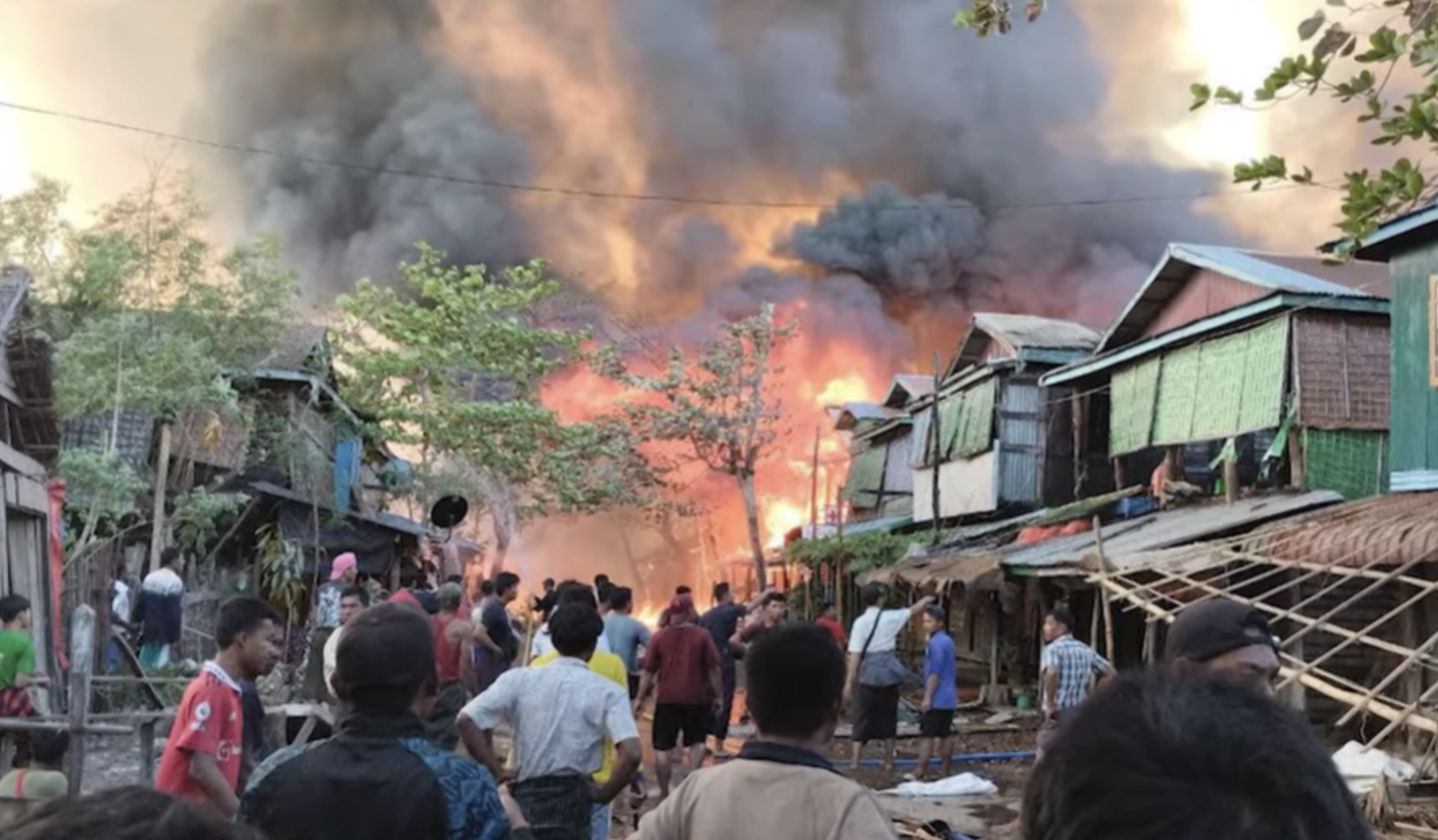
The Myanmar military’s bombing of Kyauktaw Township in January, 2025/YouTube via Wikimedia
By Si Thu Naing
July 19, 2026
I was born in Myanmar, and grew up under a rotating cast of generals whose names changed while the machinery beneath them did not.
I remember running home from a friend’s house when we heard gunfire in the distance, and I was old enough in 1988 to lose a full grade of school when the regime closed the universities rather than risk another countrywide strike.
When I eventually went on to technical and engineering education, it was not in the city, but in Thanlyin, a town across the Bago River from Yangon reachable only by a single bridge, close enough to see the city skyline but far enough that no uprising there could easily spread.
Today, five years after the 2021 Tatmadaw coup that prevented the newly re-elected National League for Democracy government from being sworn in, returned State Counsellor Aung San Suu Kyi to detention, and re-installed the military junta, that pattern of state-run repression remains the story.
While the junta is now going through the motions of a transition to civilian leadership for international consumption, it still controls only one fifth to one quarter of the country, has insufficient credibility with the government-in-exile and ethnic groups to launch peace talks, and is relying on Russia and China to keep on life support a war which, by most measures, it has already lost.
The people of Myanmar have long been consigned to a power structure that survives every change of face at the top, met by an international community that keeps responding to each new eruption of violence as an isolated crisis rather than a continuation.
Since 2021, what Myanmar’s resistance has mostly received from the West is a stack of statements of concern, followed by little change in the facts on the ground.
With so much multilateral attention drawn to Ukraine but with Myanmar serving as an equally instructive barometer of global power shifts, there is an argument for something narrower and more achievable: if the West cannot supply weapons to Myanmar’s government-in-exile, what is the realistic next-best option?
Start with why the battlefield has shifted. By 2024, a BBC investigation found that the junta fully controlled only about 21% of Myanmar’s territory. That the junta has clawed back ground since then is not a story of its own recovery.
The junta’s forced conscription drive has made little difference to the course of the conflict, and the “civilianization” since 2021 of the country’s military leader, Min Aung Hlaing, via his election as president by the Tatmadaw-controlled electoral college in April, has only further entrenched the stalemate in the civil war.
Two external powers now shape what is militarily possible, and they play vastly different roles.
Russia remains the junta’s principal supplier of combat aircraft, helicopters, and munitions, allowing the government’s air campaign to continue. This relationship runs both ways: Myanmar is now reportedly re-supplying Russia with mortar rounds and ammunition for the war in Ukraine, while bilateral cooperation on drone production is expanding.
But a junta forced to defend its own position against a better-equipped resistance becomes a less reliable partner in this axis — a real, if secondary, pressure point on Moscow.
China’s influence works differently, operating through structural leverage over border trade, logistics, investment, and critical minerals. Beijing has not hesitated to cut fuel and electricity to resistance-held territory, or to detain a Myanmar National Democratic Alliance Army (MNDAA) commander in Yunnan to force ceasefires when its own regional interests are threatened.
Rebalancing Canada’s geopolitical focus requires exactly this kind of regulatory agility. Licensing a financial mechanism for Myanmar’s National Unity Government is a cost-free, high-leverage mechanism to meet Prime Minister Carney’s stated Indo-Pacific goals today.
Yet, this immense economic footprint represents China’s soft underbelly. Beijing’s primary strategic objectives – the multi-billion-dollar Kyaukphyu deep-sea port and the vital oil and gas pipelines running directly into Yunnan – rely on absolute regional stability. A better-funded resistance forces Beijing to expend real diplomatic and financial capital propping up a failing junta that can no longer guarantee the safety of Chinese pipelines.
The implication for Western policy is straightforward: matching Russia weapon-for-weapon is not realistic and was never going to be. Something narrower is.
As with Ukraine, the obstacle to achieving a clear outcome in this war is neither the will nor the capacity of the resistance. It is the lawful access of the National Unity Government (NUG) in exile to the international financial system. The NUG raised over $150 million in its first two years alone through bond sales, lotteries, land auctions, and diaspora crowdfunding.
By its own defence ministry’s account, the binding constraint on arming its forces has been financial-system access, not willingness to pay: sanctions and anti-money-laundering rules built to starve the junta have made it nearly as hard for the resistance to move money.
As for the answer to the objection that will here be raised: is this a call for Canada to arm a civil war? No. It is a call to use the ministerial permit system already built into the Special Economic Measures Act (SEMA), the same mechanism under which Canada’s own Myanmar sanctions regulations operate, to exempt specific defensive transactions. This would allow the resistance to purchase equipment with funds it has already raised.
That is a narrower and more politically defensible proposal than either a donation program or continued inaction, and one that also changes what a negotiated settlement could mean.
When Min Aung Hlaing offered a 100-day window ending July 31st for anti-coup resistance groups to join peace talks, both the NUG and the major ethnic armed organizations rejected it almost immediately. They did this not out of stubbornness but because recent history is replete with warnings that accommodation with the military, absent real leverage, ends the same way regardless of what gets signed.
Why should a NATO country care about any of this?
Myanmar now sits at the centre of the world’s heavy rare-earth supply chain, concentrated in Kachin State’s Chipwi and Pangwa townships, territory the Kachin Independence Army seized in 2024 and now taxes directly with Chinese buyers. These are the minerals behind precision-guided weapons, electric motors, and the hardware driving the AI race. China’s growing dependence on this single rare-earth supply source means instability in Kachin is no longer a regional footnote.
Rebalancing Canada’s geopolitical focus requires exactly this kind of regulatory agility. Licensing a financial mechanism for Myanmar’s National Unity Government is a cost-free, high-leverage mechanism to meet Prime Minister Carney’s stated Indo-Pacific goals today.
This, alongside tightening sanctions enforcement, and backing the institutional capacity behind Canada’s own 2017–2018 special envoy report on the Rohingya crisis by former United Nations Ambassador Bob Rae, whose successor position Ottawa announced in 2022 but never filled, are all things Canada can do without becoming a combatant.
For decades, Canadian foreign policy has treated sanctions as blunt instruments of punishment, walls built to block rather than gates built to direct. By pioneering a licensed financial channel for Myanmar’s legitimately elected government-in-exile, Ottawa can shift from passive economic containment to something closer to regulatory statecraft.
When President Barack Obama addressed the Canadian Parliament in 2016, he famously declared that “the world needs more Canada; NATO needs more Canada.” While that call is traditionally measured in defense percentages and military hardware, today’s fractured geopolitical landscape demands a different kind of contribution.
As the United States retreats from its role as a global human rights guarantor, Canada can step forward not with empty rhetoric, but with the precise regulatory agility a middle power is uniquely positioned to deploy.
Myanmar’s democratic resistance is not asking Canada to fund a revolution. It is asking Canada to dismantle a financial obstacle the West has placed in its path.
It is time to let the resistance spend its own money to save its own country.
Si Thu Naing is a public servant in the federal government. He is an MBA candidate in Sustainable Innovation at the University of Victoria’s Gustavson School of Business and a contributor to the Canadian Centre for Policy Alternatives. The views expressed are his own.