
What Middle East Peace Looks Like in Trump’s World of Winners and Losers
The chaotic American president’s approach to the protracted conflict between Israel and the Palestinians has been anything but nuanced.
By Lisa Van Dusen/The Hill Times
March 15, 2018
A few years ago, a friend with a crafty streak surprised me with a pair of geopolitical hand puppets. They have papier-maché heads adorned with black felt hair, and sport camouflage uniforms and little felt combat boots. There are detachable mustaches. They came in their own box labelled “Super Fantastic Generic Middle East Combatant Hand Puppets”, accompanied by a tiny Henry Kissinger paper doll on a popsicle stick. They were deliberately fashioned to be indistinguishable, to underscore the moral absurdity of this conflict. I love them. In a fire, I would grab them before this laptop.
Last week, while watching Israeli Prime Minister Benjamin Netanyahu’s speech to the annual AIPAC conference in Washington, I wished I could lend him my puppets. Netanyahu loves props — cardboard cartoon time bombs, Iranian drone fenders, kooky world domination maps — and the puppets would be perfect for his next UN General Assembly address.
That’s if the embattled prime minister makes it to next fall’s UNGA, what with possible corruption charges looming and an increasingly fraught coalition in the Knesset sparking talk of a pre-emptive, tactical election call by the man famous for his resurrections in the land resurrection made famous.
Netanyahu has seemed emboldened amid this unprecedented precariousness, notably by the recent recognition of Jerusalem as Israel’s capital by former real estate developer and reality show host Donald Trump in his current capacity as Oval Office-based agent of political, geopolitical and economic chaos.
In a recent Washington Post piece about why Trump son-in-law Jared Kushner’s security clearance was downgraded came the disclosure that at least four countries — United Arab Emirates, China, Israel and Mexico — had discussed ways in which they could exploit Kushner as an easy mark. “Officials in the White House were concerned that Kushner was ‘naive and being tricked’ in conversations with foreign officials,” the Post reported.
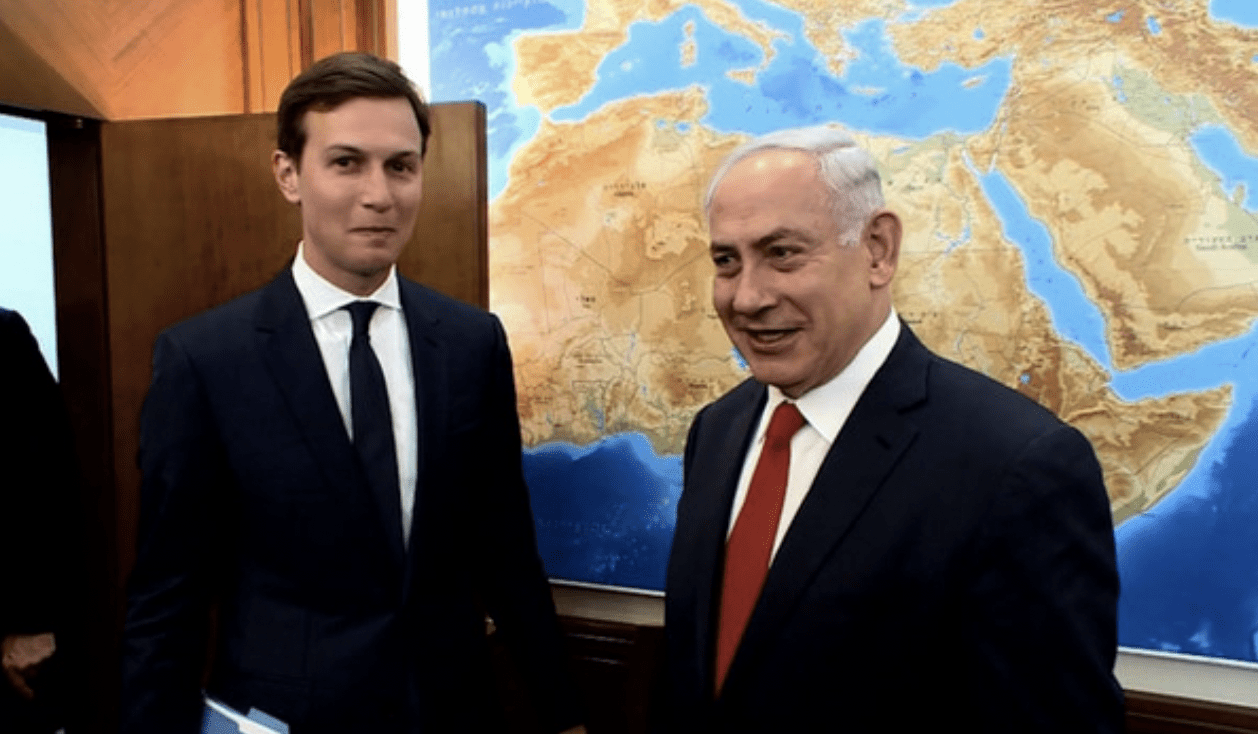
The revelation recalled a Kushner meeting with Netanyahu last summer, when it was so overwhelmingly obvious that the dewy Manhattan real estate scion would be delicately and expertly fricasseed by the canniest political tactician in Israeli history that you almost wanted to call his mommy.
Did Netanyahu, who has unironically cited the Trump team’s real estate expertise as a peace process asset, tell Kushner that the current American Embassy in Tel Aviv was in a seller’s market and Jerusalem was a better investment? Did he pitch it as a zoning issue?
America recognizing Jerusalem as Israel’s capital outside the parameters of peace negotiations has long been understood as a nuclear option, one that would be seen as the United States abandoning its honest broker role and picking a side.
In July 2000, immediately after Bill Clinton failed to secure a post-impeachment, legacy-salvaging deal at Camp David II because Palestinian Authority President Yasir Arafat balked over his terms for Jerusalem, Clinton dangled the idea of moving the embassy. The threat was clearly intended as punishment, and would have been universally interpreted as such if he’d gone through with it.
Which is why the Trump administration’s decision looks worse than naïve. To supporters of a two-state solution, including people who love Israel and believe the worst outcome for both sides would be an indefinite normalization of the status quo, it looks bafflingly spiteful.
The Trump administration’s Middle East peace proposals are said to be ready for release any day now. The New World Order actors wreaking havoc these days, including Mr. Trump, subscribe to an approach that rewards power for its own sake, no matter how ruthlessly acquired or exercised.
They see the world not as a family of human beings of every description striving for progress, peace, equality and justice but as one big game of winners and losers. And in the Middle East, whatever he proposes, it seems Mr. Trump has already declared a winner.
Lisa Van Dusen is associate editor of Policy Magazine and a columnist for The Hill Times. She was Washington bureau chief for Sun Media, a writer for Peter Jennings at ABC News, and an editor at AP in New York and UPI in Washington. She also served as communications director for the McGill Middle East Program in Civil Society and Peace Building.