
Why China was the Dragon in la Sala in Mexico City
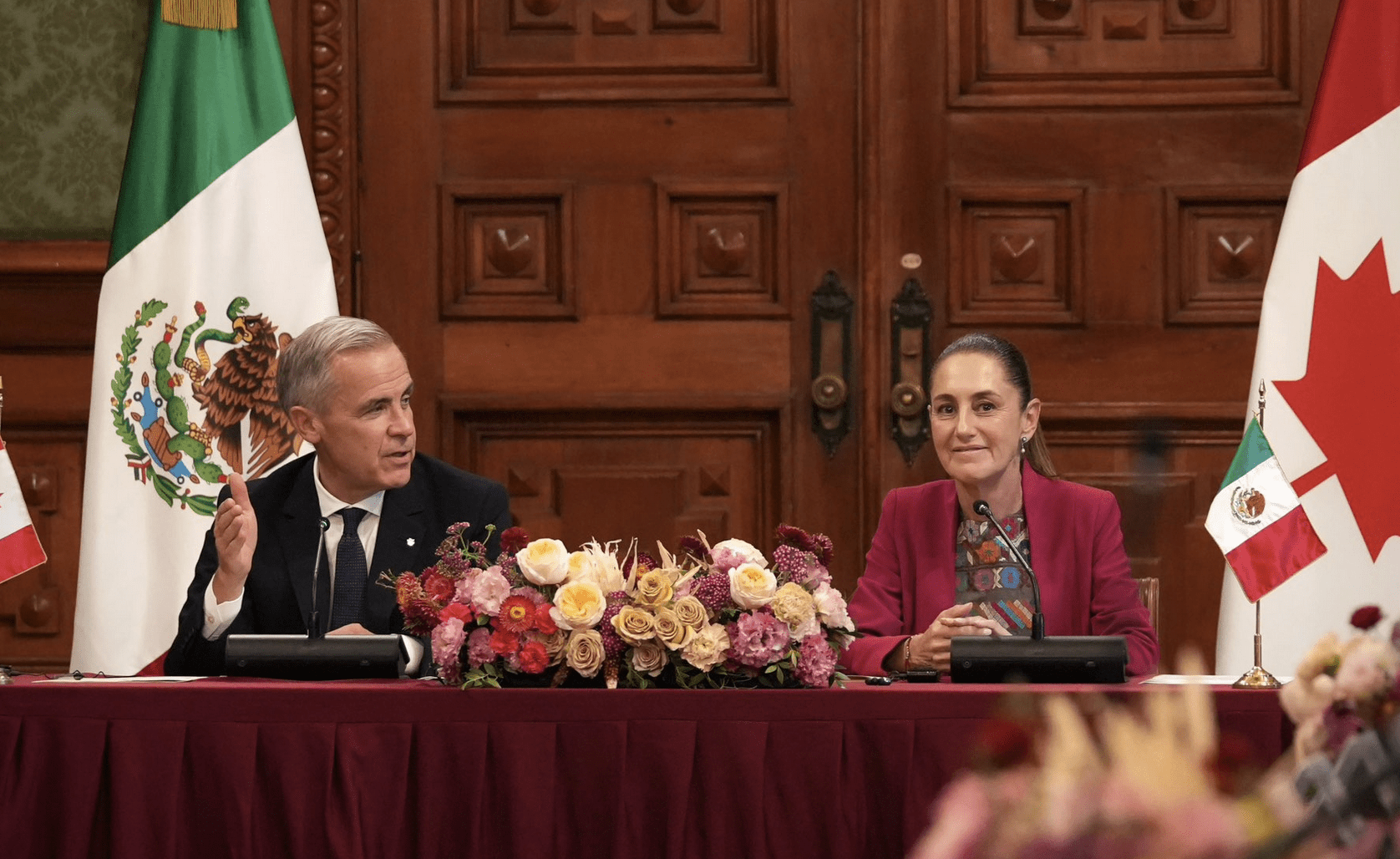 Prime Minister Mark Carney and President Claudia Sheinbaum in Mexico City, Sept. 18, 2025/Claudia Sheinbaum X
By Carlo Dade
September 22, 2025
Sometimes, what is most interesting in a conversation is what is not said. In the case of the Canada-Mexico summit, that would be any mention of China.
This is peculiar, given how central the “China issue” has become in both countries’ dealings with the United States—and, increasingly, with each other, on matters such as autos and trade.
As an aside, it is also ironic because the term used to describe the new Canada-Mexico relationship — a Comprehensive Strategic Partnership — is a concept mainly associated with China. Seven of the CSPs in the Americas are bilateral partnership agreements with China. Canada has a recent CSP with Korea and has now added this one with Mexico.
But in many ways, this classification for the hierarchy of biltateral relationships makes a useful framework for thinking about the announcement of the new partnership. A CSP elevates the Canada-Mexico relationship along a trajectory from friendship to partnership to strategic partnership to comprehensive strategic partnership. If Canada ever announces an “all-weather strategic cooperative partnership,” we’ll know that the naming convention has gone beyond mere coincidence.
In this framework, a CSP is not just a new label but a recognition of a mature relationship. It moves Canada and Mexico beyond the traditional narrow, transactional framing of free trade agreements or narrowly focused, unconnected single-sector and thematic deals. Each word—partnership, strategic, comprehensive—adds weight. Together, they signal ambition.
However, expressing ambition and achieving it are two distinct tasks, and one does not automatically lead to the other. A casual review of Canada’s history in achieving this sort of ambition and the country’s “Casper the Friendly Ghost” reputation of making large announcements only to vanish a few years later when domestic political preferences change does not inspire confidence.
Except potentially in the case of Mexico, where a deeper-than-casual reading of the history of the relationship offers a basis for hope. Looking at the difference between Canada’s two CSPs makes this point.
Colin Robertson interviews Carlo Dade and Graeme Clark, Sept 22, 2026/CGAI
Two CSPs, Two Very Different Foundations
Canada’s first CSP, with South Korea, signed just over two years ago, rests on a carefully negotiated five-pillar framework. On paper, it is detailed and ambitious. In practice, it has struggled to gain traction. Connections between Canada and Korea certainly exist, but they are narrow, shallow, and under-resourced. The CSP has the feel of an aspiration without momentum—an ambition in search of a movement.
By contrast, the Canada-Mexico CSP builds on an infrastructure that already exists and has been running for decades. The Canada-Mexico Partnership (CMP) has convened annual working groups for more than twenty years, drawing in not only government officials but also business associations, educators, scientists, civil society leaders, and cultural organizations. These networks are long-standing, practiced, resilient, and broad. The Mexico-Canada CSP has been a movement in search of ambition to lead it. That ambition may have arrived with political attention.
The attention, of course, will not last indefinitely. The next question for the relationship is how quickly and how much can be done in the window of opportunity that now exists. At a minimum, one would hope for higher-level participation at the next annual CMP meeting.
Taking advantage of this moment will require building on the current momentum. To do this, truly new ideas need to be put on the table at venues like the CMP to reinvigorate discussions and move the conversation beyond that discussion on specific sectoral or technical issues, like cooperation on infrastructure, to confront the larger challenges facing both countries.
What’s Missing: The China Question
One way to build longer-term relevance and attract attention and support is to add the most critical element of the relationship outside of dealing with the U.S., which was not featured in the announcements and press conference – China. The lack of the simplest or blandest statements about recognizing the importance of shared challenges with China was telling.
That absence cannot last. The role of China in North America looms too large to be ignored. Both Canada and Mexico face pressure from Washington on supply chains, technology, investment screening, and industrial policy—all of which tie directly back to China. Both also face hard choices about balancing economic opportunity with strategic risk.
Yet China is too sensitive a subject to be led directly by governments. Neither Ottawa nor Mexico City can afford to frame the bilateral relationship around it, for fear of provoking Washington or Beijing—or of complicating their own domestic debates.
This leaves a gap. And it is here that the Canada-Mexico relationship could evolve in an unexpected but important direction.
A Role for Track Two
The gap can be filled through Track Two diplomacy—the realm of think tanks, universities, business councils, and policy networks that convene discussions governments cannot or will not lead. Canada and Mexico already have experts who work together on North American questions. Yet, this is invariably done with the Americans at the table and more often than not, at tables that Americans convene.
That trilateral conversation is essential, but in and of itself, it is not enough to advance Canadian and Mexican interests unless those interests are purely defined as subordinate to U.S. interests. This is clearly not the case, as Canada and Mexico have both chosen to continue to pursue the path of win-win, rules-based multilateral trade across the Pacific by not following the U.S. in its abandonment of the Comprehensive and Progressive Agreement for Trans-Pacific Partnership, or CPTPP.
The Canada-Mexico Partnership meetings provide a framework for how a track two or track two point five, meaning less government participation, could function. Including discussions on China or expanding CPTPP cooperation in the current CMP meetings, or building a different mechanism, are not radical new ideas. Just as the announcements at the leaders’ summit were not truly new, but were built on the pre-existing work of the CMP, the same reasoning should apply to building on past cooperation and collaboration around shared interests to think about engagement in China and Asia.
After all, that is what Comprehensive Strategic Partnerships are supposed to do.
Carlo Dade is the Director of International Policy at the University of Calgary’s School of Public Policy and a member of the Mexican Council of Foreign Relations (COMEXI).