
Zohran Mamdani is Bigger than New York: Let’s Call it the ‘Bodega Movement’
By Anil Wasif
July 13, 2025
A primary-day photograph of Zohran Mamdani taken at bodega El Kiosko captures the essence of Mamdani’s political currency. Looking at ease, the 33-year-old Democratic candidate who, hours later, was elected the party’s nominee for mayor of New York City, holds an iced coffee and a sandwich — not policy papers, nor even a baby. The primary verdict was record-breaking.
Mamdani won the June 24th primary against Andrew Cuomo by a whopping 12 points, and will face Mayor Eric Adams, a Democrat now running as an independent, in November, along with Guardian Angels founder Curtis Sliwa running on the Republican side, and Jim Walden, a lawyer running as an independent.
The El Kiosko moment resonates because it captures the essence of the city’s famously warring economies — a story I witness during regular visits to New York for my non-profit work.
The weekdays are a blur of knocking on the doors of foundations, a circuit of meetings that takes me through the quiet, climate-controlled offices of Midtown and the mirrored towers of FiDi.
It is a world that is, in many ways, deliberately insulated from the ground-level economies it seeks to help. This is the command centre for “globalization from above”— a world of placeless policy, abstract assets, and frictionless capital.
The scene can sometimes border on caricature: my partners and I at The Campbell — the restored Jazz Age office of a tycoon, now a bar tucked into Grand Central — sketching new ideas on cocktail napkins. We are at the heart of a well-meaning technocracy, a world of macroeconomic theory and market chatter that feels a universe away from the scurry and sweat of the subway below.
My weeknights often end in economic defiance: at a bodega on East 92nd Street. It’s a cultural and commercial anomaly, a vibrant pocket of working-class life thriving like a wildflower in the manicured garden of the Upper East Side, where retail rents can exceed two hundred dollars per square foot.
Here, my go-to is a chopped cheese sandwich with gyro sauce. Holding it, I realize it’s a perfect artifact of “globalization from below.” An American sandwich born of Black and Latino ingenuity, with a sauce that tells a Greek-and-increasingly-Middle Eastern immigrant story. It’s the globe on a hero roll — what the shopkeeper, Hasan, now lets me call “a cc on a roll with the g sauce.”
New York City bodegas are not like Montreal dépanneurs or Mississauga 7-11s. In recent decades, they’ve grown from convenience stores supplying cat food and milk to frazzled office workers rushing home and rolling papers to partygoers at 3 a.m. to now include hot and cold buffets, fresh flower stands and never-stale coffee in iconic, blue-and-white Anthora Greek paper cups.
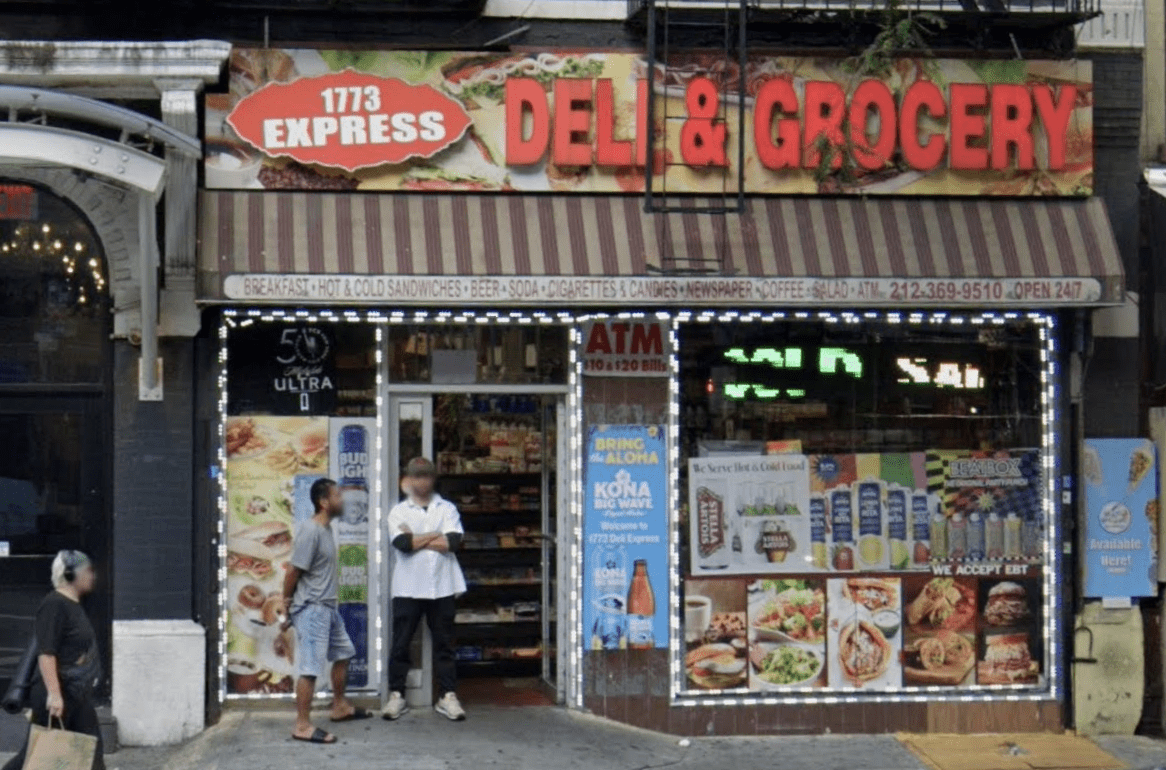
My favourite bodega at East 92nd and 1st (above) exists less for the residents of the multimillion-dollar co-ops and more as the essential support system for the neighborhood’s inconspicuous workforce — a coalition of doormen, nannies, construction crews, and retail staff.
And now, it also serves a newer demographic: the young professionals, the planners, the doctors, developers and PR strategists who, according to Bureau of Labor Statistics data, earn anywhere between $80,000 and $180,000 a year. They are the people inhabiting the leafy mid-rises, economically and physically caught in the shadow of the super-tall condos sprouting up across Manhattan. For both the doorman and the planner, this bodega is a vital economic and social satellite hiding in plain sight.
On weekends, I take the Q train south to soak in the city. With no laptop in hand, the ride becomes a pilgrimage for context. The common trip is to the cultural heartland of Brooklyn, near Hoyt Avenue, to understand the world that created the sandwich I ate this morning. The Q train doors hiss shut at Canal Street, and the car plunges into the darkness beneath the East River.
As we emerge onto the elevated tracks in Brooklyn, the city’s glittering panorama unfolds—the Freedom Tower to the right, a monument to global finance, and the skeletal remains of the Williamsburg Domino Sugar refinery to the left, a ruin of industrial labor being reborn as luxury condos. Here, the vibrant, multicultural working class are not pilot fish to a larger beast, but the main event.
This is where Mamdani’s political talent becomes clear. He understands that my bodega is the New York embassy of a global working class. His genius is in building a political language that unites the person who owns this shop with the doorman at the co-op next door, with the young professionals who live in the mid-rises, recognizing that they are all, in different ways, fighting the same battle against the economic forces of Midtown. He is the leader of the New York chapter of what might be called the Bodega Movement.
The anatomy of Mamdani’s victory reveals its unique composition. It is not a simple story of the poor versus the rich.
This triangulation — from the bodega on 92nd Street, to the command centers of Midtown, to the cultural core of Brooklyn — reveals a city in profound conflict. The Bodega Movement is the political answer to this conflict, defined not by abstract ideology but by concrete demands for non-market solutions to the city’s affordability crisis. Animated by signature policies like a city-wide rent freeze and fare-free buses — dismissed by the fiscal establishment as pie-in-the-sky pandering — its power comes from a new and unusual coalition.
The anatomy of Mamdani’s victory reveals its unique composition. It is not a simple story of the poor versus the rich. Rather, it is a coalition forged in the crucible of a housing crisis that has seen the city’s rental vacancy rate fall to a historic 50-year low of 1.4%.
The data shows this movement unites the city’s vast class of renters—who gave Mamdani 47% of their vote—with key immigrant communities, winning 52% in majority-Asian precincts and 48% in majority-Hispanic ones. Crucially, it also includes the city’s squeezed professional class, as Mamdani performed strongest in neighborhoods with more college graduates.
The hyper-financialization of housing has become the accelerant, uniting these disparate groups—the doorman, the planner, the South Asian family in Queens—in a shared state of precarity in a time of larger political chaos and existential economic uncertainty amid technological change too fast for most people to grasp.
The Bodega Movement could be described as a rights movement born of unaffordability, demanding that the city’s economy serve its residents, not just the abstract flow of international capital.
Mamdani, 33, was born in Kampala to the acclaimed filmmaker Mira Nair (Mississippi Masala, Queen of Katwe) and academic Mahmood Mamdani. He spent part of his childhood in South Africa while his father taught African studies at the University of Cape Town.
When he was seven, the family moved to New York, where his father took a post as director of the Institute of African Studies at Columbia. He grew up in Morningside Heights, attended Bronx Science and Bowdoin College, and became active early in New York municipal politics as a volunteer, aide and organizer for Democratic candidates. He self-identifies as a socialist, and has been a state assemblyman since 2021.
Zohran Mamdani X
But to see Mamdani as just a New Yorker is to miss the global significance of his economic worldview. While his promises of free buses and free childcare have drawn scorn from The New York Times and alarm from economists, the fight symbolized by the bodega on 92nd Street is the New York chapter of a much larger narrative.
It is the same battle being fought in the supermercats of Barcelona, where housing-activist-turned Mayor Ada Colau’s movement rose to power by defending tenants against private equity giants like Blackstone and pioneering a rule that requires 30% of new developments be set aside for public housing.
It is the same impulse that drove Berliners to pass a 2021 referendum demanding the expropriation of large corporate landlords, a direct challenge to what scholars in journals like Housing, Theory and Society call the financialization of housing. It is a modern struggle that stands in stark contrast to the century-old model of Vienna, whose success in maintaining affordability through a vast stock of city-owned social housing is a frequent subject of study in urban planning.
It is a global municipalist movement, where city-level leaders are using the tools of local government to defend their communities against the predatory effects of borderless global capital, creating policies—commercial rent control, tenant opportunity-to-purchase acts, community land trusts — that serve as a firewall, protecting the “globalization from below” that gives their cities life from the “globalization from above” that extracts its value.
For policymakers, this is the crucial lens for understanding the housing crisis and its role in propelling Zohran Mamdani’s campaign. For decades, the dominant model has assumed that what’s good for the Midtown economy is good for New York City. This social miscalculation has led to the residents themselves being removed from the developer’s value proposition. While Mamdani would face an uphill battle in City Hall to implement such an ambitious plan, the undeniable political reality of a housing crisis that disproportionately affects the working-majority drove his platform, like Ada’s in Barcelona.
The key statistic for the Mamdani campaign was New York’s income inequality indicator, or Gini coefficient, which is at par with Dhaka’s. The New Yorkers who backed Mamdani have agreed that true economic health is not measured by the asset value of a 57th Street skyscraper, but by the price and quality of their chopped cheese on East 92nd Street. They agreed that the first is a marker of speculative wealth; the second is an indicator of the stability and purchasing power of the hundreds of thousands of people who actually make the city run. This was Mamdani’s gamble. A bet that a city’s future depends on the well-being of its people, not access to capital.
For those of us watching from Canada, the question is not whether this tension dynamic will play out here, but whether we will have the political vision to manage it when it does.
Policy Columnist Anil Wasif is a senior civil servant in the Ontario government. He serves on the University of Toronto’s Governing Council and the advisory board of McGill’s Max Bell School. Internationally, he serves on the OECD’s Infrastructure Delivery Committee and the World Bank Economic Development Institute’s Community of Practice. He co-owns and manages the Canada-born global non-profit BacharLorai. The views expressed are his own.