
Letter from Belfast: Ireland’s New President and the Hope for Unity
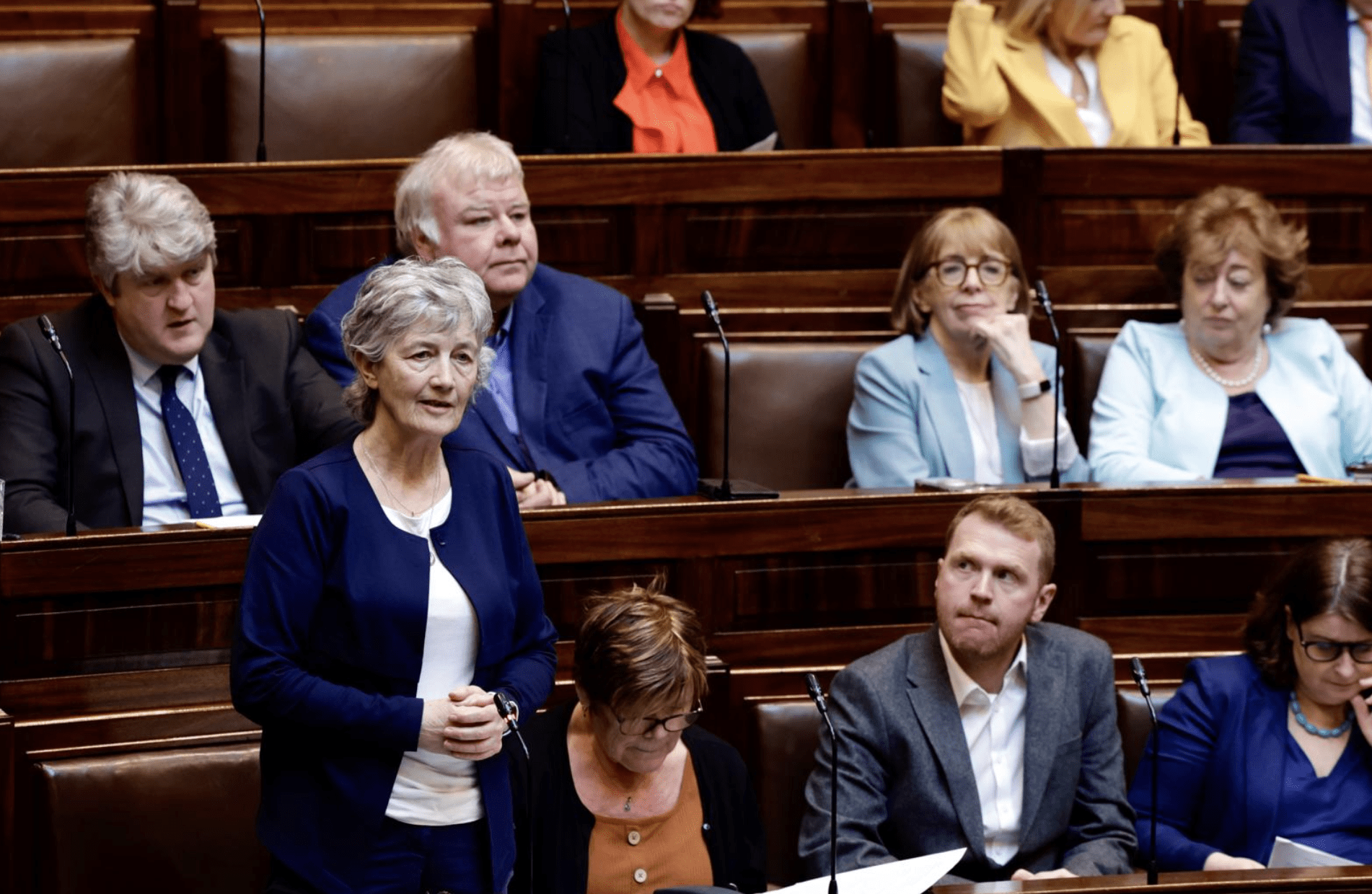 Irish President-elect Catherine Connolly, speaking in the Dáil in 2024/Houses of the Oireachtas
By Ben Collins
November 2, 2025
The recent election of Catherine Connolly as the next president of Ireland is significant in many ways. Among them is that the promise of Irish Unity seems suddenly that much closer.
(As the author of the recently released The Irish Unity Dividend, I fully disclose my interest in this question right off the top).
Connolly, 68, a former barrister and clinical psychologist, has been an independent Teachta Dála (TD) member of Dáil Éireann, the lower house of the Oireachtas (Irish parliament) since 2016. Her support for Irish unity is just one issue on which she is expected to maintain if not amplify outgoing President Michael Higgins’ political outspokenness in what was long a largely ceremonial role. Her criticism of certain European Union policies, including the bloc’s recent move to significantly increase defence spending, is another.
Connolly speaks Irish fluently, and will be Ireland’s third female president, following Mary Robinson and Mary McAleese (who graciously wrote the foreword to The Irish Unity Dividend). The president of Ireland is head of state, but the Taoiseach (PM) is the head of government.
Connolly’s margin of victory in securing 63% of the vote was the largest in the 87-year history of the role, and she will be inaugurated as Uachtarán na hÉireann, the 10th president of Ireland, on November 11th. There have been other left-wing presidents, including the outgoing Higgins. However, this is the first time that so many parties of the left have come together to jointly nominate and campaign for a single candidate.
Momentum for constitutional change is not restricted to the island of Ireland. We are seeing surging membership growth and opinion poll ratings for the Green Party of England and Wales (GPEW), which supports both Scottish and Welsh independence. In Scotland, the Scottish National Party is currently on course to win the Scottish Parliament elections next May, possibly with an overall majority. This is in a system which was designed to ensure no single party could win. Plaid Cymru, who support Welsh independence, are on course to win the Senedd elections in Wales next year.
Meanwhile, the Irish Government has not begun to prepare for the possible reunification of Ireland, which is noteworthy given that the lack of preparation before the EU referendum vote led to the chaos of Brexit. The Good Friday Agreement, which secured peace across Ireland, came into existence nearly 30 years ago and held out the prospect for constitutional change with the inclusion of a provision for a border poll to reunite Ireland by democratic means.
The far-right groups in both parts of Ireland tend to be overwhelmingly in favour of the continued partition of the island, as well as being anti-immigrant.
Connolly will have the opportunity to use her office of president to start the planning process and engage with wider society across all parts of Ireland on how a United Ireland should be structured and provide an inclusive space for all.
More specifically, the new president can move a United Ireland closer by doing three things:
First, she can fully engage with Northern Ireland throughout her term of office. This has already started, when she visited Oireachtas na Samhna, an Irish language festival in Belfast, even before her inauguration.
Second, she can establish a presidential forum to bring together political parties and civil society from across all parts of Ireland to plan and prepare for reunification.
Third, each president can appoint up to seven people to their Council of State, which acts an advisory body on “all matters on which the president may consult them”. President Connolly could appoint one or more people from Northern Ireland to this Council, including someone from a unionist and pro-British background.
One of the key roles of president of Ireland is to act as an ambassador for the country around the world. Connolly has quite rightly said that she would not refuse to meet Donald Trump if he visits Ireland, despite her previously expressing her opposition to him. She has also emphasised her support for Ireland’s neutrality. This is an issue that engenders great passion, including around the proposed amendment of Ireland’s ‘Triple Lock’ mechanism, which specifies how its Defence Forces can be deployed overseas.
Ireland has a proud history of undertaking United Nations peacekeeping missions around the world. The war in Ukraine has brought an aggressive Russia to the doorstep of the European Union and Ireland, like other European countries, has to decide how to respond to this. Non-lethal aid has been provided to Ukraine by Ireland, but closer to home, the country needs to consider how best to protect its own assets.
Ireland may be situated on the western periphery of the European continent but cyberwarfare and the attempts of the far-right from the USA and Britain to sow dissent across the island are already happening. The far-right groups in both parts of Ireland tend to be overwhelmingly in favour of the continued partition of the island, as well as being anti-immigrant.
The next Dáil elections may not take place until 2029 but we will have at least one change of leadership before then, due to the rotating Taoiseach agreement between the Fianna Fáil and Fine Gael parties of government. Only time will tell if a more fundamental shift in the Irish political landscape is also taking place.
Ben Collins is a Belfast-based communications consultant and author of Irish Unity: Time to Prepare, and The Irish Unity Dividend.