
Mark Carney’s Year Two: Results as a National Imperative
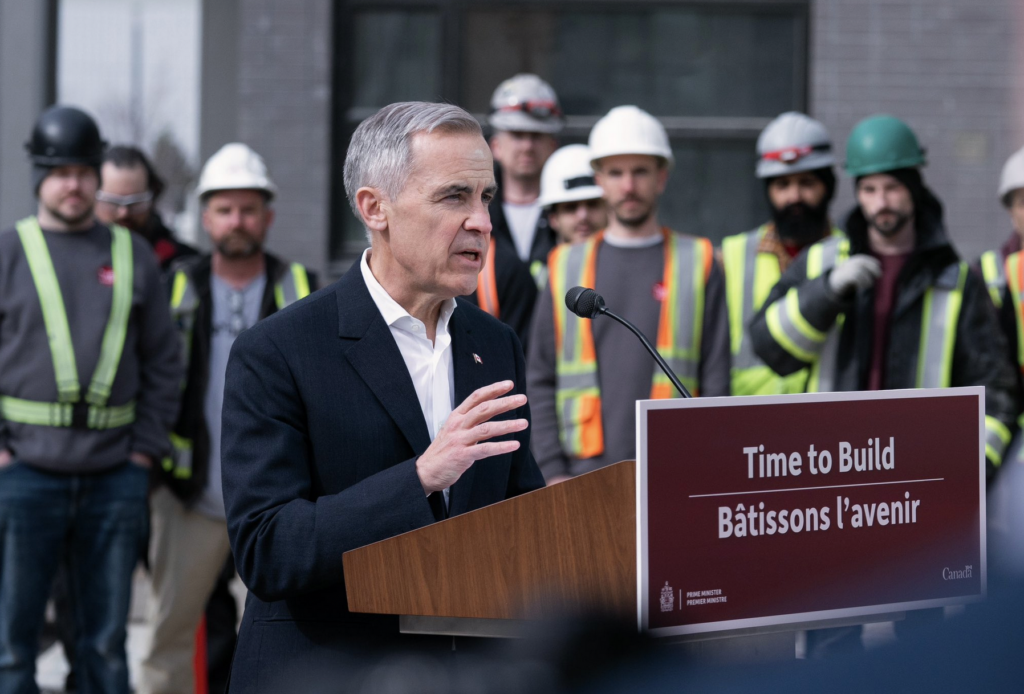 Mark Carney’s ideas must now be backed by action, writes Colin Robertson/PMO
This piece is part of our Policy Series: Carney’s Canada One Year Later.
April 19, 2026
As Mark Carney enters his second year as prime minister, he confronts the oldest problem in governing: the gap between ambition and implementation.
Carney’s “Canada Strong” is one of the most expansive agendas of any recent Canadian prime minister: economic transformation, trade diversification, defence renewal and institutional reform.
In short, a bold project of national purpose.
But can it be delivered in a volatile world? Policy is never made in a vacuum. It is constrained by resources, federalism and events.
The agenda is ambitious, technocratic and long-term. It demands public support for defence spending. That means explaining and connecting defence to prosperity, trade to security, infrastructure to unity.
Without a well-communicated narrative, even good policy fails. On that front, his Forward Guidance reports, launched today, are a smart initiative; reminiscent of Roosevelt’s ‘fireside chats’ and their modern-day equivalent, the President’s Saturday Weekly Address.
From the throne speech delivered by King Charles III to his mandate letter to Cabinet and speeches in Davos and Quebec City, Carney has been consistent. His government is organized around seven priorities: Canada-U.S. relations, trade diversification, affordability, housing, defence, immigration, and federal spending.
The narrative is clear: Canada must adapt to a fractured global order by strengthening its economic base, diversifying its trade and investing in resilience.
At home, that means infrastructure, housing and productivity. The Major Projects Office is designed to speed approvals and mobilize capital, echoing earlier nation-building eras when railways and pipelines defined sovereignty. New institutions such as Build Canada Homes aim to do the same for today’s economy.
Carney can credibly argue that overcoming the classic ‘curse of implementation’ has become existential, and therefore a national imperative.
Carney frames this policy surge in economic terms. At Davos, he argued that “resilience is the new efficiency.” Supply chains, energy systems and housing markets must be built not just for cost, but for durability.
The risk is familiar. Governments believe — almost religiously — in planning, only to find execution lagging aspiration.
In today’s context of economic threats originating from a newly belligerent neighbour, Carney can credibly argue that overcoming the classic “curse of implementation” has become existential, and therefore a national imperative.
The question is whether our public service, risk-adverse and demoralized, has the capability to deliver.
The real test is turning announcements into results in a federation where provinces hold key levers and often pull in different directions. Pipelines and internal trade barriers are obvious examples.
So is immigration, including the recognition of credentials to take full advantage of incoming talent and agreeing on reasonable levels for students, temporary workers, and refugees.
Public confidence in the integrity of the program, including enforcement of our rules, must be restored, or it will become not just divisive internally but a border-friction point with the US.
The renegotiation of CUSMA will be the overriding priority on the bilateral front. Dealing with Donald Trump means volatility by design. Preparation matters, but outcomes hinge on forces beyond Carney’s control.
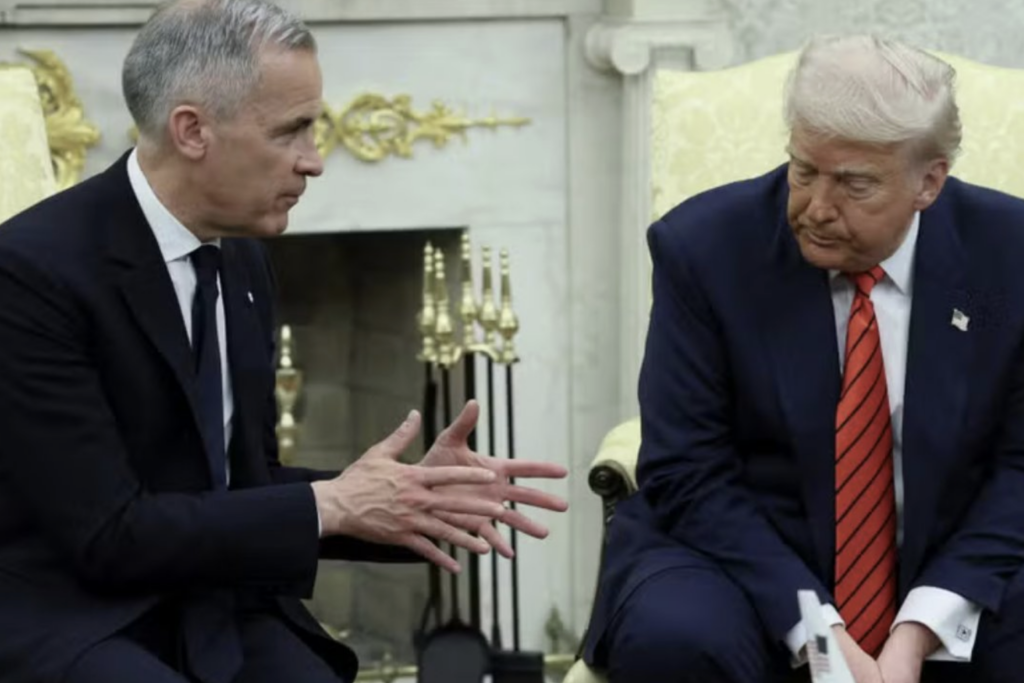 Mark Carney and Donald Trump in the Oval Office, May 6, 2025/PMO
In Trumpian terms, Canada has cards: critical minerals, energy, fertilizer; investment supporting American jobs; integrated supply chains, tourism and strategic partnership in continental defence. Carney needs to convert these assets into leverage — combining economic logic with political persuasion.
Carney’s first year has shown he is an effective salesman for Canada. His strategy is to reduce dependence on the United States by deepening ties with Europe, the Indo-Pacific and emerging markets — from India and Japan to ASEAN and the Gulf.
The risks are real. As Carney puts it, we now live in a world of predatory hegemons that requires middle powers to adopt a more nimble approach of “variable geometry” whereby alliances can form and evolve in response to unpredictable and arbitrary conditions.
But geography is stubborn. The United States will remain Canada’s dominant market. The goal is not replacement, but balance.
The coming year will also reveal whether Carney’s broader doctrine of “values-based realism” has application beyond a single, splendid speech.
His vision places him in the tradition of Lester B. Pearson: pragmatic, multilateral, but clear-eyed about power. His emphasis on coalitions of like-minded states reflects a world where middle powers must work together to resist coercion.
It is sound in theory. But ideas matter only if backed by action.
Influence requires investment: not just in defence but in diplomacy and in a new approach to development assistance that serves Canadians.
Colin Robertson in conversation with former Quebec Premier Jean Charest, former Manitoba Premier Gary Doer, and former Defence Minister Peter MacKay.
Carney can’t do it all himself. It is why he’s been building coalitions of the willing in foreign capitals and multilateral institutions.
He needs his foreign and trade commissioner service in the field pitching as well as feeding back what they hear. In Pearson’s day, it was almost three Canadian diplomats abroad to one at home; today it is three at home to one abroad. To paraphrase a former trade minister, you don’t do business sitting on your arse in Ottawa.
Defence is where the politics become difficult. Meeting NATO’s 2% target recently and 5% by 2035 is a generational shift. New institutions, including a Defence Investment Agency and a Defence, Security and Resilience Bank slated for Montreal, aim to link security with industrial policy.
But Carney must convince Canadians that spending on ships, submarines, jet fighters and Northern development is a precondition not just for sovereignty, but for prosperity.
His argument requires persuasion beyond boardrooms and editorial boards. Carney needs to convince the people standing in line at Tim Hortons.
Having secured a majority in the House of Commons should make it easier to pass legislation but it will require care and discipline. His caucus still leans progressive, with priorities rooted in social justice and climate. Managing an independent Senate, premiers and First Nations adds further complexity.
Then there are events. U.S. tariffs threaten exports. Middle East conflict risks energy shocks, inflation and recession. Populism is destabilizing allies in Europe. At home secessionists threaten in Quebec and in Alberta, where Trump proxies are putting their thumb on the scale. It’s foreign interference and must be called out.
The best leaders combine ambition with humility, recognizing limits, adapting to events and prioritizing ruthlessly. Not everything can be done at once.
Mark Carney possesses significant strengths: a clear strategic purpose, a strong economic foundation, and a window in which to reshape Canada’s role in the world.
His second year will test how he delivers on this ambitious vision for Canada.
Policy Contributing Writer Colin Robertson, a former career diplomat, is a fellow and host of the Global Exchange podcast with the Canadian Global Affairs Institute in Ottawa.