
Our Policy Series: Carney’s Canada One Year Later
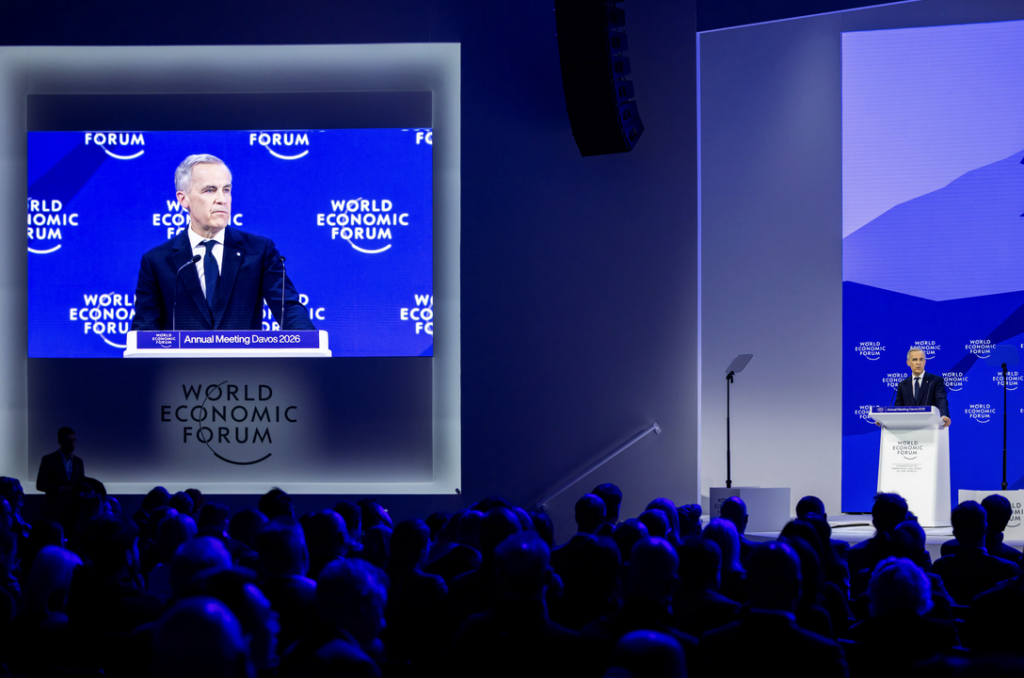 Mark Carney delivering the ‘Davos speech’ that marked the defining moment of his first year in office/WEF
On April 28th, 2025, Mark Carney was elected prime minister of Canada. A former governor of both the Bank of Canada and the Bank of England, at any previous moment in the country’s history, Carney might have been deemed overqualified for the job. Amid a trade war waged by Donald Trump’s newly belligerent United States, Carney’s credentials and a surprising affinity for retail politics produced the most stunning political reversal of any campaign in generations. With many thanks to all our contributors, welcome to our Policy package marking the first anniversary of that outcome.
We open with former clerk of the Privy Council and BMO Vice Chair Kevin Lynch and former White House economic aide Paul Deegan’s report card on year one. “With his tariff attacks and assaults on global institutions, NATO, international trade rules, and Canadian sovereignty — not to mention democracy, dignity and decency — Trump made himself, and who was best qualified to deal with him, the ballot question in the election,” the authors write. “Canadians’ answer was Mark Carney.” Here are Kevin Lynch and Paul Deegan with Mark Carney’s First Year: A Report Card on Five Fronts.
While the Carney government enters its second year with the newly achieved advantage of a parliamentary majority, the prime minister’s “Build Canada Strong” agenda will take more than legislation alone to execute. “Carney can credibly argue that overcoming the classic ‘curse of implementation’ has become existential, and therefore a national imperative,” writes Policy Contributing Writer Colin Robertson. “The question is whether our public service, risk-adverse and demoralized, has the capability to deliver.” Here’s Colin Robertson with Mark Carney’s Year Two: Results as a National Imperative.
From the Davos speech to the ‘variable geometry’ of middle-power alliances that have accompanied it as Canada’s response to a rapidly evolving geopolitical status quo, Mark Carney has already transformed Canada’s relationships and role in the world. “But the crucial story-making cachet appealing to Trump-shaken Canadian partners,” writes former ambassador and Policy Columnist Jeremy Kinsman, “was that of a respected democracy’s front-line resistance to bullying and threats from the rampaging U.S. president. ‘We are all Canadians now,’ wrote Bill Emmott, former editor of The Economist, in his old magazine.” Here’s Jeremy Kinsman with Carney’s Diplomacy for a Changing World: ‘Cometh the Hour, Cometh the Man’.
From our Policy novelist-in-virtual-residence, John Delacourt, who also serves as senior VP at Counsel Public Affairs, we have a typically literary piece exploring Mark Carney’s status as a “black swan”, per Nassim Nicholas Taleb’s 2007 bestseller, The Black Swan: The Impact of the Highly Improbable. Delacourt argues that the real black swan in our current geopolitical dynamic is not the disruptive and volatile Donald Trump. “No, the real black swan, the great deviation,” he writes, “is the remarkable political nous of a first-time politician, a globalist technocrat and finance bro, who’d never be able to connect with ‘regular Canadians’. This superficial take on Carney was never really true.” Here’s John Delacourt with Mark Carney, Black Swan Prime Minister.
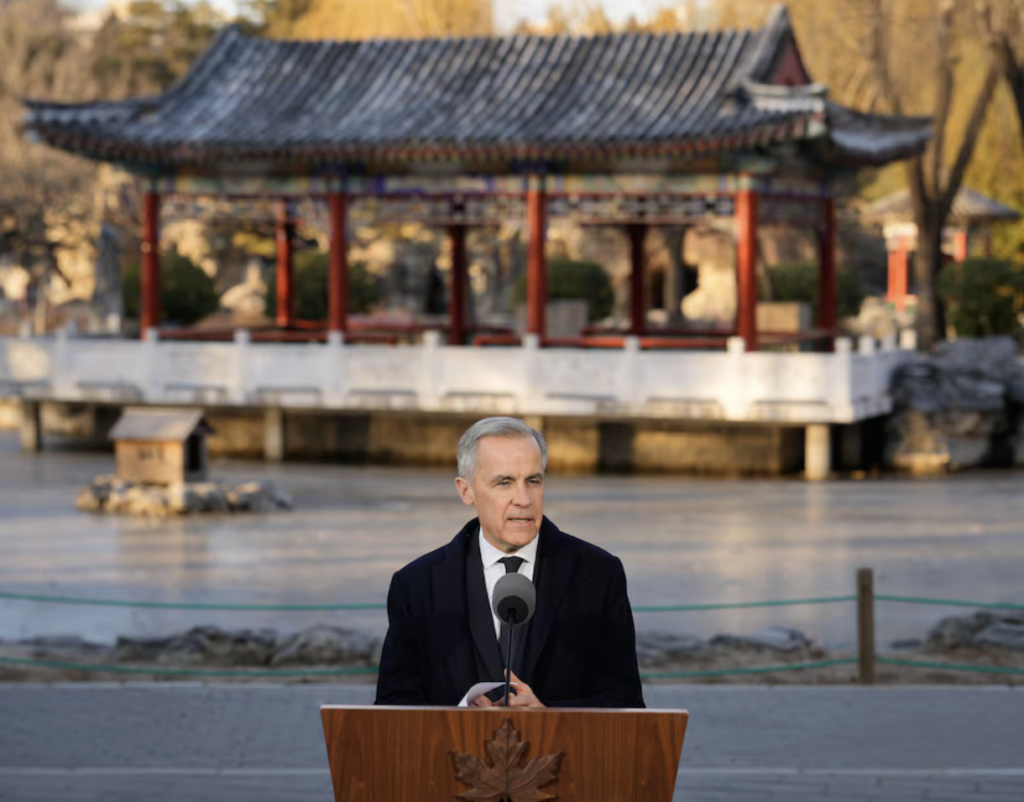 Prime Minister Mark Carney in Beijing, January 16, 2026/PMO
Among Carney’s efforts at diversifying Canada’s trade and strategic partnerships has been a marked Indo-Pacific focus, including a recalibration with China and a reset with India. “Carney’s approach is not values-free, but it is unmistakably interest-led. It is also ambitious,” writes Asia-Pacific Foundation of Canada VP Research and Policy Contributing Writer Vina Nadjibulla. “Canada is now more visible, more plugged into regional networks, and more active across the Indo-Pacific than it has ever been.” Here’s Vina Nadjibulla with Canada’s Indo-Pacific Strategy is Now More Robust than Ever. But Will Carney Deliver?
When Conservative Leader Pierre Poilievre accused Mark Carney of being “badly educated in economics”, it prompted widespread bafflement, including from Carney. “What was not supposed to happen was that, one year into this enterprise, Carney’s political skills would prove so impervious that Poilievre would be slamming him as an economist,” writes McGill Institute for the Study of Canada Director and Policy Columnist Daniel Béland. “The political education of Mark Carney — after a first year not without its gaffes but which is ending on the high of a belatedly secured majority — has been notable for its alacrity.” here’s Daniel Béland with The Political Education of Mark Carney.
Amid a radically altered security and geopolitical environment, Mark Carney’s first year has included a telescoped transformation in Canada’s defence posture, from increased NATO spending commitments to a new Defence Industrial Strategy. “Sustainability will be Carney’s biggest challenge in the year ahead and those that follow,” write Kevin Budning and Lilit Klein of the Conference of Defence Associations. “Will public support hold as billions in annual defence spending are committed while other Canadian priorities receive less funding?” Here are Kevin Budning and Lilit Klein with Carney’s Canada: A New Defence Posture, Yet to be Tested.
So much of the discussion around Mark Carney’s first-year trajectory is the extent to which beginners luck and the thanks of a besieged nation had to do with it. Policy Columnist and Dalhousie University management professor Lori Turnbull offers invaluable context for that debate. “History suggests that new prime ministers tend to enjoy a honeymoon phase with the public, but it almost always drops off — sometimes abruptly — not long after the first year,” writes Turnbull. “Prime Minister Carney’s political ‘rock star’ status might have longer legs.” Here’s Lori Turnbull with The 15-Month Itch: Can Carney Crack the Canadian Honeymoon Curse?
For a sense of how Carney’s first year has played in our sister capital south of the border, we turned to Kevin Nealer, Policy contributing writer and principal with The Scowcroft Group. “Carney has been criticized at home for overreach (something we Americans and our Canadian cousins have traditionally measured differently, as with miles and kilometers) and over-promising, even before he had a majority to act on his agenda,” writes Nealer. “Canadians, if you’re tired of Carney, send him down — we’ll gladly trade you Trump, the Bridal Veil Falls and a draft choice to be named later.” Here’s Kevin Nealer with Letter from Washington: An American Perspective on Carney’s First Year.
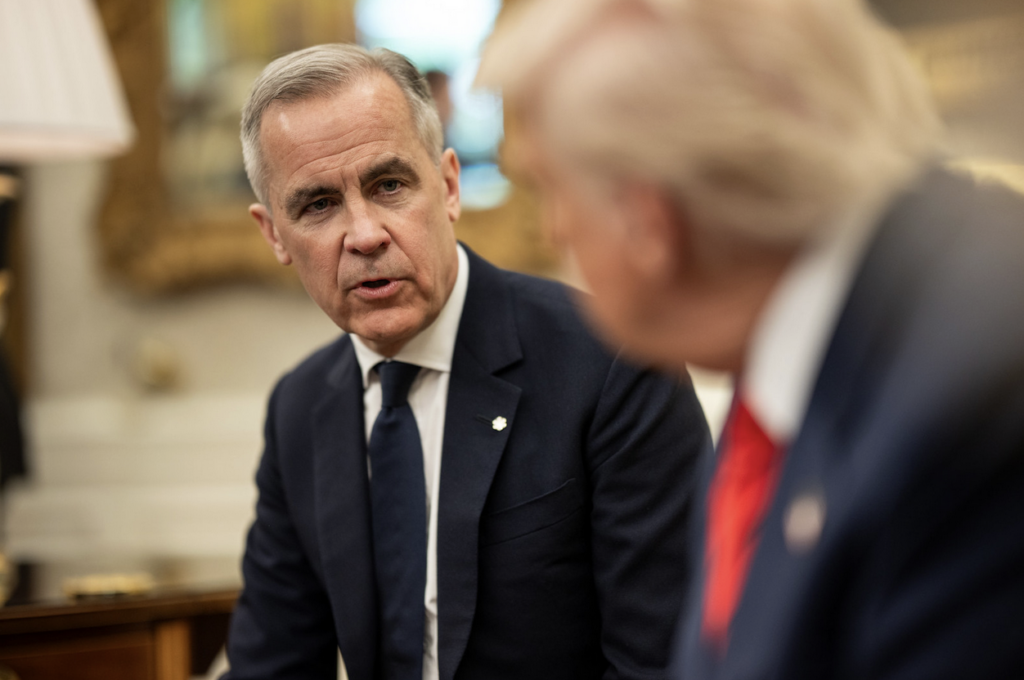 Mark Carney and Donald Trump in their first Oval Office meeting, May 6, 2025/WH
While the sound of champagne corks popping was the predominant soundtrack from Ottawa around Mark Carney’s first election anniversary, we have an indispensable reality-check piece from former Canadian Chamber of Commerce President, federal cabinet veteran, and longtime Policy Contributing Writer Hon. Perrin Beatty about the perils ahead. “Start by giving Canadians the unvarnished truth,” exhorts Beatty. “Then the truly hard work begins.” Here’s Perrin Beatty with Carney Year Two: Now the Hard Part Starts.
We’ll be adding pieces to this series into mid-May. With many thanks to our contributors, readers and sponsors.
Visit us at Policy, where you’ll find our latest Policy Specials, Columns, Dispatches, Analysis, Book Reviews and Verbatim sections, plus The Week in Policy and all our posted print issues.