
Letter from Washington: An American Perspective on Carney’s First Year
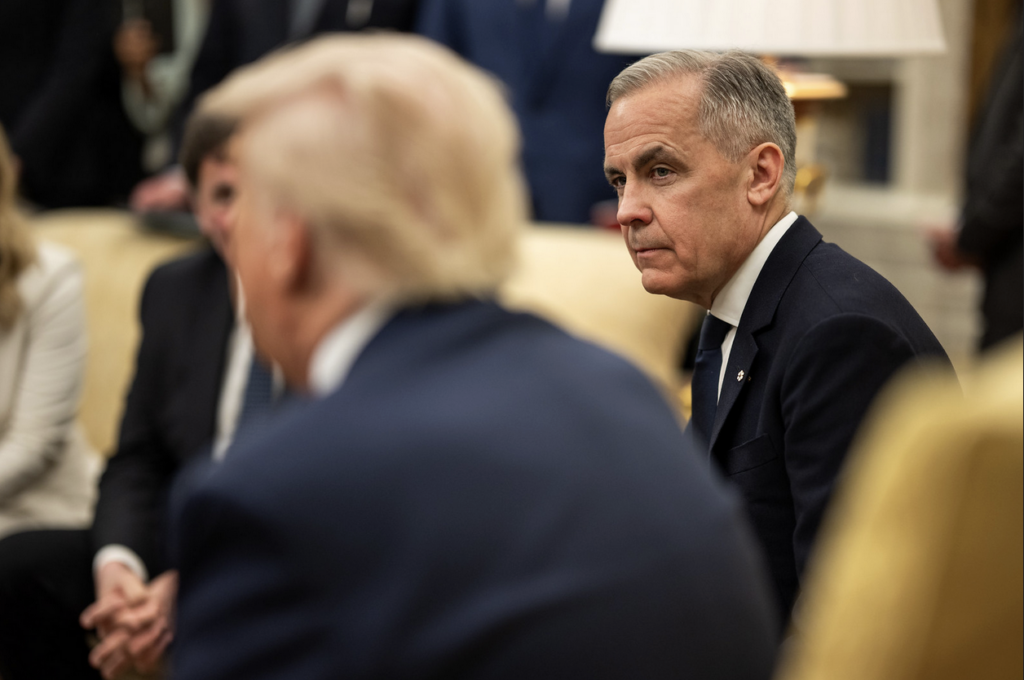 It’s all relative: An American perspective on Mark Carney is a little less nuanced/WH
This piece is part of our Policy series Carney’s Canada One Year Later.
By Kevin Nealer
May 1, 2026
Many Canadian retrospectives on Prime Minister Mark Carney’s first year are unrecognizable to those of us watching longingly from south of the border.
Carney’s resurrection of the Liberal Party, his recent securing of a parliamentary majority, and his broader narrative of moving from strength to strength seem to be met by some Canadian commentators with disbelief that any non-politician can pull off such a string of cunning stunts and execute the encore of delivering on his plans for Canadians.
Carney has been criticized at home for overreach (something we Americans and our Canadian cousins have traditionally measured differently, as with miles and kilometers) and overpromising, even before he had a majority to act on his agenda. The press speculate about how long the honeymoon can last; Canadian voters seem more focused on what he can do to improve their lives.
A little perspective may be in order. To someone writing from Washington, rest assured that any national leader who speaks clearly, acts with authenticity and decency, and has the courage to tackle problems that hold back the nation (housing, affordability, Canada’s role in the world) rather than generating new ones looks from here like a dream come true.
Canadians, if you’re tired of Carney, send him down — we’ll gladly trade you Trump, the Bridal Veil Falls and a draft choice to be named later.
Speaking with confidence and purpose about tough choices and articulating simple truths (“Nostalgia is not a strategy”) in unprecedentedly complex times, Carney has invented a Canadian realpolitik that will likely survive his tenure.
History (the non-aligned movement and G-77) teaches us that middle-power politics has very real limits. But Carney’s vision seems to recognize such constraints and — rather than offering a teleology, building systems and structures — focuses on simple coping strategies that improve Canada’s position in the global commons.
Whether with the U.S. or China, Carney has not discarded Canadian values in his foreign policy but looks for shared interest and confidence building measures that are likely to survive shifting economic and political realities.
His energetic focus on Canada’s place in the world — an element of his messaging we Americans pay attention to, especially nowadays — has not been prioritized over domestic issues but serves those issues by repositioning Canada as a source of ideas, solutions, and intellectual strength worth both the world’s attention and its investment.
That calculation has already paid off. Canada will host an international development bank (having already hosted its charter negotiations) that will fund allied defense modernization – a big idea that puts the spotlight on Canada’s own military reinvention. So too, creation of a sovereign wealth fund positions the country as a more credible actor in global markets.
The U.S. relationship remains crucial to manage. But the lesson of American politics now is that Canada cannot set the U.S. agenda and cannot be hostage to its uncertainties, including in the management of trade rules.
Central bankers are often portrayed as all-powerful policymakers when in fact they have relatively few colors on their palette. Unlike his past jobs, Carney now has the exquisite challenge of pushing deregulation, increasing infrastructure spending at a time of budget pressures, and making Canada more globally competitive.
Tax policies, federal-provincial relations, and healthcare access also demand bold solutions. Despite its deficit, Canada is growing at twice the rate of Japan or Germany, and global financial markets look for returns on a “compared to what?” basis. Carney’s investment in global positioning will help when addressing these domestic priorities.
What about relations with Canada’s largest economic partner? While Canadians are understandably seized of the significance of CUSMA renewal, Americans are distracted by war, our broken polity, and the chaotic governance style of a president obsessed with a ballroom instead of the priorities of most Americans.
For Canada, this is a propitious place from which to start any negotiation.
Because of the asymmetrical trade relationship, Canadian coverage of the agreement tends to overstate the downside risks to Canada. Start with the fact that over 80% of North American trade has been unaffected by the US tariff tantrum.
Move on to realize – as the NAFTA rebranding exercise revealed – nothing Canada does will write a clean end to Trump tariff activism. Indeed, ask Prime Minister Keir Starmer what a trade deal with Trump is worth, marked to market.
Finally, appreciate that non-renewal doesn’t end the deal — it continues for a decade unless the U.S. actually withdraws — an option that border states and large U.S. commercial interests would attack as a political failure on the part of Team Trump, which currently faces crushingly low approval heading into midterm elections in November where control of both Congressional houses hangs by a thread. No deal is not a good look for a government underwater with 70% of its public.
As Carney pivots to address the daunting challenges of getting Canada’s domestic house in order, it is a mistake to imagine the only metric for measuring his government’s success is getting something — anything — in trade talks that provide important guardrails to a critical relationship but do not of themselves determine economic fundamentals.
(Key learning from the rush to cobble together 70 faux bargains following “Liberation Day” tariffs: If you think you need a Trump trade deal in the worst way, that’s exactly what you get.)
If negotiations end with a firm “I’ll talk to you when you calm down,” Canada and Mexico can temporize while U.S. state and private-sector pressure builds down here, and as Carney’s investment in U.K./European and Asian trade options gives Canada economic space that it has undervalued in the past.
Ultimately, the Carney government will be judged by what it delivers for Canadians and how it positions Canada for a different and more diversified future. The U.S. relationship remains crucial to manage. But the lesson of American politics now is that Canada cannot set the U.S. agenda and cannot be hostage to its uncertainties, including in the management of trade rules.
Team Carney’s first year has set the table with realism, global options, and a sense of proportionality in managing the “America Problem”.
Whatever happens to CUSMA, the fact that the U.S. administration undervalues the deal and imagines a 1980s starting point equips Canada (and Mexico) to manage for the future.
Take care of Canadians, and we’ll still be here when the dust settles.
Kevin Nealer is a Principal of The Scowcroft Group, a Washington based geopolitical risk consultancy. He summers in Gananoque, Ontario.