
Canada’s Indo-Pacific Strategy is Now More Robust than Ever. But Will Carney Deliver?
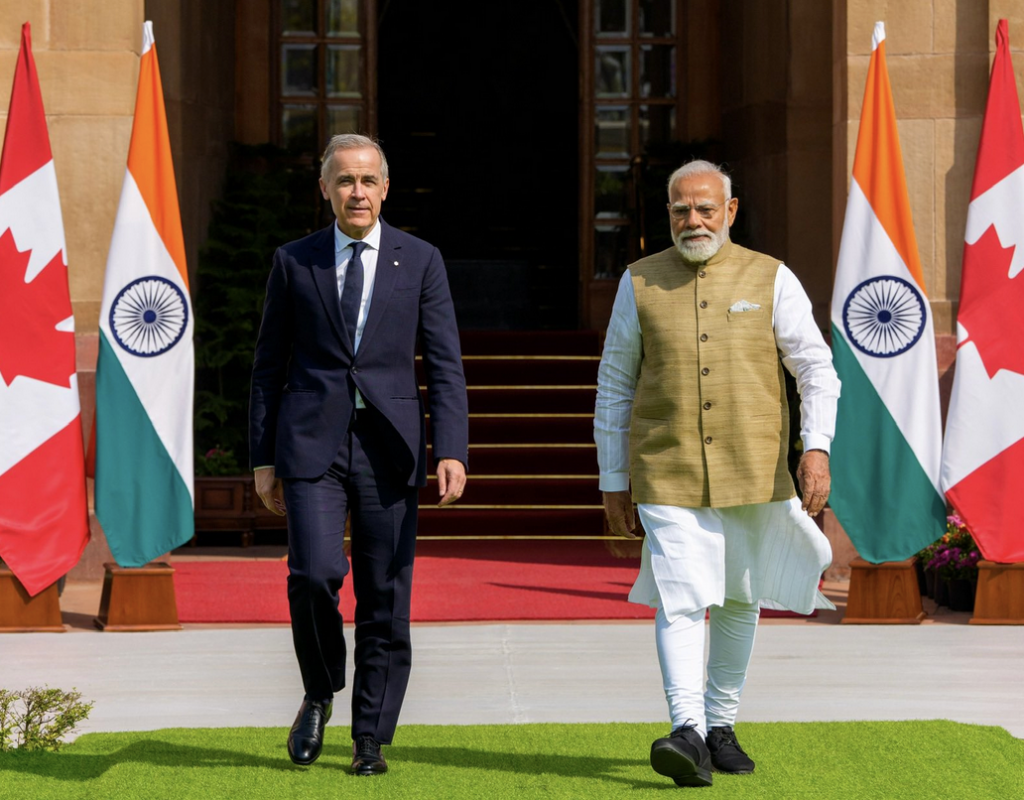 Prime Minister Mark Carney and Prime Minister Narendra Modi in Delhi on March 2, 2026/PMO
This piece is part of our Policy series Carney’s Canada One Year Later.
April 27, 2026
The first year of Prime Minister Mark Carney’s leadership has had a transformational impact on both Canada’s foreign policy and its standing in the world. The shift has been especially evident in the Indo-Pacific, where Ottawa is more active, more strategic, and more ambitious than it has ever been.
But to understand what is driving this change, it is necessary to start not in Asia, but with Carney’s reading of the United States.
The central premise of his foreign policy is that Canada is not simply managing another difficult period in the bilateral relationship with Washington. In Carney’s view, most notably stated in Davos on January 20, Canada is confronting a deeper rupture caused by changes in the United States itself.
Under Donald Trump, the U.S. has become more illiberal at home and more predatory abroad. Canada’s deep integration with the U.S. was a source of strength when Washington was the principal anchor of a liberal, rules-based order. That integration looks much more like a strategic vulnerability when the U.S. begins to behave like a predatory hegemon.
From this starting point, Carney has reframed Canadian foreign policy around two overriding objectives: economic survival and sovereignty.
The result is a foreign policy that is more pragmatic, more economically focused, and more explicitly tied to questions of national resilience. Carney has little interest in “megaphone diplomacy” and rarely foregrounds democracy promotion, human rights, or values-based framing in his external engagement. That is a notable departure from his predecessor.
Carney’s approach is not values-free, but it is unmistakably interest-led. It is also ambitious. Carney’s targets to double Canada’s non-U.S. trade and attract $1 trillion in new investment over the next decade are demanding—but also revealing. They underscore how he sees foreign policy: not as a separate diplomatic sphere, but as an instrument of economic resilience and national renewal.
Major projects, critical minerals, defence industrial policy, energy strategy, artificial intelligence, and quantum are no longer adjacent to foreign policy; they are increasingly part of it.
The Indo-Pacific Moves to the Centre
In the first months of Carney’s tenure, some wondered whether the Indo-Pacific would receive the same level of attention, especially because Canada’s Indo-Pacific Strategy had been launched by the previous government and still carried some of that political association.
Those doubts have now been put to rest. Over the past nine months, the Indo-Pacific has become central to Carney’s broader effort to diversify Canada’s partnerships and reduce overreliance on the U.S. The Prime Minister has travelled repeatedly to the region, with consequential visits to China, India, Japan, Australia, Singapore, and South Korea.
He has also used Canada’s own diplomatic platforms to bring the region closer. He invited leaders from India, Australia, and South Korea as special guests to the 2025 G7 Leaders’ Summit in Kananaskis. He hosted Indonesia’s president in Ottawa and signed the Canada-Indonesia Comprehensive Economic Partnership Agreement, alongside new defence cooperation memoranda.
Through these efforts, Carney has focused on three related objectives: resetting relations with India, recalibrating relations with China, and deepening strategic partnerships with Japan, Australia, South Korea, and key Southeast Asian states.
The clearest achievement has been India. Carney moved quickly to reset one of Canada’s most damaged bilateral relationships. His March 2026 visit to India pushed that effort further, producing new agreements and a commitment to finalize a Comprehensive Economic Partnership Agreement by the end of the year. This reset makes strategic sense. India offers scale, growth, geopolitical weight, and major opportunities in energy, agriculture, digital infrastructure, education, and emerging technologies.
Carney has also elevated ties with Japan and Australia in ways that are strategically sound. These are trusted Indo-Pacific partners with whom Canada can deepen both economic and security cooperation. His March tour produced a new Comprehensive Strategic Partnership with Japan and reinforced the trend toward closer defence, critical minerals, energy, cyber, and technology cooperation with both Tokyo and Canberra.
Canada needs anchor partners in the Indo-Pacific where interests, trust, and political alignment are relatively strong. Japan and Australia fit that description.
More broadly, Carney has benefited from — and built on — a stronger Canadian presence in the region. Canada is now more visible, more plugged into regional networks, and more active across the Indo-Pacific than it has ever been.
The groundwork laid by Canada’s Indo-Pacific Strategy — expanded diplomatic staffing, new trade and financing offices, Team Canada trade missions, the ASEAN strategic partnership, and sustained naval deployments — has given Carney’s government a stronger platform from which to operate.
Carney’s contribution has been to invest political capital in the region and give these efforts a more coherent strategic rationale tied to resilience, diversification, and harder-edged partnership building. The result is that Canada now looks more serious in the Indo-Pacific than it has ever been.
Canada’s engagement in the region has also benefited from our enhanced international profile. Carney’s Davos speech, and the ideas underpinning it, have resonated deeply from Delhi to Jakarta. Across the region, Canada is increasingly seen as a constructive and pragmatic partner — one that is willing to engage across geopolitical divides while remaining anchored in its own interests.
Initiatives such as linking the Comprehensive and Progressive Agreement for Trans-Pacific Partnership (CPTPP) with the Canada–EU Comprehensive Economic and Trade Agreement (CETA) reflect an effort to think beyond traditional regional silos and shape emerging economic architectures.
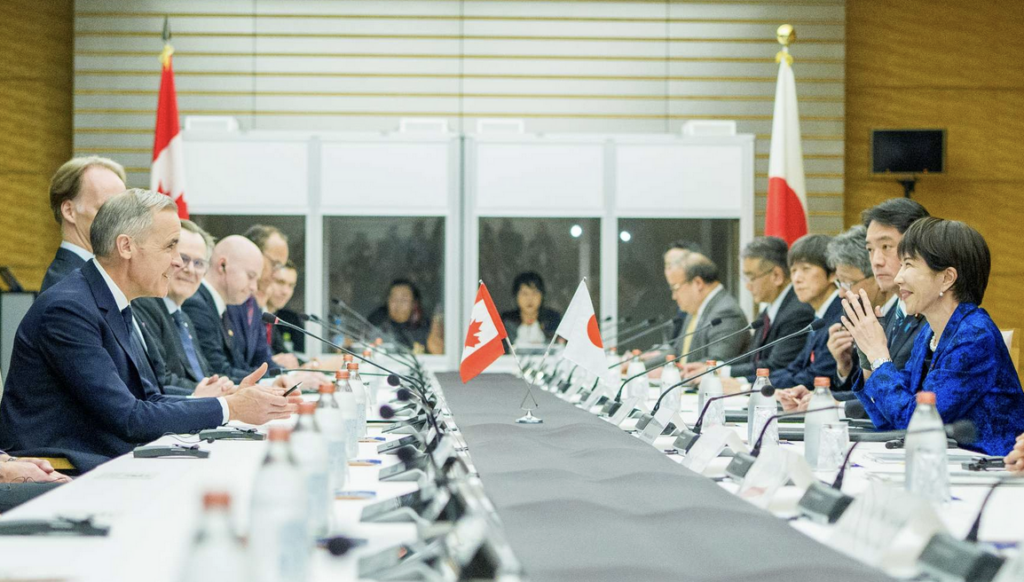 Prime Minister Mark Carney meets with Prime Minister of Japan Takaichi Sanae, March 6, 2026/PMO
From Momentum to Delivery
Carney’s first year has produced real momentum. But momentum in foreign policy is fleeting. The real test now is implementation.
The first challenge is execution. Agreements signed during high-level visits must translate into concrete outcomes: market access, investment flows, joint projects, and sustained institutional cooperation. Canada has historically struggled with follow-through in the Indo-Pacific.
The second challenge is China. Carney’s recalibration of relations with Beijing has strategic logic. In an era of overdependence on the United States, Canada needs room to stabilize its relationship with China, especially in selective areas such as agriculture, energy, climate, and other economic sectors where engagement can serve Canadian interests.
But the test of this policy is whether the guardrails Carney has promised are actually put in place, understood across government, and enforced. Canada will need to show that it can deepen engagement while still upholding Canadian law, protecting against foreign interference, guarding against forced labour, screening investment in sensitive sectors, and defending its economic and national security interests.
Selective engagement with China with clear guardrails is conceptually sound. Operationally, it is complex. It requires clear definitions of what is in and out of scope, robust enforcement of investment and security frameworks, and sustained coordination across departments.
India presents the third challenge. The diplomatic reset has created political space, but the relationship remains fragile. Public opinion in Canada is still shaped by concerns related to foreign interference, diaspora tensions, and the Khalistan issue. Canadians may support re-engagement in principle, but many still lack a clear understanding of its strategic rationale.
That gap matters. A successful India strategy cannot rest only on leader-level diplomacy. It requires a deeper investment in knowledge, networks, and institutional capacity across government, business, academia, and civil society. Canada needs more India competence if it is to turn the current opening into a durable partnership.
The fourth challenge is sustaining momentum with key partners.
Relations with Japan and Australia have finally reached a level of strategic alignment that reflects their importance. But these partnerships require sustained attention, resources, and institutional follow-through.
That should include a more serious Indo-Pacific dimension in Canada’s Defence Industrial Strategy. It makes little sense for Canada to talk about stronger defence partnerships in the Indo-Pacific while concentrating industrial cooperation almost exclusively on NATO partners. If Ottawa is serious about strategic diversification, its defence industrial vision must reflect that.
Finally, Ottawa must address an important economic blind spot. Much of Canada’s Indo-Pacific engagement has focused on expanding markets for energy, agriculture, and other goods. These are essential. But they are only part of the story.
The fastest-growing segments of trade in the region are in services, digital infrastructure, and talent mobility. Education, in particular, is a strategic asset. It underpins people-to-people ties, supports innovation ecosystems, and feeds long-term economic relationships. Yet recent policy changes and the lack of alignment between immigration, education, and trade objectives risk undermining this advantage.
A more integrated approach — linking talent strategy to trade, innovation, and regional engagement — will be essential if Canada is to compete effectively in the Indo-Pacific.
The Challenge Ahead
Delivering on Carney’s ambitious, integrated agenda will require not just new policies, but a step change in Canada’s statecraft capacity in the Indo-Pacific. It will require new ways of working across governments and with the private sector, clearer priorities, stronger coordination, and a greater willingness to measure results not by meetings held or agreements announced, but by outcomes delivered.
Canada enters Carney’s second year in office with a stronger position in the Indo-Pacific than it has ever had. The foundations are in place: increased political attention, expanded partnerships, and a clearer strategic rationale.
But those foundations will only matter if Canada can build the institutional muscle to sustain engagement, follow through on commitments, and turn diplomatic openings into strategic results.
Policy Contributing Writer Vina Nadjibulla is Vice President of Research & Strategy at the Asia Pacific Foundation of Canada.