
Carney’s Canada: A New Defence and Security Posture, Yet to be Tested
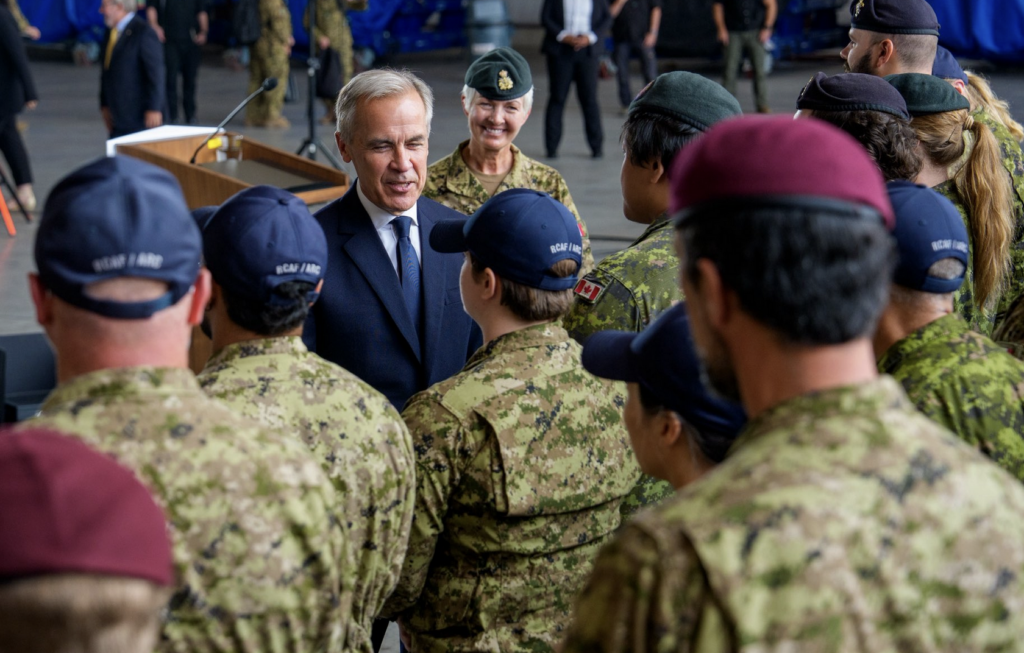 Prime Minister Mark Carney at the Fort York Armoury, June 25, 2025/PMO
This piece is part of our Policy series Carney’s Canada One Year Later.
By Kevin Budning and Lilit Klein
April 29, 2026
No incoming Canadian prime minister since the Second World War has confronted a more daunting set of challenges than Mark Carney faced in 2025. The reasons were clear: a rapidly evolving defence and security context, a punishing tariff war that doubled as a pressure campaign, and a Canada-United States relationship in open deterioration.
Donald Trump’s rhetoric about Canada taking advantage of the U.S. was neither new nor limited to trade. Accusing Canada, and the NATO alliance more broadly, of freeloading off American security guarantees has long been a favourite move in his playbook. But since returning for his second term, Trump’s fixation on military burden-sharing, mirroring his attacks on trade, has only intensified, with Canada’s chronically low defence spending bearing the brunt of his ire.
Prime Minister Carney’s response to this intense pressure has come in both words and deeds. Upon taking office, he said that Trump had to cease his sovereignty-undermining rhetoric, such as the “51st state” taunts and “governor” jabs, before Canada would engage with the administration on broader talks. At Davos, Carney went further, delivering a pointed address to the World Economic Forum that declared the era of U.S.-led international order effectively over.
But it is on defence that Carney’s actions have spoken loudest. Within three months of taking office, he committed to raising defence spending to 2% of GDP by fiscal year-end, with a further climb to 3.5% over the following decade. Combined with related security and defence commitments, the plan would bring total spending to 5% of GDP and catalyze the defence industrial base — a scale of ambition Canada has not come close to in a generation.
These investments, totalling $63 billion spent this past fiscal year, have made a real difference across the CAF, albeit much of it has gone toward undoing years of neglect rather than building new capacity. Long-overdue pay increases for CAF members, deteriorating base infrastructure, and the integration of the Coast Guard into the Department of National Defence were among the major expenditures that helped reach the target.
These are necessary investments, but they are not the hard capabilities—ships, fighter jets, and tanks—that many Canadians picture when they hear of a dramatic surge in military spending.
Beyond the spending itself, Carney has pursued a deliberate effort to reduce Canada’s strategic dependence on the United States, redirecting its focus toward Europe and the Indo-Pacific. Canada formalized deeper defence ties with the European Union through the Security and Defence Partnership (SDP), joined the Security Action for Europe (SAFE) as its first non-EU member, opening Canadian firms to Europe’s defence market, and recently launched security-of-information negotiations with Finland.
In Asia, Carney signed security and defence agreements with Indonesia and Japan, the latter focused on trade, critical minerals, energy, advanced technology, and supply chain resilience. He extended this strategy to the Middle East through a new partnership with Qatar, while also making defence-focused visits to South Korea, India, and Australia.
Not all of these agreements carry equal weight, and many remain frameworks rather than fully operational arrangements. But collectively, they signal a strategic pivot. After years of drift, Canada is re-establishing itself as a credible security partner.
Rounding out Carney’s first year were two significant institutional moves, namely the creation of the Defence Investment Agency (DIA) and the release of an ambitious Defence Industrial Strategy (DIS). The former was established to address one of Canada’s most persistent defence problems: a procurement system notorious for delay, cost overruns, and bureaucratic paralysis.
Sustainability will be Carney’s biggest challenge in the year ahead and those that follow. Will public support hold as billions in annual defence spending are committed while other Canadian priorities receive less funding?
The DIA is designed to complement the DIS, which sets out an ambitious plan to expand Canada’s defence industrial base and strengthen domestic capacity. Its headline objectives include creating 125,000 jobs, increasing defence exports by 50%, directing 70% of defence spending to Canadian firms, and investing $180 billion in defence procurement over the next decade.
Despite being an important step in the right direction, the strategy is nothing more than that — a strategy. The coming years will determine whether it actually comes to fruition. Sustainability will be Carney’s biggest challenge in the year ahead and those that follow. Will public support hold as billions in annual defence spending are committed while other Canadian priorities receive less funding?
As Carney enters his second year, implementing the DIS will be a key measure of his progress. The strategy prioritizes buying Canadian, but many questions remain unanswered: what qualifies as a “Canadian” company, can security clearances keep pace with workforce expansion, and can small and medium-sized enterprises (SMEs), which constitute 92% of Canada’s defence industrial base and 40% of its employment, meaningfully compete in a risk-averse and sluggish procurement landscape that has long favoured larger players.
Another critical task will be delivering hard capabilities. Canada’s largest procurement decisions — 88 F-35s to replace the aging CF-18s and up to 12 new patrol submarines — are costly and carry geopolitical weight. Uncertainty around the future of the fighter jet program has strained an already fraught relationship with Washington.
The submarine down-select between Germany/Finland’s TKMS and South Korea’s Hanwha will also surely read as a directional signal of Canada’s broader partnership diversification. Carney’s ability to move these files and deliver on them decisively will shape confidence at home: among industry, which benefits from the contracts; the CAF, which needs the capabilities; and the broader public, which will want to see tangible results for the money being spent on defence.
Managing Canada’s security relationship with the U.S will also be a top priority for Carney as he enters his second year. From intelligence sharing within the Five Eyes, to the future of NATO, and perhaps most importantly continental defence under NORAD, Carney will need to find ways to bring stability to a relationship with an inherently mercurial U.S. administration.
Accomplishing this will require walking a fine line: making the necessary defence and political investments to signal to the Americans that Canada remains committed to the alliance, while also hedging its bets and continuing to diversify its security relationships elsewhere.
Evidence of this dual track strategy is already in play. Carney recently committed $35 billion to defend, build, and transform Canada’s Northern and Arctic Region, building on the Trudeau government’s 2022 NORAD modernization pledge. Its centrepiece is a $6.5 billion over-the-horizon radar network designed to restore early warning and detection coverage to the Arctic, critical for NORAD and Canada’s sovereignty in the North.
Carney’s first year signalled commitment. His decision to do what none of his predecessors were willing to risk — make generational investments in national defence — deserves credit and praise. Yet, in a sense, that was the easy part. What his government will face in the next year, and likely beyond, is intense pressure to deliver on those commitments and to justify why the spending remains necessary.
In today’s conditions, the case for increased defence spending makes itself. What will be telling is how Carney and his government respond if and when those conditions change.
Dr. Kevin Budning is the Director of Scientific Research at the Conference of Defence Associations (CDA) Institute.
Dr. Lilit Klein is the Editor, Research & Publications at the CDA Institute.