
The 15-Month Itch: Can Carney Crack the Canadian Honeymoon Curse?
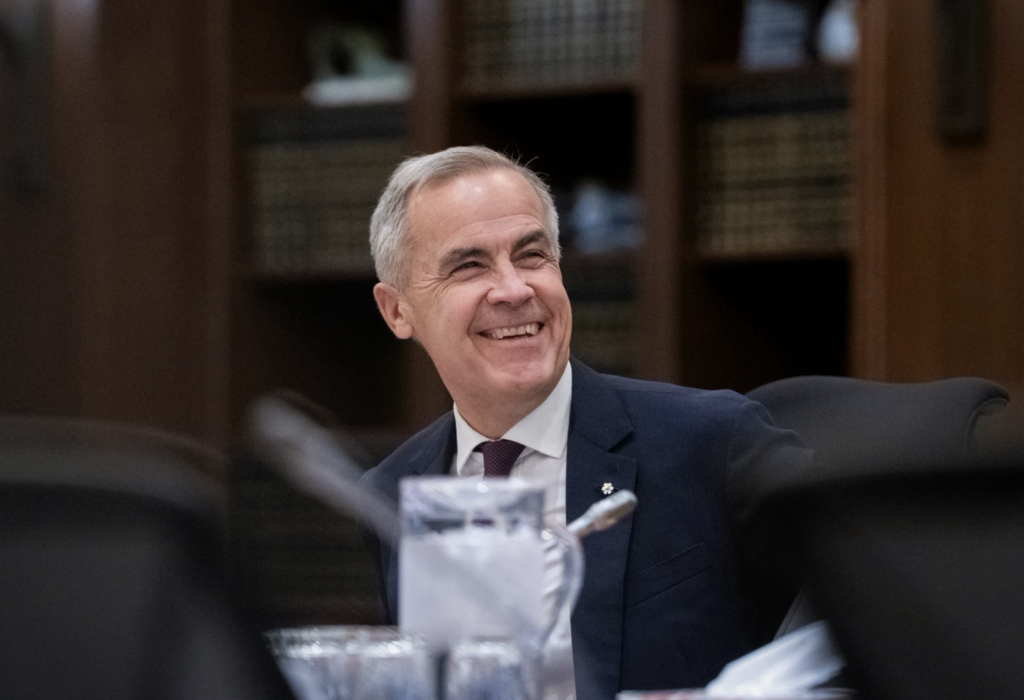 Will Mark Carney’s honeymoon break the polling mold?/PMO
This piece is part of our Policy series Carney’s Canada One Year Later.
April 30, 2026
Prime Minister Mark Carney is riding a political high. He’s more popular now than he was when Canadians went to the polls one year ago, with polling firms showing record-setting approval ratings for the Liberal leader and the government in general.
But roughly 10 years ago, similar things were said about Prime Minister Justin Trudeau and his government at their one-year anniversary mark. So perhaps what Carney is experiencing is more the rule than the exception.
History suggests that new prime ministers tend to enjoy a honeymoon phase with the public, but it almost always drops off — sometimes abruptly — not long after the first year.
If we go by the polling numbers alone, Mark Carney’s approval ratings, and those of his government, are entirely consistent with where Prime Minister Trudeau and his government were at this stage in their journey.
Abacus Data currently has the Carney government sitting at an approval rating of 54%. In November of 2016, Abacus Data clocked the Trudeau government’s approval rating at 55% a year into its mandate. Angus Reid found that Prime Minister Carney had a personal approval rating of 63% in February of 2026 but it dipped to 59% in March, while they found that Prime Minister Trudeau had the approval of 65% of the country in September of 2016.
Analysis by polling expert Éric Grenier for CBC News in 2017 shows how almost all prime ministers in recent decades, apart from Jean Chretien, saw their approval ratings slump to below the crucial 50% mark when the clock struck 15 months. And things tend to keep going downhill from there.
If this happens to Prime Minister Carney, he’ll be experiencing a decline in his political capital when he needs it most, just as the review of the Canada-United States-Mexico Agreement (CUSMA) gets going in earnest.
However, there is some evidence to suggest that Prime Minister Carney’s political “rock star” status might have longer legs than the initial generous spirit/benefit of the doubt extended to all new prime ministers. Will Mark Carney experience the conventional 15-month popularity slump, or is there something different, and more durable, about his support base?
First, he’s not a typical politician – especially by today’s standards. He’s a technocrat in a world increasingly populated by career politicians. His professional and educational suitability to handle the current challenges facing the country have been noted many times over, to the point where it often feels as though Canada hired him for the job of prime minister.
Will Mark Carney experience the conventional 15-month popularity slump, or is there something different, and more durable, about his support base?
If this is true, public support for Mr. Carney is likely based not on fleeting or superficial characteristics but, instead, on skills and credentials that do not fade over time. This could help his approval ratings to hold steady.
Second, Prime Minister Carney seems to transcend regional and partisan lines, as attested to by the number of floor-crossings to the Liberals in the past six months as well as the high levels of support he enjoys across the regions of the country and among people who voted for another party in the last election.
He’s won people over in the past year, even in the absence of relief from U.S. tariffs and as the affordability crisis rages on. His political practice and style of communicating are based on consensus-building and the brokerage of differences.
This is a sharp contrast to the previous political era, during which Justin Trudeau and Pierre Poilievre did their level best to out-wedge each other, contributing to growing polarization and voter apathy. Prime Minister Carney has met many Canadians where they are: in the political centre. On this point alone, it’s little wonder why his numbers are high.
All of this said, no politician has unlimited political capital. They all run out eventually, if they stay long enough.
As is the case with everyone else in the business, Mr. Carney has tendencies that could and likely will depreciate his brand over time, including his brusqueness with the media and his emergent tendency to take all important decisions on himself instead of using his cabinet ministers more strategically. If government credit is not diffused, blame won’t be either when things go wrong.
Further, a failure to address more substantively the acute consequences of the affordability crisis could become an insurmountable problem — and leave the door open for opposition parties to make gains.
As the country marks one year since the general election of 2025, the question is not whether Mark Carney will stay popular forever.
The question is whether his relationship with Canadians is based more on trust than novelty, and whether they’ll give him enough time to make progress on his ambitious agenda.
Dr. Lori Turnbull is a professor in the Faculty of Management at Dalhousie University.