
Carney Year Two: Now for the Hard Part
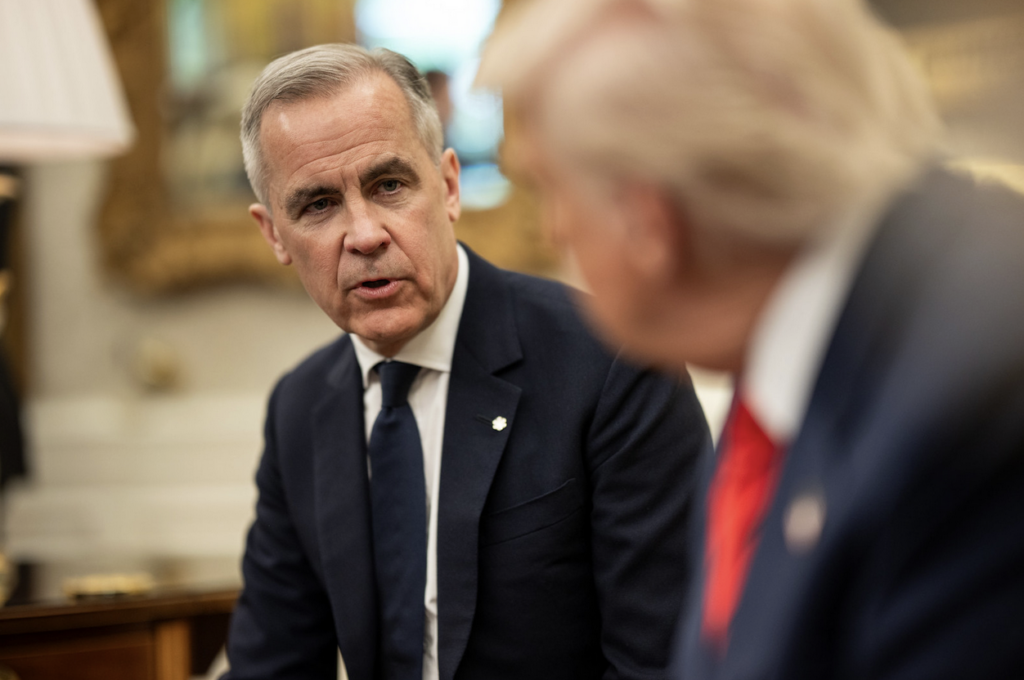 Mark Carney and Donald Trump in their first Oval Office meeting, May 6, 2025/WH
This piece is part of our Policy series Carney’s Canada One Year Later.
May 2, 2026
While he generally avoids the type of self-congratulation that overflows the Oval Office, Mark Carney could be forgiven a moment of satisfaction a year after his election.
In that time, Carney has revived a political brand that had come perilously close to extinction. After almost wining a majority last April, he has now constructed one through a combination of poaching and by-elections.
He has maintained a comfortable spread in both Liberal support and his own approval ratings, persuaded most premiers that they would benefit by actually collaborating with Ottawa, and won international applause for stating what other leaders understood but wouldn’t say — that the international order needs to be remade.
This week, his finance minister reported that last year’s economic performance was better than expected, providing the government with a $60 billion windfall. It allowed him to both increase spending significantly and promise a somewhat lower deficit than he projected in last fall’s budget.
Notwithstanding his current political fortunes, Carney might soon see a very different landscape. As the obstacles to implementing his agenda have disappeared, so have any excuses if it doesn’t get done.
In his recent Forward Guidance video, Carney promised to level with Canadians. He promised he would never “sugarcoat our challenges.”
A starting point would be to explain that what ails Canada didn’t start with Trump. The U.S. president will gleefully exacerbate and exploit our vulnerabilities, but he didn’t create them.
None of this should be news to anybody: our productivity and living standards have been slipping for years, regulation has hardened into sclerosis, and we still tolerate interprovincial barriers that would be illegal inside the EU.
Meanwhile, we’ve drifted toward irrelevance in foreign affairs, neglected infrastructure and defence here at home, watched our political system become increasingly polarized, and piled up debt.
These problems are systemic. They have no simple, quick, or painless fixes. They were decades in the making and will take decades to repair.
To correct them, we’ll need to create both a national understanding that inaction threatens our very survival, and a political will to endure whatever it takes even as governments come and go. That sort of unflagging determination has never existed in Canada in peacetime.
As we negotiate with an increasingly erratic and vindictive president who says our country should not exist, we should expect things to get worse before they get better.
There are some encouraging signs. Unlike too many in both government and business, the Prime Minister understands we can’t go back to how things used to be once Trump leaves.
He has scrapped several divisive, ideologically based policies from the Trudeau era and reintroduced civility into politics. He sees the need to reform regulation, eliminate internal barriers and start building things again. He is working to broaden our trade and defence ties. He has reduced Canada’s preachiness on the international stage and says we must deal with the world as it is.
All of this is a good start. Unfortunately, however, these are only a few steps down a very long road.
The internal trade barriers Canadians hoped would disappear by Canada Day last year mostly remain. The international agreements on trade are MOUs, not bold new free trade pacts (even if they had been concrete arrangements, they would have replaced only a fraction of the trade now threatened by Trump).
And measures like the Major Projects Office and the new Defence Investment Agency don’t fix our broken regulatory and procurement processes. Instead, they short-circuit the system by lifting some very large projects out of it. The underlying problems remain.
Despite promising not to sugarcoat the hard truths, Ottawa still seems to believe we can buy our way out of our problems by spending now and sending the bill to our kids. Instead of earmarking their budgetary windfall to reduce Canada’s debt, the government treated the vast majority like a year-end bonus that could fund a whole new wish list.
It ignored the fact that the increased revenues didn’t create a surplus; instead, they offered an opportunity to reduce the new debt it’s adding.
Consider the $2.4 billion gas tax cut between now and Labour Day. If ever the government could have legitimately called for sacrifice because of events outside of Canada’s control, this was the time. Instead, they pulled out the national credit card.
Will they show more courage when it’s time to choose between social programs and rebuilding the military? We’ve finally hit the 2% of GDP spending on defence that successive governments had refused to meet, but our commitment has changed. Reaching the new 5% target will take more than the combined budgets of several federal departments.
The government has entered a new phase when it will be judged not on promises, but on performance. As we negotiate with an increasingly erratic and vindictive president who says our country should not exist, we should expect things to get worse before they get better.
But they can eventually get much better if Ottawa levels with us about our problems and sets out the tough choices and sustained sacrifices they will take to correct.
Start by giving Canadians the unvarnished truth. Then the truly hard work begins.
Policy Contributing Writer Perrin Beatty, PC, OC, is the former President and CEO of the Canadian Chamber of Commerce. He served as a cabinet minister in seven different portfolios, including Treasury Board, national revenue, solicitor general, defence, national health and welfare, communications and external affairs. He is Co-Chair of the Expert Group on Canada-US Relations.