
Where the Two Solitudes Meet: Quebec Sovereignty and the National Capital Region
 Shutterstock
This piece is part of our Forum of Federations Series on National Unity and Canadian Federalism.
By Jack Jedwab
July 22, 2026
As we’ve seen recently with the Gordie Howe International Bridge between Canada and the United States, bridges have a way of mutating from benign infrastructure to political flashpoints.
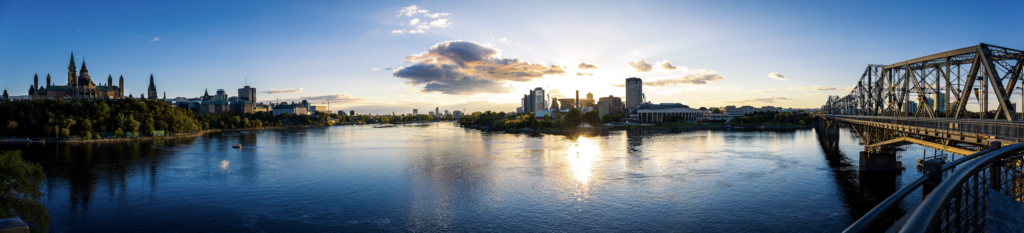
In Canada’s National Capital Region, which straddles the Ottawa River — with Greater Ottawa on the Ontario/south side and Gatineau on the Quebec/north side — interprovincial bridges are the arteries that make the conjoined cities work as a single metropolis.
It is already clear that the Quebec provincial election scheduled for October 5th may not just be fought over health care, housing or the cost of living. The Parti Québécois (PQ) is once again making Quebec sovereignty central to its political project, so the possibility of a referendum on independence will be a ballot question.
Which makes this an especially important time to once again ask a series of questions on what separation would actually mean — not in theory, not in slogans, but in the practical implications for the daily lives of people, including in the place where Canada and Quebec are most deeply intertwined, which also happens to be the national capital region of the former.
The idea of establishing an international border between Ottawa and Gatineau is so absurd that even the PQ wouldn’t dare propose it: customs posts on the Alexandra Bridge, passport checks between Hull and Ottawa, barriers dividing one of the most integrated urban regions in the country.
Thirty years after the failed 1995 referendum, the relationship between Ottawa and Gatineau has only deepened. The region is no longer merely two neighbouring cities on opposite sides of a river. It functions as a single metropolitan space, tied together by labour markets, federal employment, public transit, housing, families, culture, commerce and shared infrastructure — including and especially bridges.
Tens of thousands of people cross the river for work, study, services or family life. For many residents, the Ottawa River is not a provincial border. It is a commute.
The region’s demographics reinforce the point. Ottawa is not simply an anglophone city facing a francophone Québecois city across the river. In the 2021 Census, some 141,560 Ottawa residents identified French as their first official language spoken, about 14% of the city’s population; another 25,845, reported both English and French as first official languages.
In Gatineau, the reverse reality is also significant: 48,755 residents identified English as their first official language spoken, roughly 17% of the population, with another 11,860 reporting both English and French.
These are not separate communities living on opposite sides of a fixed cultural line. They are part of a bilingual, interdependent metropolitan region.
The National Capital Commission (NCC) notes that the five interprovincial bridges linking Ottawa and Gatineau carry more than 150,000 vehicles a day, along with more than 9,000 pedestrians and cyclists. Statistics Canada’s 2021 commuting data also counted 433,985 workers in the Ottawa–Gatineau census metropolitan area (CMA) who commuted to a usual workplace or had no fixed workplace address.
Put plainly, any new border would cut through a daily pattern of movement that has become ordinary, practical, and deeply embedded in the life of the capital.
This is also where Quebec’s distinct society claims meet one of the more complicated realities of Canadian identity. Canada is not best understood as a single pan-Canadian entity, but as a country of multiple and intersecting identities, shaped by region, language, Indigenous presence, immigration, religion, race, class and history.
But some intersections are especially critical to the glue that holds the country together. The centuries-old challenge of coexistence between English- and French-speaking communities has produced conflict, compromise, accommodation, and continuing debate over the meaning of equality and recognition.
Yet it is also one of the few areas in which Quebec’s distinctiveness and the broader Canadian experience are not separate stories but deeply connected sources of enrichment.
These are not separate communities living on opposite sides of a fixed cultural line. They are part of a bilingual, interdependent metropolitan region.
The National Capital Region manifests that connection every day. In Ottawa-Gatineau, official bilingualism is not an abstraction written into legislation. It is lived through work, schooling, public services, federal institutions, neighbourhoods, families and cultural exchange.
It is also a place where Canada’s newer diversity regularly interfaces with its older bicultural architecture. Immigrant communities, federal employees, francophones, anglophones and bilingual households all move through a shared urban space where language and culture are not merely markers of identity but practical conditions of daily life.
That is why the region is such a powerful test of sovereignty’s promises. To divide Ottawa from Gatineau would not simply separate jurisdictions. It would disrupt one of the places where Quebec’s distinct society and Canada’s intersecting identities are most inextricably intertwined.
This creates a problem for sovereigntists that cannot simply be waved away. If an independent Quebec would require open borders, international mobility, integrated infrastructure and special arrangements to preserve daily life in Gatineau and Ottawa and avoid regional partition, then what exactly would separation mean in practice?
The Parti Québécois has never seriously answered that question. It has spoken in broad terms about sovereignty, international recognition, economic continuity and normal relations with Canada. But it has rarely explained what independence would concretely mean for Gatineau or for the National Capital Region as a whole.
The PQ’s 524-page pre-election Livre bleu, released June 23rd, makes the central point well in a single page on this subject: Gatineau is not simply another Quebecois city; its economy, labour market and institutional ecosystem with Ottawa and the federal government make it the “most integrated” region between Quebec and Canada.
That reality may require more than vague assurances of an un-disrupted status quo. It may require some form of special status, formal recognition or negotiated arrangement for the National Capital Region in the event of Quebec independence.
The PQ Livre bleu asserts that Ottawa and Gatineau would continue to function much as they do today, with freedom of residency for federal employees who want to continue living in Quebec, with unfettered mobility across the Ottawa River, with dual citizenship amid Schengen-style borderlessness.
All of this is asserted as though Canada will have no say in these matters.
These are not technical details to be sorted out later. They go to the heart of whether sovereignty can be presented honestly to voters in Western Quebec and across the province.
Of course, sovereignists may argue that none of this would be a problem because Canada and Quebec would both have an interest in keeping borders open and life normal. But that argument proves too much. If the palatability of independence depends on preserving nearly every practical feature of the existing federation, then sovereignty begins to look less like the recognition of a pre-existing condition than a complicated renegotiation of interdependence.
And if the PQ wants to persuade people that, after a breakup, life would continue more or less as usual in Ottawa-Gatineau, they should be candid about what that would require.
Open borders are not slogans. They require agreements on customs, immigration, labour mobility, security, currency, taxation, trade and regulatory alignment. They require institutions. They require compromise. They require the consent of all parties. The Schengen Area is codified in the Schengen Agreement, the Schengen Convention, and the Amsterdam Treaty. But the terms of those treaties were agreed in a spirit of integration, not disintegration.
It cannot be assumed that post-separation Canada would simply be the broadly amenable negotiating partner sovereignists imagine. A Quebec departure would trigger constitutional, political and economic uncertainty across the country. Western alienation, Indigenous territorial claims, regional tensions and debates over federal institutions could all intensify.
Quebec might not find itself negotiating with the Canada it thought it was leaving, but with a country undergoing its own profound restructuring.
It’s important because Quebec today possesses significant influence within Canada: representation in Parliament, weight in federal elections, constitutional protections, transfer payments and a central role in the country’s political conversation. An independent Quebec seeking access to open borders, shared economic arrangements and institutional continuity might find that influence replaced by a status no different than that of any other bilateral negotiator.
The Ottawa-Gatineau question crystallizes the broader contradiction.
Sovereigntists often say independence would give Quebec full control over its future. But in the very region where separation would be felt most immediately, the practical goal would likely be to ensure that as little as possible changes. The bridges would remain. The workers would keep crossing. The institutions would keep cooperating. The economies would remain linked.
As Quebec approaches the 2026 election, voters deserve more than emotional appeals and deferred explanations. They deserve a detailed account of what sovereignty would mean.
In the National Capital Region, the bridges between Ottawa and Gatineau are more than infrastructure. They are the bonds of a shared life that no referendum can easily tear asunder.
Jack Jedwab is President of the Association for Canadian Studies and the Metropolis Institute.