
The Davos Moment in an Undeclared War
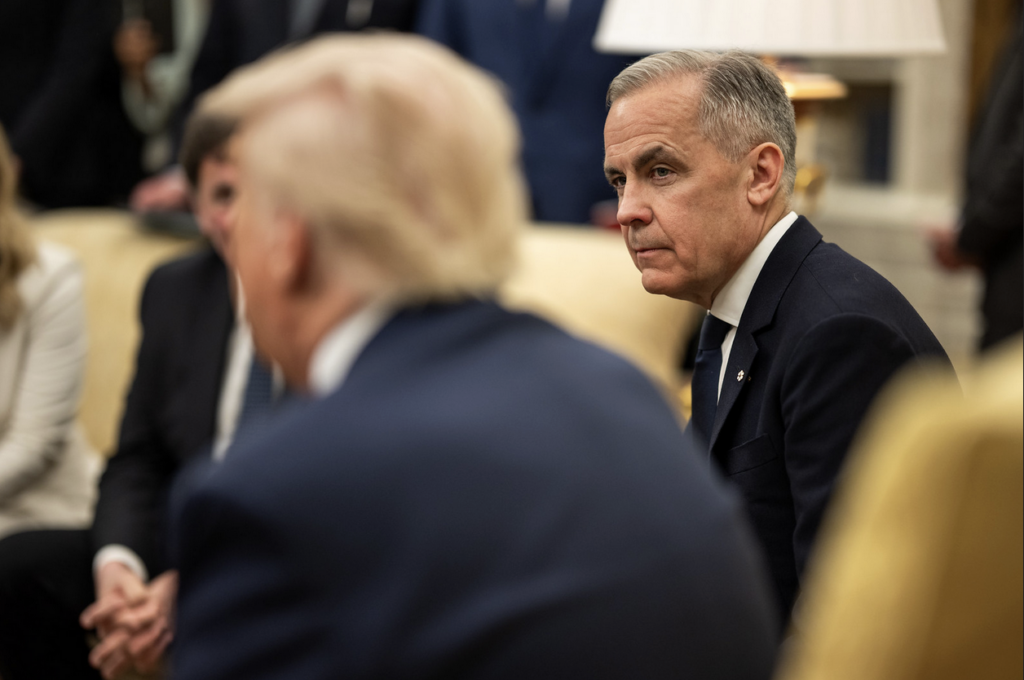 Prime Minister Mark Carney’s first Oval Office meeting with President Donald Trump on May 6, 2025/WH
By Jerry Bannister
August 8, 2026
Despite the churn of transformative world events since January, we are still in the Davos moment.
The terms used by Prime Minister Mark Carney to describe it have varied — rupture, fracture, hinge moment, inflection point. But there remains a consensus that the era unleashed by Donald Trump’s second presidency and the trade war that has defined it marks a before-and-after delineation in Canadian history, as well as in the global economic and geopolitical narrative.
At Davos, Mark Carney invoked European thinkers — Greek philosopher Thucydides, Czech dissident-turned-president Václav Havel, Finnish President Alexander Stubb — yet made no mention of events or leaders in Canadian history.
He referred instead to “the story of the international rules-based order,” which was partially false and should not be mourned. “Nostalgia,” per his oft-quoted line, “is not a strategy.”
As political theatre, the speech was brilliant. It resonated deeply with its intended audience, particularly European elites, and evoked simple, universalist themes.
Carney likes neologisms – variable geometry, plurilateral – but his argument was straightforward: to avoid getting crushed by great powers, middle powers must adapt pragmatically to protect their sovereignty, forging bilateral and regional ties where feasible.
While realpolitik was not resurrected that day in Graübunden, Carney made basically the same appeal to rational self-interest in setting foreign policy via the neologism popularized by Stubb, values-based realism. “We actively take on the world as it is,” Carney said in Davos, “not wait for the world as we wish it to be.”
Among the noteworthy responses to the Davos speech was the commentary by Massey College Public Policy Chair Tom Axworthy in Policy, which compared Carney’s speech to Louis St. Laurent’s Gray Lecture in 1947.
One might take issue with Axworthy’s assertion that Carney faces a harder road than St. Laurent did during the Cold War, but he is right to see parallels in how both speeches remade Canada’s foreign policy.
Axworthy emphasizes that while it’s early days in the Davos era, we must remember that St. Laurent walked the talk. For St. Laurent, five principles characterized Canada’s emergent role in the postwar order: national unity, political liberty, rule of law, human values, and international responsibility.
These principles highlight differences between both the speeches and the eras. Prime Minister Carney has placed much less emphasis on human rights, international law, and the role of justice.
In the principled and pragmatic formulation of the Davos speech, the latter overshadows the former. Human rights are mentioned twice, and the UN, sustainable development, and solidarity are each listed once.
Values are invoked repeatedly, both as the twist in values-based realism and framed as an asset for negotiating international relations. Like oil, our values are something others aspire to acquire (with the notable exception of our immediate neighbour — covetous of the oil, not so much the values). As Carney himself put it, “We are no longer just relying on the strength of our values, but also the value of our strength.”
This is not to suggest that the Canadian government has abandoned its commitments to social justice or our constitutional rights. Even a cursory read of federal policy initiatives and announcements demonstrates that the prime minister is keenly aware of issues such as the need for affordable housing, the impact of climate change, and threats to national unity.
From a historical perspective, it’s a question of setting priorities and the balance between foreign and domestic imperatives. Rhetorical markers such as the Gray Lecture and the Davos speech both reflect the zeitgeist and shape it. Words and phrases become part of our shared lexicon and colour how we see our past, our present, and our future.
Indeed, the Gray Lecture became the foundation for Canada’s foreign policy in the Cold War, but what’s often overlooked are Louis St. Laurent’s accomplishments in domestic policy. While navigating Canada through the war in Korea and then the Suez Crisis, St. Laurent’s government appointed the landmark Massey Commission on Canadian culture; reformed and extended old-age pensions; passed the Female Employees Pay Equity Act; oversaw construction of the Trans-Canada Highway; and negotiated the bilateral agreement for the St. Lawrence Seaway.
Mark Carney’s Davos moment and his popularity draw on the angst most Canadians feel about Donald Trump. Cravings for reassurance and protection have, not surprisingly, fed a focus on Carney himself as our national leader.
St. Laurent got along well with both Harry Truman and Dwight Eisenhower but still had to manage trade disputes and the question of whether Canada should allow nuclear weapons on its soil.
St. Laurent’s successors, particularly John Diefenbaker and Lester Pearson, had tense relations with John Kennedy and Lyndon Johnson respectively, and the Bomarc Missile Crisis highlighted conflicts with the United States and the complexities of Canada’s defence policy.
Yet even Diefenbaker’s beleaguered government passed the Bill of Rights, while Pearson’s many accomplishments in domestic policy spanned a new national flag, major reforms to our immigration system, a royal commission on the status of women, and the foundations of our medicare system.
Public fears during the Cold War based on the unpredictability and domination games of predatory hegemons were not unlike our collective anxieties today.
Mark Carney’s Davos moment and his popularity draw on the angst most Canadians feel about Donald Trump. Cravings for reassurance and protection have, not surprisingly, fed a focus on Carney himself as our national leader.
If, as Don Newman recently observed in Policy, we are witnessing a “delegation deficit” in a government fixated on the Prime Minister, there is also a looming deficit in social policy.
If the old international order is never coming back, we should think carefully about our national order as well. The pressure to submit to a post-democracy social order in America, if it comes to that, will be just as acute as the pressure to submit to a coercive, transformative trade war.
Moving forward in this undeclared war, redefining our relations with other nations will have powerful implications for how we imagine, or re-imagine, ourselves and our governments. In charting a new foreign policy, we need to consider how the current crisis is reorienting our domestic political culture and governance landscape.
The seismic shifts in federal resource allocation and fiscal capacity will ripple though national and regional politics and policy making. How far can defence spending, infrastructure projects, and trade negotiations be stretched to meet our country’s social needs?
If comparisons between the Davos speech and the Gray Lecture tell us anything, it’s that international crises never lessen the hard work of progressive public policy.
The Davos moment has persisted through another political season. How it will truly shape our lives as Canadian citizens remains to be seen.
Jerry Bannister is the Director of the MacEachen Institute for Public Policy and Governance at Dalhousie University