
Sober Second Thinking in a Time of Turmoil: Mobilizing Canada’s Senate
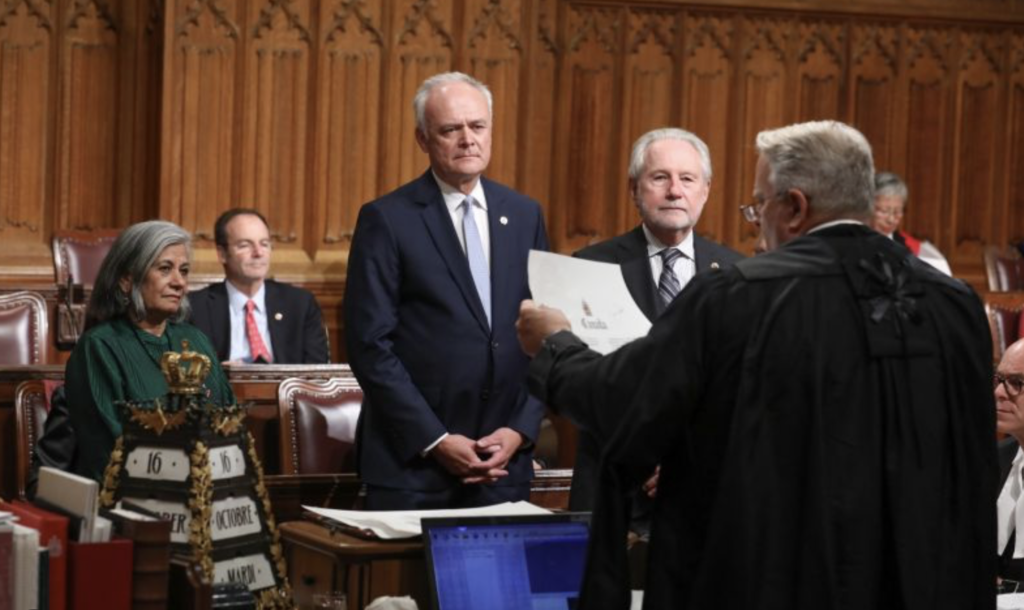 Peter Boehm being sworn in as a Canadian Senator, October 16th, 2018/Courtesy
August 31, 2026
Come October, I will have been a senator for eight years.
Following a career in the public and foreign service whereby I changed jobs and assignments with relative frequency both at home and abroad, my tenure in the Senate is my longest single work experience by far.
As an unexpected expert, I’d like to offer some perspectives on this unique, vital, and often misunderstood parliamentary institution in the context of our current national moment.
Most Canadians recognize the value of the Senate, but there remain a few who would wish to see it abolished or, at least, elected.
Having spent the better part of a decade in the Senate and learned a thing or two about the reality behind the worst stereotypes and stickiest misconceptions about it, I truly think the Senate needs to tell its story better.
As I reached the end of my public service career, the idea of continuing to contribute to public policy in a less partisan Senate was attractive. I knew both politics and government, and had worked closely with many high-level political figures, both in Canada and abroad. I had never been a member of a political party.
I thought moving to the Senate would be an easy transition. I was wrong.
I am often asked: what is it like? Are you enjoying yourself? Soon after my appointment, an American senator at an international conference asked me how my campaign had gone. “It was a landslide,” I replied. Misconceptions can be both a negative and a positive.
Our Senate runs on its own arcane bundle of rules, rulings, and precedents. Unlike a senior public servant or diplomat, as a senator you are no longer in the anonymous shadows but always on the record through your utterances and votes.
Being an ambassador was a bit like that. Still, I found my adaptation during the first year to be particularly challenging.
Soon after my appointment, an American senator at an international conference asked me how my campaign had gone. ‘It was a landslide’, I replied.
Byzantine procedure, internal politics and hortatory interventions all struck me as not necessarily helpful in getting legislation through to royal assent. Yet somehow, the place functions.
As the Upper Chamber whose members are unelected, the Senate prides itself on providing a complementary role to the House of Commons through rigorous oversight — often referred to as “sober second thought,” per John A. MacDonald’s ironic description — particularly through its standing committee system.
Ideally, in practice, senators are mindful of supporting both Canada’s regions and minorities. The appointment process started by former Prime Minister Justin Trudeau has led to the composition of a Senate that reflects gender parity, and mirrors Canada’s diversity.
My former Senate colleague and friend, the late Anishinaabe Truth and Reconciliation Commissioner Murray Sinclair, suggested that we might see the Senate evolve into a “council of elders.” I am not certain this will happen with party politics dominant in the House of Commons and our hybridized Westminster traditions.
The new, less-partisan Senate has amended (and I would say improved) more legislation, either government or private members’ bills — to say nothing of putting forth its own “public bills” (as private members’ bills are called in the Senate) — than its previous iteration.
Legislative tension between both houses has increased lately, in terms of pressure on the Senate to act quickly and the Senate’s counterpoint to employ full rigour in its oversight, with the traditional exception of not overly delaying or blocking “money” bills.
Some of this may be a result of most senators now serving not having a political party loyalty and therefore not being subjected to “whipping” — a Westminster term for maintaining party discipline in both attendance and voting derived from the “whipper-in” who keeps the hounds in line during a fox hunt.
Historians will debate whether this has been for good or ill.
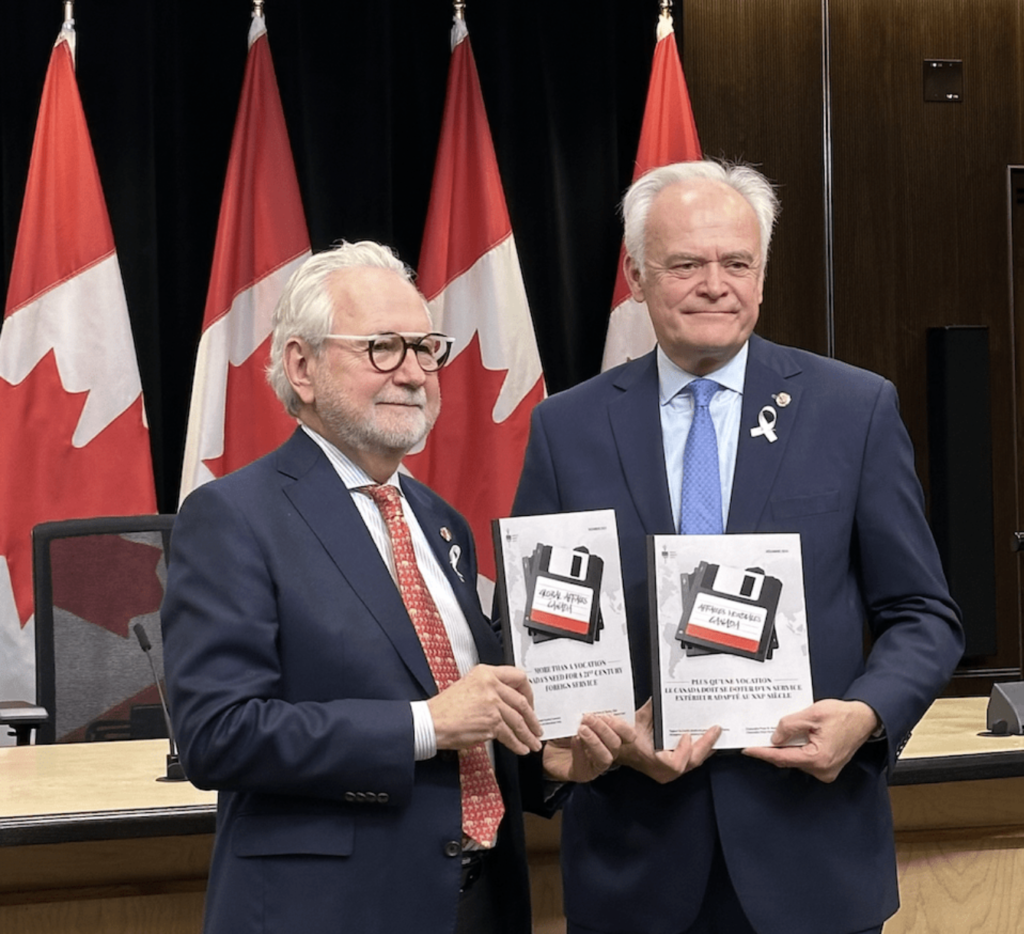 Unveiling our AEFA report on Canada’s foreign service with deputy chair Peter Harder on December 6, 2023/Sen. Marty Deacon
To me, the most useful aspect of the Senate is its standing committee work. In the past, I have had the good fortune to have been a member of both the National Finance and National Security, Defence and Veterans’ Affairs committees for several years.
I currently sit on the Committee of Internal Economy (charged with the administrative management of the Senate) and have been chair of the Foreign Affairs and International Trade Committee (AEFA) for the past six years.
I am particularly proud of the studies AEFA undertook on sanctions policy and legislative review of the Sergei Magnitsky Law (following Russia’s invasion of Ukraine), of the foreign service as a vocation (a topic dear to me given my previous life and one the government took seriously in setting out its own transformation agenda for Global Affairs Canada) and our study on a new approach to Africa.
We have had excellent testimony and debate on Ukraine, Sudan, Haiti, regional geopolitical tensions, CUSMA (the first version) and increasingly, earlier this year, given the actions of US President Donald Trump in his second term, trade issues.
As we return later this month, I wish to make a few observations on the road ahead, both for the Senate as an institution and its role in our national policy agenda.
First, there has already been some focus on Senate appointments with a few having been announced before the summer parliamentary break. There will be more to come in what can only be described thus far as an amended appointment process. Look for new senators with strong public policy backgrounds, economic expertise and some with partisan political antecedents. I am certain they will integrate well.
Second, the tension between a government wishing to move initiatives quickly and we sober second thinkers will persist. This is not a binary, finite debate, but an ongoing feature that says our bicameral parliamentary democracy is working.
As an institutionalist, I would suggest that the will of the elected House should be respected, but not without due diligence in terms of senators raising questions and amendments. There needs to be more pragmatism.
Third, there are the government policy questions. Our country and the people who work in its political institutions need to be seized of the reality that our relationship with our southern neighbour has changed, and that in some respects we are living in an existential moment in terms of the exercise of our sovereignty and our road ahead.
While I appreciate the suggestion of the Official Opposition to strike a special Senate committee to deal with trade problems with the United States, we already have a permanent international trade committee — I know, because I chair it.
For the Senate, standing on precedent and tradition in moving legislation forward might not be enough. Having committees undertake long-term studies — as valuable as they might be — could miss the acute policy moment in which we now find ourselves. In short, the House and the Senate need to work more closely together with clearer lines of communication.
So, too, with the Committee on Foreign Affairs and International Trade (AEFA), which I have the honour to chair. There is no point in engaging in longer term studies on given subjects when the global agenda could change at a moment’s notice as the result of unexpected geopolitical actions or an overnight Truth Social post.
While I appreciate the suggestion of the Official Opposition to strike a special Senate committee to deal with trade problems with the United States, we already have a permanent international trade committee — I know, because I chair it.
AEFA has held several hearings on CUSMA and will concentrate its efforts further, including along the lines suggested in the Conservative Party’s proposal. Its members are already well-versed on trade matters and, of course, other senators may join the meetings as observers.
If we really are at a point of rupture in the international rules-based order, as Prime Minister Mark Carney asserted in his oft-quoted Davos speech then we really will need an all-out parliamentary effort, with the executive branch extending more detailed briefings to parliamentarians and with greater availability of ministers and negotiators to appear before committees of both chambers.
Like MPs, senators also participate in what can be described as parliamentary diplomacy. Diplomacy is mainly practised at the executive level and by our representatives abroad. But through their participation in inter-parliamentary associations, parliamentarians can offer complementary, if untethered, support to government positions and initiatives.
Given the global rupture and the ongoing challenges to our sovereignty, those of us travelling abroad will need to leave our partisan affiliations behind and act as Team Canada. Substantive briefings from the government that go beyond traditional bureaucratic boilerplate will be required.
There is another aspect where the Senate can make a difference. At 105 members when the Senate is full, we are smaller than the House of Commons and less fractious. There is greater collegiality, and since our appointments last a long time, we get to know each other well and become remarkably familiar with the key policy issues of the day.
Eight years into my job as a senator, I know for a fact that the Canadian Senate is far more than a sinecure. It is a source of expertise and intelligence addressing the most urgent problems facing the country and the world in a complicated time.
I also know that there is a willingness among all of us in the Senate for the government to use that expertise to greater advantage in this defining moment. Indeed, more than a willingness — a sense of national duty.
Policy Contributing Writer Sen. Peter M Boehm is Chair of the Senate Standing Committee on Foreign Affairs and International Trade and a former ambassador and deputy minister.