
The Nightmare Before Halloween: How Quebec and Alberta Could Rain on Carney’s Honeymoon

September 22, 2026
As a veteran columnist and editor, I can attest to the predominance of a handful of opening gambits that have stood the tests of both time and competition from political-aphorism upstarts.
Harold Macmillan’s irresistible “Events, dear boy, events” and Yogi Berra’s (and Lenny Kravitz’s) “It ain’t over ’til it’s over” come to mind.
In the Canadian canon, there’s Robert Bourassa’s “A week is a long time in politics, and a year is an eternity” — often conflated for enhanced quotability with Harold Wilson’s “A week is a long time in politics” to “A week is an eternity in politics.”
Perhaps the most oft-cited Brian Mulroney quote is a vocational warning, one that he issued time and again over years both in office and after he returned to private life: “The two most important files on a prime minister’s desk are national unity and Canada-US relations.”
The reason Mulroney listed national unity first in those priorities wasn’t merely rhetorical. If Canada doesn’t remain united, all the other files will fall like dominoes.
Canada now finds itself in an unprecedented confluence of avoidable, politically counterintuitive (i.e. unjustifiable per conventional norms of advisability and electability — Danielle Smith’s risk-rationalizing base notwithstanding) crises in both files.
Among the many, many checklist items on Donald Trump’s to-do list of American performative self-immolation, world-order subterfuge, and relentless democracy discrediting is the active alienation of the United States and Canada in ways previously inconceivable.
After nearly two years of tariff terrorism designed to abrogate and incapacitate the updated continental trade deal that, ironically enough, Mulroney implemented to solidify Canada-US relations by enmeshing our economic interests, Trump’s operational assault on the second item on Mulroney’s warning list is officially on pause following Prime Minister Mark Carney’s suspension of negotiations on August 21st.
Meanwhile, in Alberta and Quebec, two deceptively incremental independence narratives threaten the national unity that should be, per Mulroney’s admonition, every prime minister’s priority.
In Quebec, if the Parti Quebecois wins the October 5th election, leader Paul St-Pierre Plamondon has vowed not to hold a referendum on independence as long as Donald Trump is in office, which another way of saying “I promise not to threaten Canada as long as a greater threat to Canada remains active.”
It’s also a way of defusing a long-promised independence referendum as an obstacle to winning while increasing the chances of an independence referendum by winning.
Those chances have also been boosted by the series of unfortunate events that preceded the current campaign in the camp of the classic federalist alternative, the Quebec Liberal Party (LPQ).
Former federal cabinet minister and allophone vote-magnet Pablo Rodriguez’s exit from the provincial Liberal leadership based on a later-discredited texting exchange implying vote-buying in his leadership campaign produced a six-point drop for the Liberals and a six-point spike for the PQ last December.
The subsequent splitting of the federalist vote between Rodriguez successor Charles Milliard and incumbent Coalition avenir Québec (CAQ) Premier Christine Fréchette will be the key driver of a PQ victory.
That split has left both parties toggling for second place in the low-to-mid 20s, behind the PQ at just under 30.
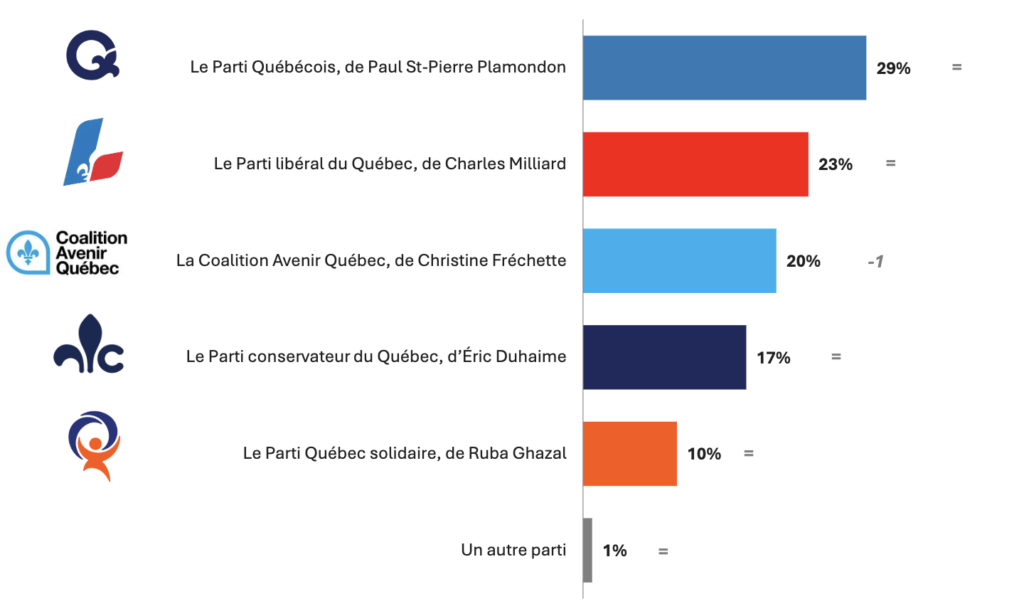
But today’s Leger/Journal/TVA poll (above), conducted Sept. 18-21 after last week’s first and second leaders’ debates, shows the PQ steady at 29 per cent, the CAQ slipping to 20 per cent after a Trump-factor surge early in the campaign (Trump has reversed that surge by dulling his threats against Canada in the absence of a daily trade-war volley, thereby benefiting the PQ by robbing Fréchette of her early nemesis), and the Liberals taking second place at 23 per cent.
The pre-existing federalist fragmentation is now being torqued by the provincial Conservative party’s position under Éric Duhaime from the Quebec City numbers, which haven’t changed its overall 19 per cent since the last poll on September 14th, but have tweaked the momentum and growth mojo.
“Two weeks before election day, voting intentions remain stable, but several campaign indicators are shifting,” per the Leger analysis. “The Parti Québécois remains in the lead, Paul St-Pierre Plamondon is gaining ground on several leadership measures, and the Conservative Party of Quebec is showing potential beyond its current level of support.”
Which means, if it were not for the potential spoke spanner of Wednesday’s third and final debate on Radio-Canada, the election would already be labelled the PQ’s to lose.
Or, per the Montreal Gazette‘s reporting on the new numbers: “Plug those numbers into polling aggregator QC-125’s election simulator and the estimate shows the PQ just one seat shy of the 64 seats required to form a majority government.”
Meanwhile, in Alberta, with a month to go until an October 19th independence referendum that was slid into a menu ballot where it sits like a time-bomb impersonating an afterthought, the odds of a Brexit-like result that would both defy and overrule the consistent two-thirds of Albertans who wish to stay in Canada are still playing out.
The odds of such an outcome being influenced by foreign interference, narrative warfare, misinformation and tactical confusion have been apparent for some time.
(As ever, the best reference for the wildly disproportionate time and energy spent on covert-operations assaults by anti-democracy interests on divisive referendum campaigns that can rationalize all manner of disaster is Carole Cadwalladr’s 2017 Guardian piece, The Great British Brexit Robbery: How Our Democracy was Hijacked. Some of the tactics have evolved and adapted, but the motive, intent, and a few of the players remain unchanged).
So, by Halloween — more pertinently, by the Canada-EU Summit in Montreal on October 29th and 30th — Mark Carney’s plan to position Canada as a stable, trustworthy North American democracy and global-capital tentpole could be suddenly undermined by two domestic-division dramas, both with the potential to catalyze political fracture and economic uncertainty.
If both Quebec and Alberta tilt toward independence in the next month, the opposition framing that could end Carney’s protracted honeymoon of domestic and international popularity and impact will go something like this: Mark Carney used his unique credentials, credibility, and global influence to save the world from Donald Trump, but lost Canada in the process.
As Mr. Dooley — the South-Side publican alter-ego of Chicago columnist Finley Peter Dunne — remarked so quotably in 1895: “Politics ain’t beanbag.”
Policy Editor and Publisher Lisa Van Dusen has served as Washington bureau chief for Sun Media, Washington Columnist for the Ottawa Citizen, international writer for Peter Jennings at ABC News, and as an editor at AP National in New York and UPI in Washington.