
Remembering Václav Havel, and His Moral Clarity, at Forum 2000
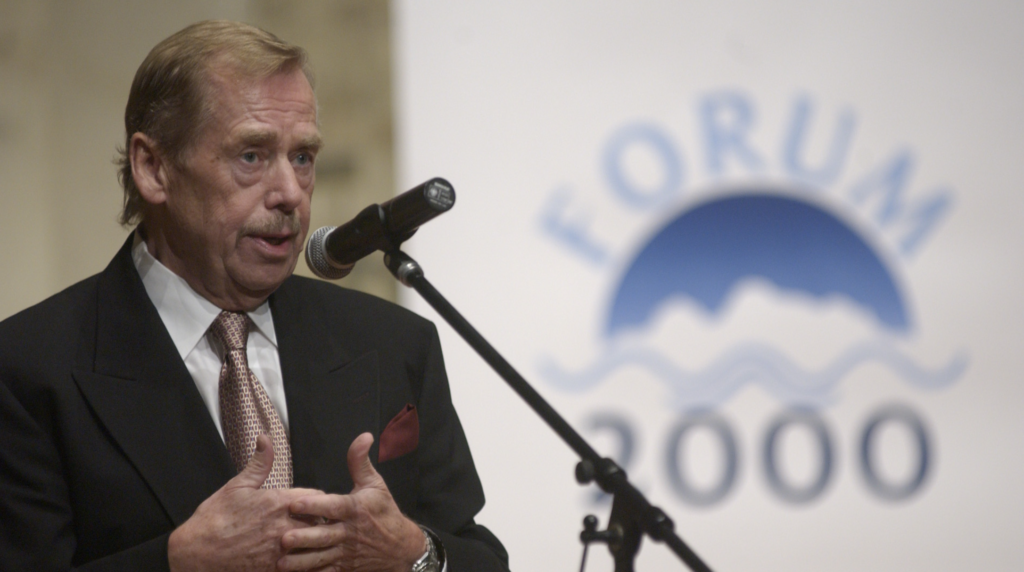
Forum 2000
October 27, 2026
“I have said again and again that it would be good if intelligent people, not only from the various ends of the earth, different continents, different cultures, from civilization’s religious circles, but also from different disciplines of Human knowledge could come together somewhere in calm discussion.”
~ Václav Havel, on the founding on Forum 2000.
After Václav Havel made the radical transition from political prisoner to President of Czechoslovakia in 1989, he began, in his own words, “for understandable reasons, to travel all around the globe.” Having spent years as a captive of injustice, Havel took full advantage of his post-Soviet freedom and traveled to roughly 80 countries while in office.
He also brought the world to Prague.
In 1996, Havel, Japanese philanthropist Yohei Sasakawa, and Nobel Peace laureate Elie Wiesel founded Forum 2000, a global conference whose aim was to “identify the key issues facing civilization and to explore ways to prevent the escalation of conflicts that have religion, culture or ethnicity as their primary components.”
On October 11-13 in Prague, Forum 2000 marked its 30th anniversary. It was my privilege to represent Canada’s Raoul Wallenberg Centre for Human Rights (RWCHR) at the conference.
The Forum’s co-founders were moral visionaries. They were also friends and close collaborators of the RWCHR’s founder, former Minister of Justice and Attorney General of Canada and longtime parliamentarian Irwin Cotler, a regular attendee of the Forum. The legendary stories of their work together in common cause came to life in Prague this year.
The shared values that underpinned their leadership found particular expression in the stories of the participants at the 30th anniversary event. Delegates from every part of the world huddled together between sessions, plotting campaigns to advance democracy, free political prisoners, and hold perpetrators to account. What united them was not only their struggle for freedom, but the fact that several owed their own freedom to the Forum’s founders.
One human rights lawyer shared how then-President Havel had seen global news reports of her being publicly threatened with imprisonment by her authoritarian government. Shortly thereafter, the Czech ambassador appeared at her door with an entry visa and escorted her onto a flight to Prague. Beyond the grasp of the dictatorship that sought to imprison her, this lawyer is now a voice for so many others who would otherwise be voiceless, pursuing justice and rescuing human beings at risk.
These stories served as a reminder of the role democracies can play in saving lives and advancing freedoms, and the kind of leadership we should aspire to see from our democratic governments.
Indeed, Havel, who died in 2011 and would have turned 90 on October 5th, also mentored a generation of dissidents and decisionmakers to continue in this tradition. His former disciples now attend the Forum as diplomats and legislators, former cabinet ministers, and civil society leaders. They share their knowledge and networks with human rights defenders, while also listening to, and learning from, these movements on the front lines.
For a Canadian lawyer working to support dissidents and pro-democracy movements as Canada navigates a world increasingly dominated by new technologies and tyrannies, some sessions felt especially salient.
Public intellectual Yuval Noah Harari was incisive in his warnings of the risks of artificial intelligence (AI) and the response it demands, sounding the alarm on the dangers of abdicating key elements of our sovereignty and self-governance to systems soon to be beyond our understanding and control.
Dominican Republic President Luis Abinader argued that good governance, the rule of law, and strong public institutions are what grow an economy and sustain trust in democracy. For middle powers, Abinader said, this is a matter of survival, making a country an attractive market and partner when democratic norms are under global assault.
That leadership has to begin with elected officials, who must invest in these pillars and abide by them. He also stressed that multilateral institutions, so important to middle powers, need to be reformed and made fit for purpose rather than left to be dismantled by major powers.
I left Prague more convinced than ever that the world needs more Havelian leaders to respond to these crises and their profound human costs.
Carl Gershman, founding president of the National Endowment for Democracy, made an essential point in quoting Havel’s frequent refrain that affluent democracies grow complacent and take freedom for granted. Havel’s answer was public education and movement-building around democratic solidarity: helping people understand the dangerous world we live in, why freedom is hard-won and must be preserved at home, and why its dissident champions abroad deserve our support.
The leaders of the historic Charter 77 movement that Havel helped lead showed how holding an authoritarian regime accountable to its own laws exposes its hypocrisy, and, in cases of arbitrary detention, can help free political prisoners. As Havel wrote in the Power of the Powerless: “Demanding that the laws be upheld is thus an act of living within the truth that threatens the whole mendacious structure at its point of maximum mendacity.”
Beyond the formal programming and informal plotting, structured roundtable sessions allowed for meaningful movement on some of the most pressing issues of the day.
The International Coalition for Democratic Renewal (ICDR), facilitated by the Forum, was one such gathering. Its in-person, guided discussions, where leading academics and activists, former statespeople, human rights lawyers, and dissidents could freely exchange insights and plan collective action, were especially encouraging at a time when such discussions in the daily content sphere tend to be drowned out by conflict and belligerence.
With the conference falling around the anniversary of Hamas’s horrific massacre and hostage-taking of October 7, 2023, I was reminded that the ICDR was among the first international groups to stand in solidarity with the victims, condemn the perpetrators and their state sponsors, and call unequivocally for the hostages’ release (read the ICDR’s statement here).
The Forum has always taken a stand for justice and spoken out for those unjustly detained. The conference’s opening speaker, Belarusian opposition leader Sviatlana Tsikhanouskaya spoke compellingly of the struggle for freedom under authoritarian president Alexander Lukashenko, and the plight of the democratic opposition and political prisoners who continue to suffer in her country.
In the “Unissued Diplomas” exhibition, posters along the main entrance to the venue showed the faces and told the stories of young Ukrainian students who ended their studies prematurely and lost their lives defending their homeland and our shared democratic values against Vladimir Putin’s unjustified war of aggression. The value of each of those stories to the larger narrative of human rights backsliding across the globe since Havel’s passing is immeasurable.
Leadership does not depend on public office alone. Havel regarded civil society as the truest foundation of democracy, and the people at the Forum — those he helped, mentored, or inspired — are a testament to this, as is the Forum he founded.
So are the civil society leaders whose presence would have been fitting, and whose absence was keenly felt: Nasrin Sotoudeh, the Iranian human rights lawyer who has been repeatedly imprisoned for defending women and juveniles sentenced to execution; Jimmy Lai, who is 78, diabetic, and serving a 20-year sentence for publishing a pro-democracy newspaper.
Each is an emblematic Havelian figure, someone who chose to live within the truth when the cost was clear. Their choices, like those of the first Charter 77 signatories — a few hundred people in 1977 — show that individual decisions can shape societies. Twelve years later, their country was an independent democracy, and one of those signatories was its president.
For those of us living in freedom, standing up for the dissidents deprived of it is the least that living within the truth requires of us.
I left Prague more convinced than ever that the world needs more Havelian leaders to respond to these crises and their profound human costs.
Democracy is eroding in places where it once seemed secure, authoritarian governments are more confident and coordinated than they have been in generations, and too many of those in power seem to have concluded that principle is weakness.
Václav Havel never made that mistake. He exemplified that moral clarity is not a substitute for political strength, but the source of it.
Brandon Silver is an international human rights lawyer and Director of Policy and Projects at the Raoul Wallenberg Centre for Human Rights.