‘A Certain Idea of France’: Lessons About Sovereignty from Charles de Gaulle
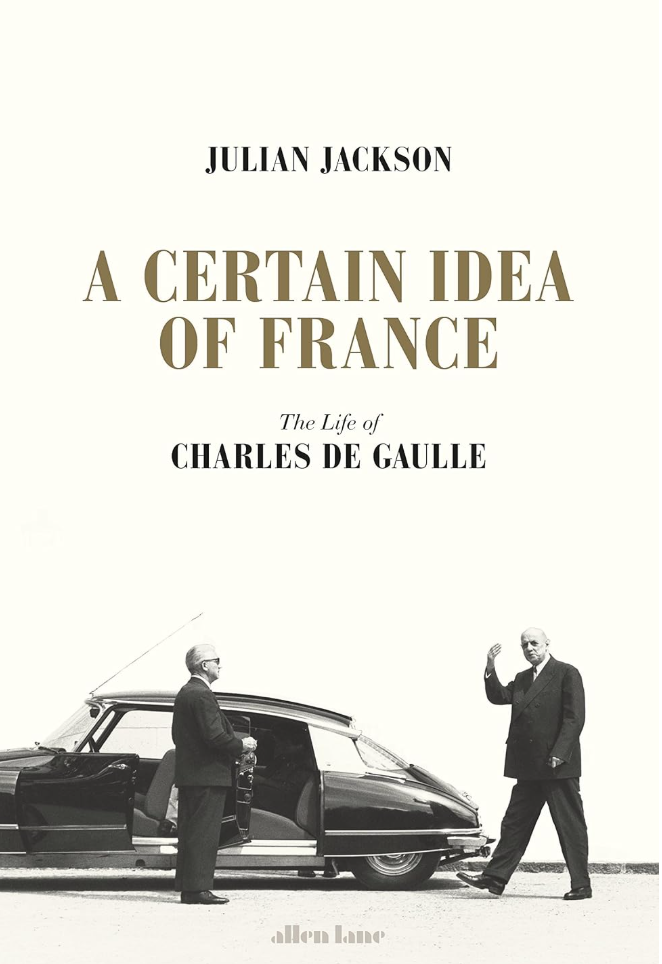
A Certain Idea of France: The Life of Charles de Gaulle
Penguin Random House, 2019/944 pages
Reviewed by Rupak Chattopadhyay
October 1, 2026
Following my recent reading and review of Bob Rae’s Reclaiming Canadian Sovereignty in a Ruptured World, I found myself returning to Julian Jackson’s magisterial biography of Charles de Gaulle, A Certain Idea of France.
Rae’s central argument is that sovereignty cannot be understood merely as legal independence or control over territory. It is ultimately about capacity: the ability of a country to absorb pressure, defend its interests, and retain the freedom to make choices when circumstances change.
That argument brought me back to de Gaulle, because he confronted precisely this dilemma in a very different historical context.
When I first read Jackson’s biography (now a two-part French-produced feature film, La Bataille de Gaulle, that has become a political event in France), I was more interested in de Gaulle’s early life and career — his military formation, his writings on mechanized warfare, and especially the intellectual ferment of the 1920s and 1930s that shaped his views on strategy and leadership.
On rereading the book, however, I found myself drawn much more to Jackson’s portrait of de Gaulle the politician and statesman: the leader who understood France’s diminished position after 1945 and sought to construct the capabilities necessary for France to retain strategic autonomy in an age of bipolarity.
What makes de Gaulle worth revisiting today is not nostalgia for Gaullism. It is the question he confronted: how does a country preserve meaningful room for manoeuvre when the distribution of power leaves it dependent on larger states?
De Gaulle’s genius was that he recognized France’s decline without accepting France’s irrelevance. The France that emerged from the Second World War was a victorious nation, but it was no longer the great power that had entered the war in 1939.
It retained important assets — a permanent seat on the United Nations Security Council, diplomatic influence, a sophisticated state apparatus, and global interests — but the strategic environment had changed fundamentally.
The defeat of 1940 had exposed the limits of French military power, while liberation had depended heavily on American and British strength. The emerging international order was being shaped by Washington and Moscow.
The challenge facing France was therefore not how to recreate the past. It was how to remain an independent actor in a world dominated by superpowers. De Gaulle’s response was to focus on capabilities. He understood that sovereignty without the means to defend and exercise it was largely symbolic. The most visible expression of this thinking was the creation of an independent French nuclear deterrent.
The foundations of France’s nuclear programme had been laid under the Fourth Republic before de Gaulle returned to power after 12 years in 1958, first as prime minister, then as president from 1959 to 1969. His contribution was to give the programme a clear strategic purpose.
Under his leadership, France conducted its first nuclear test, Gerboise Bleue, in February 1960, after adopting the nuclear deterrent policy known first as the force de frappe and, after 1961, force de dissuasion.
De Gaulle understood that France could never match the nuclear arsenals of the United States or the Soviet Union. The objective was not numerical parity. It was political independence. France needed the capacity to ensure that decisions affecting its ultimate security could not be made entirely elsewhere.
This was the essence of the Gaullist argument. Nuclear weapons were not simply instruments of war; they were instruments of political autonomy. They provided France with the ability to influence strategic calculations rather than merely accept the decisions of others.
The issue is not whether Canada can or should escape geography. It cannot. The issue is whether Canada possesses sufficient capabilities to ensure that dependence does not become vulnerability.
The same logic shaped de Gaulle’s approach to NATO. He was not opposed to alliances. France remained part of the Western community throughout the Cold War and shared the fundamental objective of containing Soviet power. His concern was different: whether alliance arrangements could become a substitute for national capability.
In 1966, he withdrew French forces from NATO’s integrated military command structure while remaining within the alliance itself. France would continue to cooperate with its allies, but it would maintain control over decisions involving its own forces. For de Gaulle, the distinction was between partnership and dependence.
This distinction is central to Rae’s discussion of Canadian sovereignty. Canada’s challenge is obviously different from France’s in the 1950s and 1960s. Canada is deeply integrated with the United States economically and strategically, and that relationship has brought enormous benefits.
The issue is not whether Canada can or should escape geography. It cannot. The issue is whether Canada possesses sufficient capabilities to ensure that dependence does not become vulnerability.
That is why Rae’s broader conception of sovereignty is important. It is not a call for withdrawal from the world. It is an argument for resilience: the ability to remain open and engaged while ensuring that Canada has the assets required to make meaningful choices.
The parallels with de Gaulle are not exact, but the underlying question is similar. What capabilities allow a country to retain agency?
For France, the answer included nuclear weapons, an independent defence industry, diplomatic weight, and technological capacity. The nuclear deterrent was only one element of a broader strategy that included investment in aerospace, energy, telecommunications, and advanced industrial capabilities.
Projects such as Airbus, Ariane space technology, and France’s expansion of nuclear energy reflected the belief that technological dependence could eventually become strategic dependence; anathema to a country that had lost its independence so dramatically well within memory of so many of its citizens, including and especially the president of the republic.
The contemporary debate over American alliances raises a related question. The postwar order depended not only on American military power but also on confidence in the reliability of American commitments.
During Donald Trump’s presidency, his more transactional approach to alliances, criticism of NATO burden-sharing, and willingness to question longstanding assumptions about U.S. commitments led many allies to reconsider the risks of excessive dependence.
Jackson’s biography is compelling because it avoids turning de Gaulle into a simple hero. He was a figure of extraordinary strategic imagination, but also one whose conception of France was shaped by a powerful national mythology.
His pursuit of independence sometimes created tensions with allies. Yet his central insight remains difficult to dismiss: countries that wish to influence events require the capabilities to do so. That insight has relevance well beyond France.
The lesson from de Gaulle is not that alliances are unnecessary. It is that alliances function best when partners possess their own sources of strength. States with independent capabilities have greater freedom to cooperate because cooperation is a choice rather than a necessity. This question is equally relevant in Asia.
India provides an important example. Over the past two decades, Washington and New Delhi have built a much deeper strategic relationship through defence cooperation, technology partnerships, military exercises, and the Quad framework.
The Modi government has overseen the most significant expansion of US–India strategic ties to date. Yet India has continued to pursue strategic autonomy, maintaining relationships with multiple powers, including Russia, while expanding cooperation with the United States where interests align.
India’s approach reflects a reality that de Gaulle understood: even close partners seek room for manoeuvre. The objective is not to avoid cooperation but to preserve choices.
De Gaulle’s achievement was not restoring France to its former dominance. He understood that the world had changed. His achievement was ensuring that France retained the ability to shape events rather than simply respond to, or worse, be engulfed by them.
This is ultimately the connection between Rae’s reflections on Canada and de Gaulle. Sovereignty in the twenty-first century depends not only on legal authority but on the assets that underpin it: economic resilience, technological capacity, defence capability, diplomatic credibility, and institutional effectiveness.
Influence requires assets and Canadians are well advised to read both books.
Policy Contributing Writer Rupak Chattopadhyay is President and CEO of the Forum of Federations in Ottawa.