
Can a New Canada-EU Relationship Stand the Tests of Time and Geopolitics?
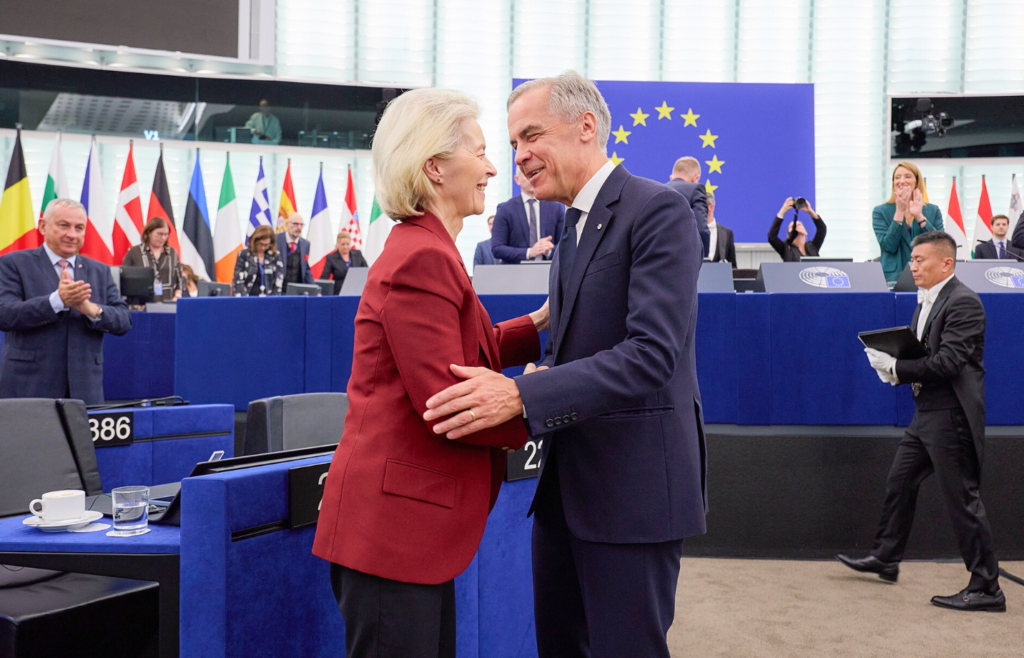 Ursula von der Leyen and Mark Carney at the European Parliament, Strasbourg, September 17, 2026/EP image
This piece is part of Our Policy Series on the Canada-EU Relationship.
By Perrin Beatty and Fen Osler Hampson
October 25, 2026
Are Canada and Europe really “besties”? That is certainly the message that Prime Minister Mark Carney and European Union President Ursula von der Leyen hope to convey when they meet for their much-anticipated Canada-EU Summit in Montreal this Thursday and Friday.
But whether this budding romance between Canada and Europe becomes a serious relationship will depend on a host of factors, some largely beyond the two leaders’ control.
There is little doubt that Europe and Canada have moved closer together in the “ruptured” world that the Prime Minister described in his much-touted Davos speech in January.
The Prime Minister deserves much of the credit for deepening ties through a host of Canadian-led initiatives, including the landmark EU-Canada Strategic Partnership of the Future and the Security and Defence Partnership (SDP) signed in Brussels on June 23, 2025.
So, too, do former Prime Minister Stephen Harper, who paved the way for trade diversification by initially negotiating the Comprehensive Economic and Trade Agreement (CETA) with Europe and his successor, Prime Minister Justin Trudeau, who successfully navigated some of the tough, outstanding issues about investor-state dispute settlement and Wallonia’s threat to scupper the entire deal. To this day, 10 countries, including France and Italy, have yet to ratify CETA — an issue that will, no doubt, be raised in Montreal.
However, there is little doubt that the real impetus for this new partnership lies in Washington.
Were it not for Donald Trump’s tariff wars, his threats to invade Greenland and make Canada the 51st state, his continuing dalliance with Russian President Vladimir Putin, his on-again, off-again support for Ukraine, and growing doubts about whether the United States would actually honour its Article 5 commitments under the Atlantic Treaty, we would not be bear-hugging Europe to seek deeper economic and defence ties in a geopolitical storm.
Just as former President Richard Nixon’s tariff and monetary “shocks” of 1971 prompted Prime Minister Pierre Elliott Trudeau to announce with great fanfare in 1972 that Canada would pursue a “Third Option” with Europe, 54 years later another Liberal government is doing the same.
But the similarities should not be overstated. Nixon was a pussycat compared to Trump. Canada secured the removal of Nixon’s surcharge on Canadian goods within months. Not so with Trump, who is causing much greater — and more permanent — damage.
Unlike the Third Option of yesteryear, which was largely stillborn, the evolving partnership with Europe has genuine substance. Trade and investment have increased substantially, though 72 per cent of Canada’s merchandise exports still go to the United States. Importantly, there are now strong incentives in Europe to “buy Canadian,” especially when it comes to energy and critical minerals, where Europe’s traditional sources of supply—Russia, the Middle East and China—are neither reliable nor desirable.
Europe and Canada should also work more closely on digital services and AI, where a handful of American Big Tech firms dominate. There are sound economic and security reasons to reduce our dependence on them by pooling talent and resources, increasing competition and nurturing homegrown firms.
The same logic applies to defence, where excessive reliance on American suppliers is unhealthy and leaves Canada and Europe exposed to the vagaries of American politics and presidential pique. Elon Musk’s decision to throttle Starlink’s service to Ukraine should eliminate any doubt about the dangers of overdependence on American suppliers.
The symbolism of a bold declaration of a new relationship between America’s erstwhile partners, taking place in a major North American city barely 50 km from the U.S. border, will not be lost on either Americans or their irascible president.
On both sides of the Atlantic, the public needs to understand exactly where this relationship is headed.
Ursula von der Leyen’s suggestion that Canada become an “associate member” of the EU in September raised more than a few eyebrows. Such a membership category does not currently exist. It was a clear case of overreach. Nor is anyone in Ottawa, including the Prime Minister, contemplating Canada becoming a full-fledged member of the EU, which would require amending the accession terms in articles 2 and 49 of the Treaty of European Union — an essentially insurmountable obstacle.
And subordinating Canadian autonomy to the costly and unresponsive Brussels bureaucracy would be a singularly bad way of escaping Washington’s imperial overreach.
Carney refers to this new relationship as an “alliance,” as does the draft text of the agreement that will be signed at the Summit. We already have a formal alliance with Europe – it is called NATO. While NATO membership doesn’t preclude other alliances as well, “partnership” would likely be less confusing term.
The challenge for this summit, however, is bigger than getting the nomenclature right.
Concrete agreements on what we do next with Europe are important. But a genuine partnership requires more. To explain to Canadians and Europeans where this relationship is headed and the values and principles on which it is based should be the main task Montreal.
As we and fellow members of the Expert Group on Canada-US Relations recently urged, the time has come for Canada and Europe to enunciate some basic principles that underlie their partnership, much as the Atlantic Charter defined the basis of the partnership between the U.S. and Britain some 85 years ago.
Just as that partnership was open to the inclusion of other members who later joined, this new partnership should be open to other middle-power democracies in the Indo-Pacific and elsewhere.
The symbolism of a bold declaration of a new relationship between America’s erstwhile partners, taking place in a major North American city barely 50 km from the U.S. border, will not be lost on either Americans or their irascible president, who has, on more than one occasion threatened to withdraw the U.S. from the Alliance.
But Canadians and their Prime Minister also need to be clear-eyed about the rewards and risks of their evolving partnership with Europe.
Europe tomorrow may not look the same as Europe today, as far-right and populist parties gain ground at the ballot box and in the polls in key countries such as Germany, France, Poland and Italy ahead of national elections in 2027 amid social and economic upheaval.
Some of these parties advocate reducing support for Ukraine, lifting sanctions against Russia and loosening what they view as Brussels’ stranglehold on national sovereignty. Europe may soon not be the strong dance partner we are looking for, and in many ways could become a transatlantic echo of Trumpism.
Meanwhile, closer to home, if Trump’s political power wanes, particularly if the Democrats win control of both houses of Congress in next month’s midterms, tariffs may come down and a more stable, businesslike relationship with the U.S. may return.
The temptation in Ottawa will be to turn south again and let the European project drift, as happened with the Third Option. Europe may be our newfound friend, but geography is still destiny.
The test of this partnership will be whether it can outlast the crisis that created it.
Hon. Perrin Beatty, PC, OC, is the former President and CEO of the Canadian Chamber of Commerce and served as a federal minister in seven portfolios, including Treasury Board, national revenue, solicitor general, defence, health, communications, and external affairs.
Fen Osler Hampson, FRSC, is the Chancellor’s Professor and Professor of International Affairs at Carleton University, and President of the World Refugee & Migration Council. He is the former Director of Carleton’s School of International Affairs and author and co-editor of some 48 books on international affairs.