
Elevating Europe: Canada and the EU’s New Ambition

This piece is part of Our Policy Series on the Canada-EU Relationship.
September 9, 2026
In June 2025, as Canada’s ambassador to the European Union, I briefed Prime Minister Mark Carney in advance of his first Canada-EU Summit in Brussels. I explained that Canada is experiencing with the EU what could be described as a “triple alignment”: an alignment of values, of interests, and of trust.
PM Carney repeated these words in his public speech after the summit. He also underscored:
“We really have two choices as a jurisdiction, as a country in this circumstance: we can nostalgically look back and long for the old order to somehow return, or we can build a new one with purpose and partnership. As the most European of non-European countries, Canada looks first to the EU to build a better world.”
As the PM prepares to join EU Commission President Ursula von der Leyen’s State of the Union address at the European Parliament in Strasbourg and then address Parliamentarians himself, our “triple alignment” is more powerful and necessary than ever, given the unstable geopolitical climate we now find ourselves in.
From that June 2025 summit, and thanks to the vision and execution orientation of Prime Minister Carney, the start of a new architecture can be seen. The summit conclusions included a comprehensive Annex outlining a new strategic partnership that I highly recommend reading for signposts of where we are headed.
This includes the real possibility of a more profoundly ambitious institutional structure for the Canada-EU relationship, akin to the EU’s partnership with Norway or with Switzerland. A partnership far deeper than our current arrangements. A new structure that signals a fundamental shift to a comprehensive and action-oriented mutual support platform.
Ahead of this year’s Canada-EU Summit, scheduled for October 29-30 in Canada (location as yet undisclosed at this writing), I see five areas where we must deepen cooperation immediately. This moment is a political test, not only a policy one. New institutions and instruments will need to be forged. The EU and Canada’s capacity for action will be tested.
Five Priority Areas for Action:
1. Trade and B2B ties
As Chief Terry Paul of Membertou First Nation, a member of the Canadian Business Hall of Fame, explained to me, the people of Canada have been trading with Europe for hundreds of years. Oral Mi’kmaw history tells of over 400 years of trading with European fishermen. Canada’s trade and economic partnership agreement, CETA, is the modern structure we’ve given to longstanding trade routes.
Canada and the EU traded $191B (CAD) in goods and services is 2025, a 60 per cent increase since the signing of CETA. Ten years on from signing, however, 10 EU member states have still not ratified the agreement. This includes key partners such as Italy and Belgium, and my own ancestral home of Ireland.
It’s time for the nations of the EU to show they understand the proof is in the pudding they’ve been happily eating. All 10 member-state leaders should commit to ratifying CETA as soon as possible, certainly no later than in the next 12 months. To help business continue to make the most of our partnership, all 27 member states should each commit to building bilateral Chambers of Commerce with Canada by Q1 2027, if they do not already exist, and to hosting a business forum at the 2028 Leaders Summit that provides recommendations to leaders on breaking down barriers and building new supply chains. Business to business (B2B) ties are essential to build and win more together.
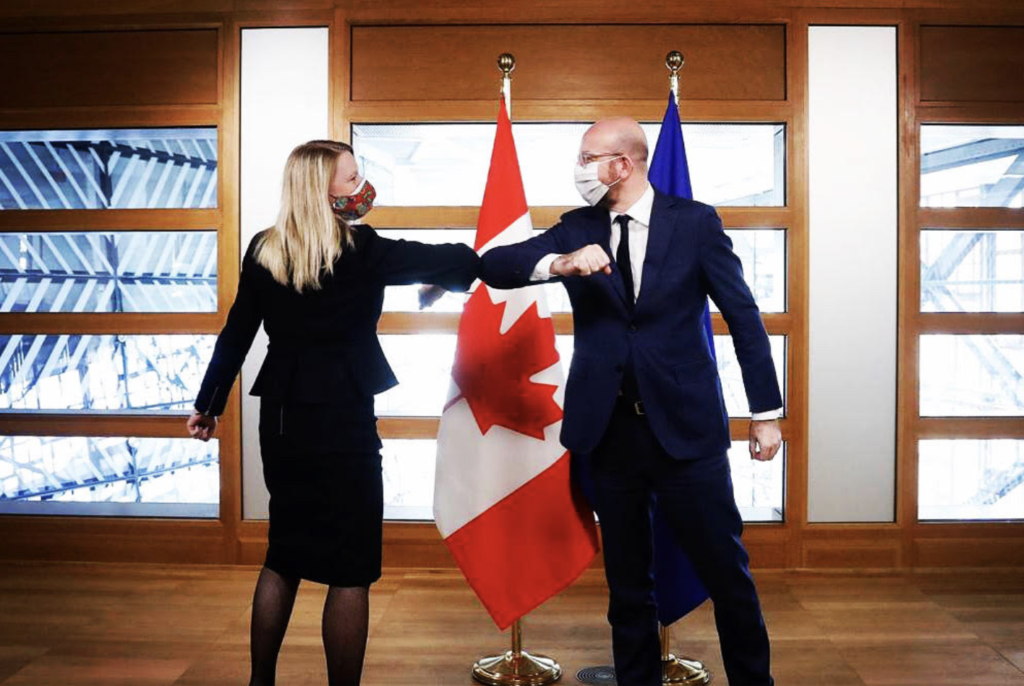 Ambassadorial accreditation ceremony with President of the European Council Charles Michel, February, 2021/EU image
2. Security and Defence
Canada is a committed member of NATO and this foundation remains critical. Strong bilateral ties are seen in military cooperation and expanding procurement from icebreakers with Finland to submarines with Germany.
The new Security and Defence partnership and Canada’s membership of the Security Action for Europe (SAFE) instrument are vital to Canada’s re-arming, which must proceed with all supply chain partners, not only the EU, and with as much Canadian IP and advanced manufacturing as possible.
The new Defence, Security and Resilience Bank (DSRB) headquartered in Canada and Luxembourg, is an important addition to our toolkit and EDC is now backing the defence sector. Encouraging more European members of DSRB is now critical to capitalizing the bank and scaling the acquisition of key capabilities including in AI-assisted drone and missile defence.
Given Canada’s unwavering support for Ukraine, including $25 billion in financial, military and humanitarian support, our next click is far more rapid scaling of advanced drone tech and collaboration on advanced systems to combat aerial attacks. We must also protect undersea cables that link our nations together, and forge more cooperation in the Arctic, building on our close and effective Arctic nation partnerships, including with Greenland and Denmark.
Cybersecurity is another critical area for cooperation. The reality is that hybrid attacks from state and non-state actors are proliferating. A much more robust architecture for cyber cooperation strengthens all partners.
3. Artificial Intelligence
The next revolution in business processes and productivity is rolling out with powerful AI models and agents performing complex tasks on behalf of humans. The speed of performance improvements in AI in 2026 has been incredible.
Canada and Europe share values and will join together with other democracies to foster effective AI governance frameworks and standards.
The challenge, as always, for Canadian AI companies, is to scale more rapidly. The product and intention may be strong, yet the ability to execute is weaker than what is required. The EU and Canada must create business alliances and AI partnership all along the value chain from original research to AI for enterprise to advance their AI strengths and ensure capabilities.
4. Investment in Key Sectors
Shortly before travelling to Strasbourg, Prime Minister Carney will host the Canada Investment Summit with new Invest in Canada Board Chair, Dominic Barton.
Attracting European investors in sectors including the critical minerals essential to renewable energy generation, electric vehicles and data storage must be top of the list. Canada and the EU must also anchor their savoir faire in the form of advanced manufacturing, which cannot be allowed to atrophy in the face of subsidized competition.
Upcoming political summits should be accompanied by tables of business leaders and researchers to advance AI and cyber-cooperation with a focus on advances in health, defence and energy. On the EU side, there are numerous chambers of commerce and the new Rhine Group, chaired by Mario Draghi. Canada needs an expanded group of bilateral and EU chambers, with business leaders assigned as champions with a priority on key investor nations including Germany, France, the Nordics, Netherlands, Italy and Belgium.
These leaders could report to the PM and presidents at their 2027 Summit, including with recommendations on term sheets that would make off-take and purchase agreements attractive in energy and minerals.
 At the Canada-EU Summit in Newfoundland with EU Commission President Ursula von der Leyen, November 2023/Courtesy
5. Extended Partnership of Middle Powers
The architecture of a new Canada-EU partnership could move into a more ambitious phase, building on CETA and the new Strategic Partnership Agreement. This could be a unique “variable geometry” form of associate membership status, such as membership in the European Economic Area (EEA) and a Norway-style partnership.
Membership in the EU is also worth a national debate, kicked off by Canadian Stanley Pignal in his Charlemagne piece in The Economist in early 2025, and debated since then in Policy and elsewhere.
Whatever form of deeper cooperation is forged, it can be a new model for the Carney vision that has gained such policy traction globally. Closer ties are developing between the Asia-Americas CPTPP, now adding the UK. The EU has observer status to the CPTPP. Increased cooperation with middle powers that align on interests and rule of law as an operating system requires an institutional home, a true commonwealth of independent nations that see mutual cooperation as a benefit not a weakness.
Elevating an Alliance is a Team Sport
As Canada considers next steps and builds on our PM’s excellent rapport with President von der Leyen, we must simultaneously deepen relations with the 27 member states that drive the EU agenda.
Canada must use the appointment of a strong, new EU Ambassador in Jonathan Wilkinson, and support back home from the experienced Personal Representative of the PM to the EU, former Clerk the Hon. John Hannaford, to push through more coordination.
Domestic departments in Ottawa must become even more engaged to deliver outcomes — from low Earth orbit (LEO) satellite and space cooperation to energy, and from new health innovations to increased transportation links by air and sea, including the critical driver of people-to-people ties: more direct flights and expanded port capacity.
Expanding Canada-EU ties will be a team sport, combined with sprints on key issues and a marathoner’s eye for the long-term. The prize? A stronger and more diversified economy and social ties for both partners.
An elevation of Europe does not mean neglecting other critical bilateral relations. An elevated European partnership signals that Canada, and the EU, always have options and are ready to seize them.
Ailish Campbell is the former Ambassador of Canada to the EU (2020 – 2025) and former Chief Trade Commissioner of Canada.