
Our Asia Pacific Foundation of Canada Series: Canada’s Critical Minerals Advantage

Canada’s 2022 critical minerals strategy was built for a particular world. That world has not held: China has tightened its grip on supply chains; protectionism is fraying the allied coordination that loosening it requires; and a turbulent relationship with Washington has added urgency Ottawa did not plan for. These shifts have left the Carney government with a framework that no longer fits the moment — and a geopolitical reality that demands more than incremental updates. This series examines Canada’s critical minerals agenda in terms of what Ottawa has actually delivered, how the strategy needs to evolve, and how deeper partnerships with key Indo-Pacific players can be mutually beneficial in achieving resilient supply chains. Welcome to our Asia pacific Foundation of Canada Series on Canada’s Critical Minerals Advantage.
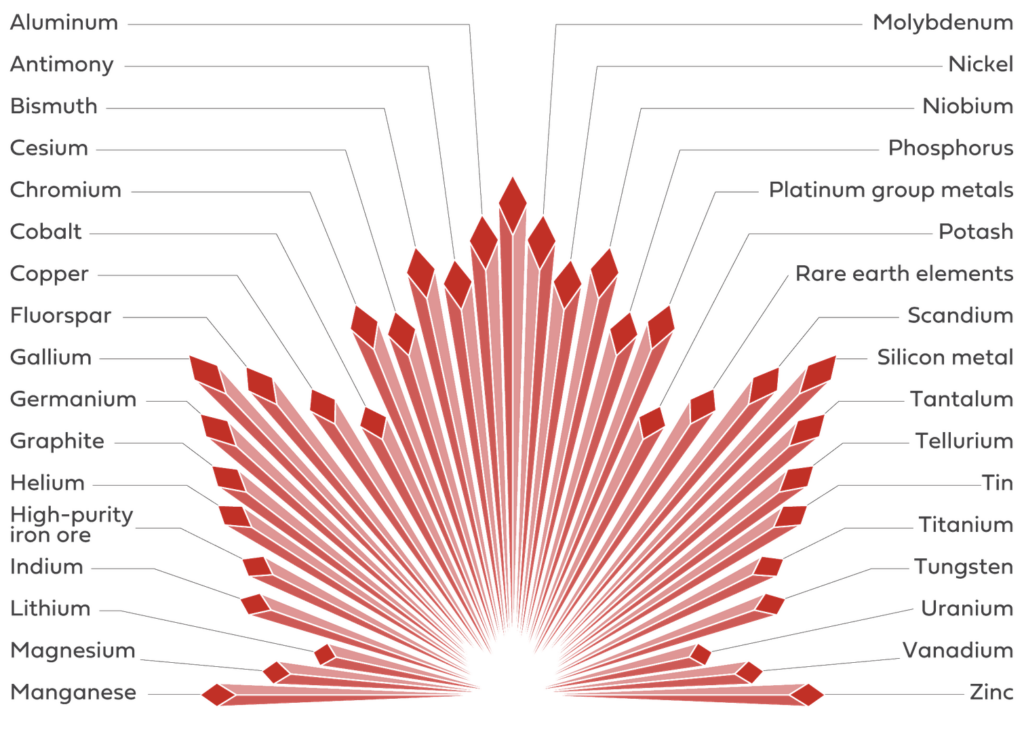
The Government of Canada’s critical minerals list of 34 minerals and metals:
China’s export controls, a more interventionist G7 agenda and Washington’s widening network of mineral partnerships have transformed the market in which Canada’s critical-minerals strategy must operate. “Ottawa now needs to connect domestic industrial policy, international partnerships, and its North American economic relationship into a single strategy,” writes APF Vice-President Research & Strategy and Policy Contributing Writer Vina Nadjibulla. “Canada has helped shape the international conversation on critical-mineral resilience. The next task is to demonstrate that it can build.” Here’s Vina Nadjibulla with Building Canada’s Place in the New Critical Minerals Order.
Since 2025, Canada and the European Union have been doubling down on the transatlantic relationship — from trade to defence to the securing of reliable and sustainable critical minerals supply chains. As deputy director in the European Commission’s Directorate General for the Internal Market, Industry, Entrepreneurship and SMEs, Peter Handley and his team negotiated the 2021 EU-Canada Strategic Partnership on Critical Raw Materials as well as the EU’s 2024 Critical Raw Materials Act. “Canada, overreliant on the U.S. market, urgently needs to diversify,” writes Handley, “while EU companies need to become much more active as offtakers and investors to secure minerals and refined metals from Canada, the EU’s reliable and stable partner in North America.” Here’s Peter Handley with On Critical Minerals, Canada and Europe Meet in the Midstream.
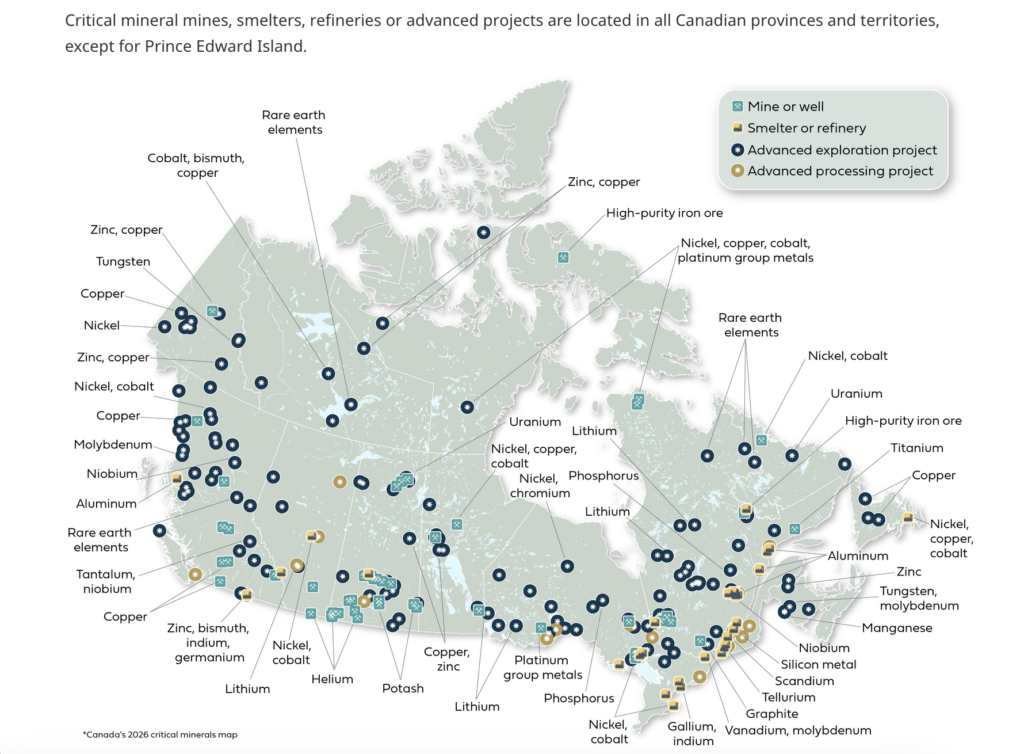
Critical mineral development across Canada:
Amid a new focus on the middle-power “variable geometry” that Prime Minister Mark Carney laid out in Davos, Canada and South Korea provide a classic example in the realm of critical minerals. “Canada brings deep resource potential and low-carbon power, reinforced by its strategic position within North American manufacturing networks,” writes Asia Pacific Foundation of Canada Senior Research Specialist Sun Ryung Park. “South Korea brings the industrial demand and processing expertise needed to turn those advantages into supply.” Here’s Sun Ryung Park with Canada and South Korea Need a Critical Minerals Partnership that Delivers.
Critical minerals constitute a policy-defined category rather than a geological one: governments designate minerals as critical based on their economic importance and supply risk. Rare earth elements (REEs) are one category on this list. “Canada possesses substantial REE resources and a growing portfolio of extraction and processing projects, but most have yet to reach commercial scale,” write Anastasia Ufimtseva and Sun Ryung Park. “Japan, meanwhile, can provide the patient capital, technical expertise, and long-term offtake commitments needed to advance these projects.” Here are Anastasia Ufimtseva and Sun Ryung Park with Building Resilience: The Canada-Japan Rare Earths Supply Chain.
On critical minerals, “Canada and Australia often behave less like partners than like parallel versions of the same country,” writes critical minerals expert and geopolitical analyst Vlado Vivoda, a member of APF Canada’s Canada-Indo Pacific Critical Minerals Hub. “The result can be competition where coordination would serve both better.” Here’s Vlado Vivoda with From Competition to Coordination: Canada, Australia and Critical Minerals.
We’ll be posting pieces to this series throughout 2026.
The Asia Pacific Foundation of Canada is Canada’s only national public-purpose institution dedicated exclusively to Canada-Asia engagement.
Policy magazine serves as an independent, nonpartisan platform for insight and analysis on Canadian, U.S. and international politics and public policy, written by policy and political professionals.