
From Competition to Coordination: Canada, Australia and Critical Minerals

This piece is part of our Asia Pacific Foundation of Canada Series: Canada’s Critical Minerals Advantage.
By Vlado Vivoda
September 13, 2026
Canada and Australia do not lack reasons to cooperate on critical minerals. On the latest available data, together they produce about one-third of the world’s mined lithium and uranium.
Both have strong mining sectors, high environmental and labour standards, trusted political institutions, and close security relationships. What they still lack is a mechanism for deciding which critical-minerals projects come first, where each stage of production should occur, who will finance them and who will buy the resulting material.
Critical minerals policy is no longer mainly about finding deposits. Success is not a count of strategies, memoranda or ministerial meetings. The test is whether two producer countries can turn resources into processed, qualified, and commercially durable supply for manufacturers.
The political foundations of the bilateral critical-minerals relationship are stronger than is sometimes recognized. On November 1, 2025, Canada and Australia signed a Joint Declaration of Intent that called for the two countries to move “from competition to collaboration.” It established an annual ministerial process and a bilateral special-envoy mechanism.
The envoys were tasked with mapping the two countries’ value chains and identifying opportunities including reciprocal project offtakes and co-investment in each other’s stockpiles. The declaration also calls for blended financing using both countries’ public investment and export-finance tools.
Prime Ministers Mark Carney and Anthony Albanese deepened that architecture in March 2026, during the first bilateral visit to Australia by a Canadian prime minister in nearly two decades.
Australia joined the Canada-led Critical Minerals Production Alliance, which G7 leaders broadened and renamed the Critical Minerals Resilience and Production Alliance in June. The two governments also committed to stronger collaboration between Australia’s Critical Minerals Strategic Reserve and the Canadian instrument then known as the Critical Minerals Sovereign Fund. They announced a mining-skills exchange pilot and a bilateral work plan to be launched later in 2026. The architecture exists; the work plan is where it acquires industrial purpose.
Peril of Parallel Strategies
On critical minerals, Canada and Australia often behave less like partners than like parallel versions of the same country. Their respective Canadian Critical Minerals Strategy and Australian Critical Minerals Strategy seek investment across the value chain, aim to move beyond extraction into downstream processing, and seek to connect mineral production to advanced manufacturing.
Both court the same allied governments, manufacturers, and institutional investors. Both back projects facing high capital costs, uncertain demand, and prices set by concentrated incumbents. The International Energy Agency estimates that capital expenditure on mining and refining outside the dominant producing country is typically 50 per cent higher.
The result can be competition where coordination would serve both better. Two governments subsidize similar facilities and neither achieves commercial scale. Projects chase the same customers while essential stages of the value chain remain missing. Announced processing capacity can remain commercially stranded because feedstock specifications or customer qualification were never resolved.
This is the central weakness in much of allied critical minerals policy. A mine is treated as a supply chain, and nameplate capacity is mistaken for available supply. Yet, leverage increasingly sits between extraction and final manufacturing: chemical separation, refining, metal and alloy production, component manufacturing, and qualification by the downstream user. The problem is becoming more acute: supply concentration in refining has continued to rise for most major energy minerals.
Neither country needs to reproduce every stage of every critical-minerals value chain. Neither should settle for being a quarry for industries located elsewhere. The answer is selective specialisation. Each keeps sovereign capability where it is strategically indispensable and places other functions where energy, infrastructure, skills, technology, feedstock, and customer access line up best.
The two countries’ similarities can obscure how well they complement each other. Canada is embedded in North American manufacturing and has direct access to Atlantic and European markets, large hydroelectric resources, experienced mining-finance institutions, and strength across uranium, potash, nickel, cobalt, and graphite. Australia sits within the Indo-Pacific industrial system, close to Japanese and South Korean customers, with long experience in hard-rock mining and major lithium and rare-earth resources alongside growing processing capability.
Together, they can connect Atlantic and Pacific markets and reduce dependence on any single customer, financier, or processing jurisdiction.
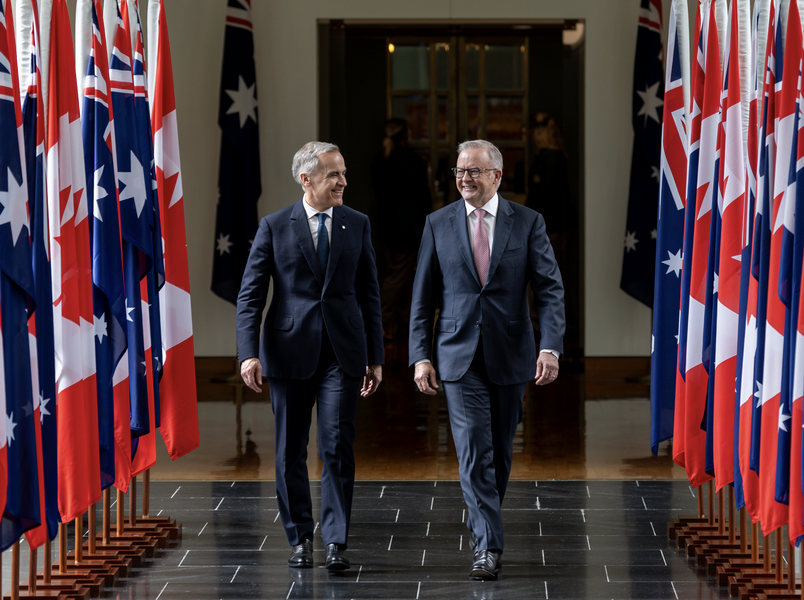 Prime Minister Mark Carney and Prime Minister Anthony Albanese in Canberra, in March, 2026/PMO
A Bilateral Delivery Compact
There is precedent for this kind of coordination, even if no existing model maps perfectly onto critical minerals. Since 1956, the Canada–United States Defence Production Sharing Agreement has treated industrial capacity on either side of the border as complementary, using coordinated procurement and reciprocal access to support an integrated production base rather than requiring each country to duplicate every capability. The Australia–Japan relationship offers a parallel lesson from the resources sector. Long-term Japanese offtake and investment helped make major Australian LNG projects commercially viable by linking production to committed customers and durable demand.
A Canada–Australia critical-minerals arrangement could combine these lessons: industrial specialisation and reciprocal access, alongside investment tied to production and durable demand. The practical vehicle could be a Critical Minerals Delivery Compact that turns the agreements the two countries have already signed into an operating framework. Rather than creating another treaty or large new secretariat, the compact could give substance to the promised bilateral work plan. A small delivery unit, built around the special-envoy mechanism already established in the declaration and reporting to the annual ministerial process, could perform four functions.
First, produce a shared map of priority supply chains. This means going beyond comparing national lists of “critical” minerals. The unit could identify vulnerabilities at each stage: mine development, processing, refining, transport, technology ownership, skilled labour, customer qualification, and end-user concentration. Priorities could reflect the severity of the bottleneck and the importance of the downstream system, rather than tonnage alone. A smaller project that closes a missing processing or qualification stage can be strategically more valuable than a large deposit that leaves the bottleneck untouched.
Second, create a joint project pipeline. The financial instruments are no longer hypothetical. Canada launched the C$2-billion Canada Critical Minerals Accelerator (the instrument originally announced as the Sovereign Fund) on July 7. Its first strategic agreement brought government offtake negotiations together with a proposed equity-like investment in Teck’s Trail. B.C. smelting and refining complex. Australia’s A$1.2-billion Critical Minerals Strategic Reserve can use offtake agreements, trade forward contracts, aggregate demand, selectively stockpile and offer contracts for difference, initially for antimony, gallium, and rare earths.
Used together with export-credit agencies, these tools could close the whole commercial structure around a project: loans, equity, price floors, reserve purchases, and reciprocal offtakes. That is worth more than another isolated grant. A Canadian project might receive Australian-backed offtake. An Australian processor might qualify Canadian feedstock. Each government reduces its exposure without needing every facility at home.
Third, make qualification a policy priority. Producing material does not make it strategically available. It must meet the purity, consistency, and performance requirements of a specific battery, magnet, semiconductor, aerospace or defence manufacturer. In advanced-battery supply chains, the U.S. Department of Energy found that suppliers may wait 12 to 18 months for qualification after building a full-scale facility. The compact could bring manufacturers into projects much earlier, co-fund pilot production and testing, and develop reciprocal qualification pathways where commercially possible.
Shared approaches to traceability and environmental performance could also help responsible production weigh more heavily in procurement decisions. The G7 has already set out a road map for standards-based critical-minerals markets. Standards could create markets. Another reporting burden detached from purchasing helps no one.
Fourth, provide a resilience layer. The two governments could share information on inventories, production schedules, and project delays. They could coordinate reserve acquisition and release rules, open trade in secondary and recyclable materials, and expand the skills pilot into processing, metallurgy, and industrial project delivery.
Indigenous participation belongs in this structure from the beginning. Both countries have learned, sometimes painfully, that formal consultation does not amount to durable partnership.
Indigenous equity, procurement, employment and governance arrangements are part of project design and investment readiness. They ought not wait until the commercial model is settled. These arrangements would give practical effect to the bilateral declaration’s commitment to involve Indigenous partners and respect Indigenous rights, and to parallel benefit-sharing commitments in Canada and Australia.
Measure Material, Not Meetings
The compact could publish a short annual delivery scorecard: projects reaching final investment decision, financing mobilized, offtake coverage, processing yields, customer qualifications completed, tonnes of non-dominant-source material delivered, and reductions in exposure to single points of failure.
It could also disclose where projects have stalled, and why. Bilateral cooperation is too often judged by activity. Meetings are held, working groups are established and agreements are renewed, while the material remains years from production or fails to meet customer specifications.
A Canada–Australia compact would not replace cooperation with the United States, Europe, Japan, South Korea or other Indo-Pacific partners. It would give those wider arrangements a reliable bilateral core. Canada brings access to North American and Atlantic industrial systems. Australia brings deep Indo-Pacific relationships. Together they can offer partners geographically diversified projects governed by comparable standards and supported by coordinated public instruments.
Canada and Australia are frequently described as natural partners. In Canberra, Carney went further and called the two countries “family”. But geology and affinity do not produce industrial capability. Partnership becomes much more meaningful when it helps determine who will invest, who will process, who will buy, and how risk will be allocated when the market turns.
The two countries have declared their intention to move from competition to collaboration. The work plan due later this year will show whether they mean it. A Critical Minerals Delivery Compact would give the declaration practical meaning, and a way to measure cooperation in qualified material rather than diplomatic language.
Dr. Vlado Vivoda sits on the Advisory Council of APF Canada’s Canada-Indo Pacific Critical Minerals Hub. He is also an Honorary Fellow at University of Queensland’s Sustainable Minerals Institute and an Affiliate at Deakin University’s Centre for Future Defence and National Security.