
Mark Carney’s ‘Europe Trilogy’: Mapping an Alliance for the Future
This piece is part of Our Policy Series on the Canada-EU Relationship.
September 25, 2026
For the Canadian community in Brussels — those of us in diplomacy, law, business, defence and security who work every day in a context defined by the Canada-EU bilateral relationship, Prime Minister Mark Carney’s recent trip to Strasbourg was, to coin a phrase, a hinge moment.
Carney’s presence at European Commission President Ursula von der Leyen’s State of the European Union (SOTEU) address — the first foreign leader to be invited — and his own speech to the European Parliament the next day moved the relationship forward in ways that would have normally taken years or been impossible to achieve.
Strasbourg is in France but on the border with Germany. That it was chosen as the seat of the European Parliament is no accident. In the 19th and 20th centuries, it was a fault line in the Franco-German rivalry, passing between French and German control several times.
In his speech, Carney evoked the world wars that Canadian soldiers fought and sacrificed in; the blood of Canadians that lives in the soil of the battlefields of Europe is such an enduring image because it is true, and because it says so much about how deep our connection goes.
Strasbourg sits at the edge of the Vosges Forest, and so the analogy of the acorn and trees the Prime Minister used in his speech was apt. While Carney called on the spirit of Goethe, my own thoughts were of another European poet, Dante Alighieri, whose immortal work Inferno begins with the following lines:
In the middle of the journey of our life,
I found myself in a dark wood,
For the straight way was lost.
The loss of the straightforward path amid the global bedlam produced by anti-democracy power consolidation has been a central theme of Carney’s since his Davos speech. His message in Strasbourg, and von der Leyen’s the day before, was not just that Canada and Europe need to find a new path, but that it is one we will build together, and which others can join as the world moves forward.
Carney’s speech to the European Parliament can be seen as part of a trilogy of its own, the “Europe Trilogy”. It begins with the Davos speech, where he outlines the problem (i.e., that the world is in the midst of a rupture, not a transition, and we can no longer travel on the road we’ve been on).
As with most second volumes of a trilogy, the Prime Minister’s speech at the European Political Community Summit in Yerevan, Armenia in May, is lesser known, but helps advance the story. Speaking to European leaders, Carney introduced key concepts like “sovereign capabilities” and “complementarity” to help address the problem he identified in Davos.
He extended the concept of strategic autonomy to mean more than food, energy and defence. He also re-iterated his belief that Canada is “the most European of non-European countries” and that Canada was bound to Europe by history, values, and trust.
The third part of Carney’s Europe trilogy came on September 17th. In Strasbourg, he developed the themes of the Yerevan speech (i.e., values, sovereignty and resilience, complementarity), but focused on building a new partnership with Europe, an “Alliance for the Future”, to address the imbalances he set out in Davos and that could serve as a template for other like-minded countries.
Beyond CETA
The ambition of Carney’s Strasbourg speech is clear. It is for Canada and the EU to move beyond the Canada-EU Comprehensive Economic and Trade Agreement (CETA) – a comprehensive agreement, but a trade agreement nonetheless – and forge a new dimension of partnership, one revolving around sovereign capabilities.
For some time, I have referred to the Canada-EU relationship as a “CETA-Plus” model, a stacking of new partnership agreements on top of the CETA architecture. The relationship is already institutionally supported with over 100 touchpoints involving CETA, the Strategic Partnership Agreement and a growing list of sectoral partnerships between Canada, the EU, and EU member states.
Taken individually, these arrangements hold a lot of promise; collectively, they are disjointed, lacking overall coherence and structure. The vision set out in Strasbourg is for a far more focused and strategic alliance.
Terra Incognita
In the lead-up to Strasbourg, leaders were at pains to define and name this prospective new relationship. On the eve of the SOTEU, Carney referred to it as an alliance. Von der Leyen went further in her own address, calling it an “Alliance for the Future” and inviting Canada to become the EU’s first associate member, something that took many by surprise. Though she spoke only of “opening the door” to such an invitation, it caused waves on both sides of the Atlantic.
The term “Associate Member” is undefined as a matter of EU law. Some EU member states, notably Germany, had proposed it as a new and more flexible category of EU membership, including for Ukraine, which rejected it. However, legally and politically speaking, the term is terra incognita.
There has been much speculation as to why the Commission President chose to use the term. Yet, as reporting has made clear, the use of the term was debated before her speech, so its inclusion was intentional and therefore deliberately provocative. By employing the term in her SOTEU, von der Leyen challenged Europeans on the scale of the ambition with a name that she knew to be politically charged. A term like “CETA Plus” simply was not up to the task.
That the phrase was directed more at a European audience than a Canadian one may explain the Prime Minister’s own restrained response. Rather than adopt the “associate member” label, Carney referred to it as an “Alliance for the Future”. It was an important signal to Carney and the Canadian public that the European leadership was ready to match his stated ambition, and that whatever name and shape this alliance would take, it would be defined together.
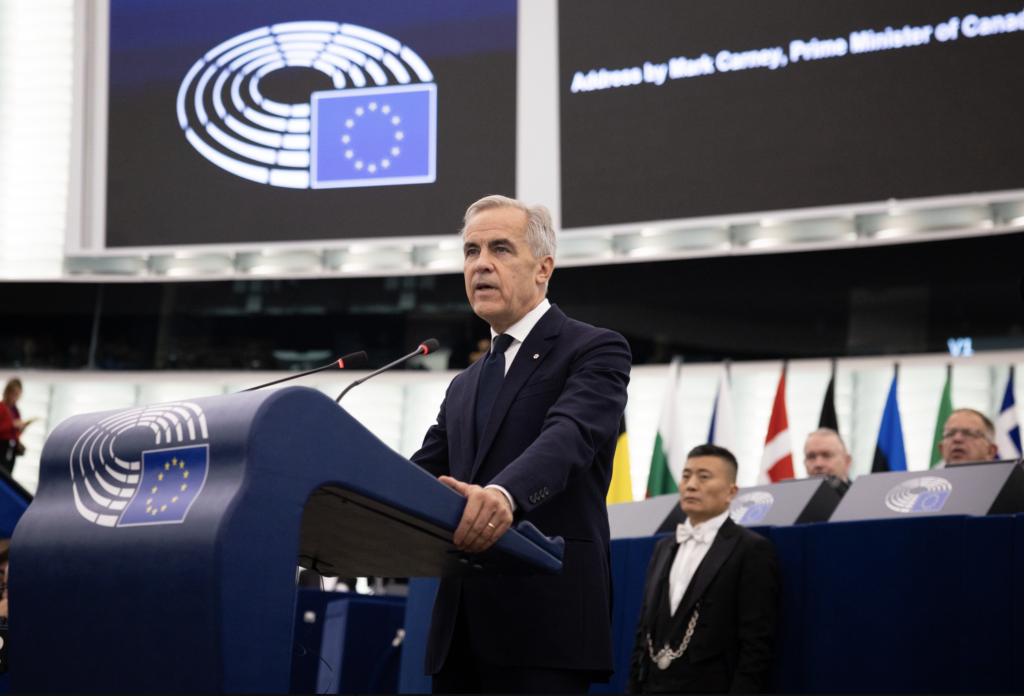 Prime Minister Mark Carney addressing the European Parliament on September 17, 2026/Carney X
A Member by Any Other Name
More details of the new alliance can be expected at the Montréal Summit in October, but Strasbourg provided the outline. First, Canada is not joining the EU, a point that should be settled by now. Instead, an Alliance for the Future would be characterized by deep, sectoral, functional integration rather than institutional membership.
But that kind of integration still needs an organizing logic of its own. The key to such an alliance is the concept of complementarity. As Carney stated, “Where our strengths differ, they complement. Where they overlap, they create scale.”
This is meant to counter both the self-sufficiency narrative and the assumption that deals must be zero-sum. Some will point to the imbalance of scale (i.e., the EU economy is nearly nine times the size of Canada’s) and argue that deeper alignment will mean Canada adhering to European rules. While the asymmetry is real, the outcome is not inevitable.
Complementarity is about mutual necessity and not equality of size (i.e., a partner in substance need not be of comparable size). The goal is to ensure that neither side can simply dictate terms to the other, and together, build resilience against being dictated to by others.
So, what are the areas of complementarity? Looking at Carney’s Strasbourg speech, six stand out:
- Raw Materials. Canada holds deposits of key critical minerals. An alliance would help meet Europe’s demand for these minerals and Canada’s need for advanced processing capabilities, while building out complete value chains.
- Energy. Canada could provide Europe with LNG and hydrogen while Europe can help supply clean energy technologies.
- Digital & AI. Canada and the EU can pool sovereign compute capacity and work together on AI safety protocols and common standards.
- People to People. The Prime Minister called for greater mobility, especially for young people to live, work and study across the Atlantic. This work is already in progress with Canada’s association with Horizon Europe and early talks for Canada to join Erasmus+.
- Security and Defence. Although Canada’s defence industry already has preferential access to EU joint procurement through SAFE (based on the Canada-EU Security and Defence Partnership), Carney listed defence industrial capacity as an area for deeper cooperation.
- Financial Services. Carney’s call to explore an integrated Canada-EU market for financial services is a potentially significant element, not surprising given the Prime Minister’s former roles as a central banker in both Canada and the United Kingdom. For Carney, it would broaden consumer choice and lower the cost of capital while preserving financial resilience.
Von der Leyen’s own vision was deeply aligned with the Prime Minister’s, particularly on energy, critical minerals and batteries, defence industrial cooperation, AI, quantum and cybersecurity. Her list did go further on ideas for intelligent manufacturing, a standalone “tech alliance” and a flagship joint Arctic project.
Taken together, these areas point to something more specific than merely “building on CETA”, but far narrower than EU membership.
In some cases, deepening the relationship will mean Canada formally joining existing EU programs, as it already has with SAFE and Horizon, and may do with Erasmus+. It will come at a cost and, more specifically, a financial contribution from Canada. In other cases, new institutional arrangements will be required. None of this necessitates a new category of EU membership, as existing institutions can be better utilized or new discrete ones established.
The Moonshot Moment
I have recently referred to last week’s events in Strasbourg as a “moonshot” moment. This is not meant as hyperbole. If Canada and the EU are to deepen their relationship, then the moment calls for this type of ambition, a point that was underscored by former Canadian Ambassador to the EU Ailish Campbell in her contribution to Policy‘s Canada-EU Series, when she recommended “more institutional connectivity than the predominantly bureaucratic engagement that has dominated the relationship to date.”
At the political level, that deepening is already visible beyond the leaders’ summit itself. Already, senior Canadian government ministers (i.e., Foreign Affairs Minister Anita Anand, Finance Minister François-Philippe Champagne, and Trade Minister Maninder Sidhu) are being invited to participate directly in EU meetings alongside their European counterparts, with more expected to follow. Each invitation is, in its own way, a way of “opening the door” to deeper Canada-EU partnership.
There should also be more engagement between Canadian and European parliaments. This helps share the load of bridge-building and also brings a degree of accountability to the relationship. The European Parliament’s recent announcement that it will open a liaison office in Ottawa is a welcome step in that direction.
Finally, stronger business-to-business linkages are needed, both across the Atlantic and within the wider Canada-EU institutional architecture. The CanChams of Europe network, of which I am proud to be a part, is an example. It is one that continues to grow, with new Canadian bilateral chambers recently established in Slovakia and Sweden. These bilateral chambers play an important role in identifying, supporting and deepening business-to-business ties, particularly for SMEs, and should be seen as partners of government as we deepen this relationship.
Of course, none of this will mean much without addressing frictions that already sit beneath the ambition. In the case of agriculture, Carney’s own call for “seamless” trade was tellingly limited to non-agricultural goods, perhaps a tacit acknowledgement that Canada and the EU will continue to agree to disagree.
A more difficult friction to set aside is the rise of Buy Canadian and Buy European measures, which risk eroding one of CETA’s signature achievements, namely the reciprocal opening of access to each side’s public procurement market. As I and others have warned, Canada’s own Buy Canadian framework and the EU’s increasing use of European preference measures both threaten that access.
If a deeper Canada-EU alliance on sovereign capabilities is to be achieved, then this issue, and others that affect market access, will need to be managed.
Dante wrote his trilogy at a time of transition, from the High Middle Ages to the Renaissance. For him, the dark wood of the Inferno is not a dead end. It is a place where the traveller learns that the straight path forward is closed, and that another way must be found.
This was a core message of Prime Minister Carney’s speech at Davos and a theme he has carried forward in the other speeches of his trilogy, including the one in Strasbourg. For Carney, a new path would be built by Canada and the EU together, voluntarily, as partners. And, while the road is still being mapped, it will be wide enough to invite other travellers.
Strasbourg supplied the vision and elevated the ambition. The challenge now is to produce deliverables. Judged against the complementarity that featured in both Carney’s and von der Leyen’s speeches, we can expect some tangible outcomes on sovereign capability and people-to-people engagement from the Leaders’ Summit in Montréal.
Mark Carney set this up through his “Europe Trilogy”. Montréal is where the path will become clearer.
Policy Contributing Writer Mark Camilleri is President and founder of the Canada EU Trade and Investment Association (CEUTIA). He is a Brussels-based Canada and EU regulatory lawyer and Special EU Advisor to the Business Council of Canada.