Our Policy Coverage of the Middle East War
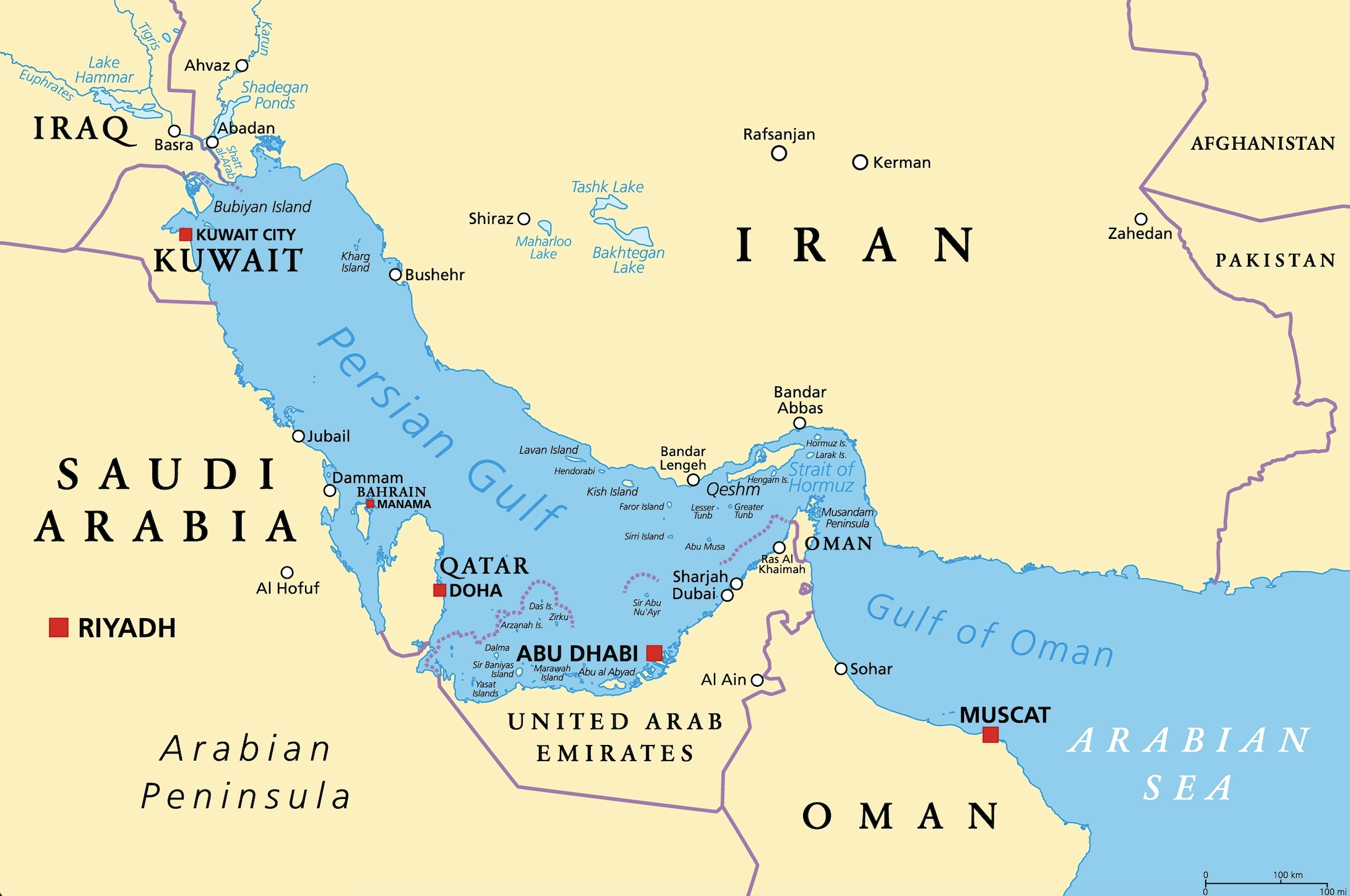
The Strait of Hormuz, the world’s busiest oil shipping artery, currently being blocked by Iran/Shutterstock
President Donald Trump’s campaign to redefine American power has escalated with a war in the Middle East triggered by the U.S.-Israeli bombing campaign against Iran launched on February 28th and the assassination of its supreme leader, Ayatollah Ali Khamenei. That operation expanded within days to all all-out regional war, with retaliatory strikes by Iran on Gulf State targets, Israel attacking Lebanon, the key shipping artery of the Strait of Hormuz blocked, and oil prices run amok. Meanwhile, the search for a coherent casus belli continues. We have a selection of must-read pieces from Policy writers.
Five hundred kilometres northwest of the Strait of Hormuz, 25 km off the coast of Iran in the Persian Gulf, sits Kharg Island. Sometimes called “the forbidden island”, Kharg is an oil export and storage hub through which passes 90% of outbound Iranian oil. As the war in the Middle East hit its two-week mark, Donald Trump had begun targeting the key strategic asset. “The military action is just the overture,” wrote Policy Columnist Fen Osler Hampson on March 15th. “The real play will be financial. We should remember that Trump’s transactional universe is governed by two rules: grab the best piece of real estate at a discount, then sell it and make a fortune.” Here’s Fen Osler Hampson with Middle East War: The Strategic Value of Kharg Island.
On what is now being called the “third Gulf War”, our friends at The Scowcroft Group have filed a Policy/Scowcroft Group Snapshot from Washington on President Donald Trump’s rhetoric on a short war and the realities of the conflict. “Until the U.S. sufficiently degrades the potential for Iran to close the Strait of Hormuz, hit critical infrastructure in the region, target U.S. forces and vessels, and threaten the safety of U.S. diplomats and civilians in the region, the U.S. military will likely need to stay engaged.” From March 12th, here’s Scowcroft Group Snapshot: Trump May Get Neither Regime Change, Nor a Short War.
Former United Nations Ambassador Bob Rae‘s Policy column of March 11th looks at the shrinking plausibility of the various casus belli advanced by the Trump administration for its war in the Middle East. “Trump’s Middle East envoy, Steve Witkoff, has said that Trump’s actions have stopped Iran from building 30 or 40 nuclear bombs ‘within a year’,” writes Rae. “There is no evidence to back up that statement.” Here’s Bob Rae with The War That Must End.
As the price of oil shot up to nearly $120 a barrel on March 9th, Policy Columnist and McGill Institute for the Study of Canada Director Daniel Béland filed a brief history of the energy and domestic U.S. politics angles of the escalating conflict. “Economic fears related to oil prices stemming from this war,” writes Béland, “might create strong incentives for the president to pull the plug on U.S. military operations.” Here’s Daniel Béland with Oil Prices, US Politics, and the New Gulf War.
With the major trade-artery choke point of the Strait of Hormuz a battleground, Policy contributor and Forum of Federations President Rupak Chattopadhyay filed a tour d’horizon on the wider supply chain implications of the shipping paralysis. “This is not the 1970s,” writes Chattopadhyay. “The strait is a critical artery, not only for crude but also for the downstream industrial inputs that now underpin modern economies.” Here’s Rupak Chattopadhyay with Beyond Oil: The Wider Supply Shocks of the New Gulf War.
As the conflict widened through early March, its impact on the Strait of Hormuz made trade in general and the price of oil in particular major stories. Policy columnist and Expert Group on Canada-US Relations Co-Chair Fen Hampson sees an opportunity for Canadian Prime Minister Mark Carney in the CUSMA negotiations, and the political history of oil crises. “In an ironic twist,” writes Hampson, “this colossal disaster may have just handed Prime Minister Mark Carney the ultimate ‘get out of jail’ card in his difficult relationship with Trump.” Here’s Fen Hampson on March 9th with Carney’s New CUSMA Cards: Trump’s Gulf war and the Ghost of Jimmy Carter.
From former United Nations Ambassador and Policy Columnist Bob Rae, we have an essential piece on the context and consequences of Donald Trump’s latest unilateral military action. “No matter how many times we tell ourselves differently,” writes Rae, “we need to confront the fact that the United States under its current president and administration is in no position to lead us anywhere good.” Here’s Bob Rae on March 4th with Trump’s Consequential War.
As the world processes the implications of Donald Trump’s Middle East war, Canadian Prime Minister Mark Carney has presented the most befuddled response among G7 leaders — arguably due in part to the perils of proximity. “While it might be tempting to attribute the Prime Minister’s evolution on this question to his political inexperience,” writes Policy Editor Lisa Van Dusen, “it is also the product of unprecedented circumstance; of the military and security version of dealing with a suddenly-more-Hyde-than-Jekyll superpower neighbour that has similarly stymied trade policy by violating all the rules of economic engagement.” Here’s Lisa Van Dusen on March 4th with Game Theory vs. ‘Death and Destruction’: Mark Carney’s Trumpian Dilemma.
From Policy Columnist and co-chair of the Expert Group on Canada-US Relations Fen Osler Hampson, a look at the implications for the looming CUSMA review of Carney’s needle-threading position on the U.S.-led war. “One can almost hear Trump accusing Carney of failing to live up to his own words about standing up to dictators,” writes Hampson. “More tariffs and other punitive measures would likely follow, as Canadians have learned, when the president is piqued.” Here’s Fen Hampson with Carney’s Iran Trap: How Trump’s War Could Become Canada’s Problem.
From former Ambassador to Russia, the EU and Italy and former high commissioner to the UK Jeremy Kinsman, a look at a show of force as performative as the rest of Trump’s presidency, this one to register a new American approach to power. “This operation is less comparable to previous American military interventions than to the ‘massacre of the heads of the five families’ scene in the Godfather,” writes Kinsman, “the luring of parties to a bloodbath by a new don to consolidate power under the guise of a ‘bygones’ dinner.” Here’s Jeremy Kinsman with Trump’s ‘Don-roe’ Doctrine for a Whole Other Hemisphere.
From former Canadian Ambassador to the United Nations Paul Meyer, who serves as our Policy expert on nuclear disarmament (including on Iran’s nuclear capability), a piece filed hours after the bombs began falling on Tehran on February 28th, when Prime Minister Mark Carney had made his first controversial statement about the U.S.-led action with Foreign Affairs Minister Anita Anand. “The Carney-Anand statement,” writes Meyer, “far from challenging a world order that reflects Thucydides maxim that ‘The strong do what they can and the weak suffer what they must’, appears to be endorsing it.” Here’s Paul Meyer with Trump’s Iran Strikes and Carney’s New World Order Tightrope.
In Policy background links on Iran and the Middle East:
Former United Nations Ambassador and Simon Fraser University professor Paul Meyer from July/25 with
The Future of Iran’s Nuclear Program: Could Withdrawal from the NPT be Next?
From University of Ottawa professor Peter Jones from June/25: Will Iran be Donald Trump’s ‘Forever War’?
From Centre for Israel and Jewish Affairs VP Nico Slobinsky in July 2025: 31 Years After the AMIA Bombing, Canada Must Confront the Iranian Threat.
From 2022 by Policy editor and publisher Lisa Van Dusen, Iran’s Social Revolution: A Policy Q&A with Homa Hoodfar.
And, our Middle East Coverage Package of key content from the past several years.
Many thanks to all our Policy contributors, sponsors, readers and supporters.