
The New Multilateralism: Our Policy Package on the Évian G7
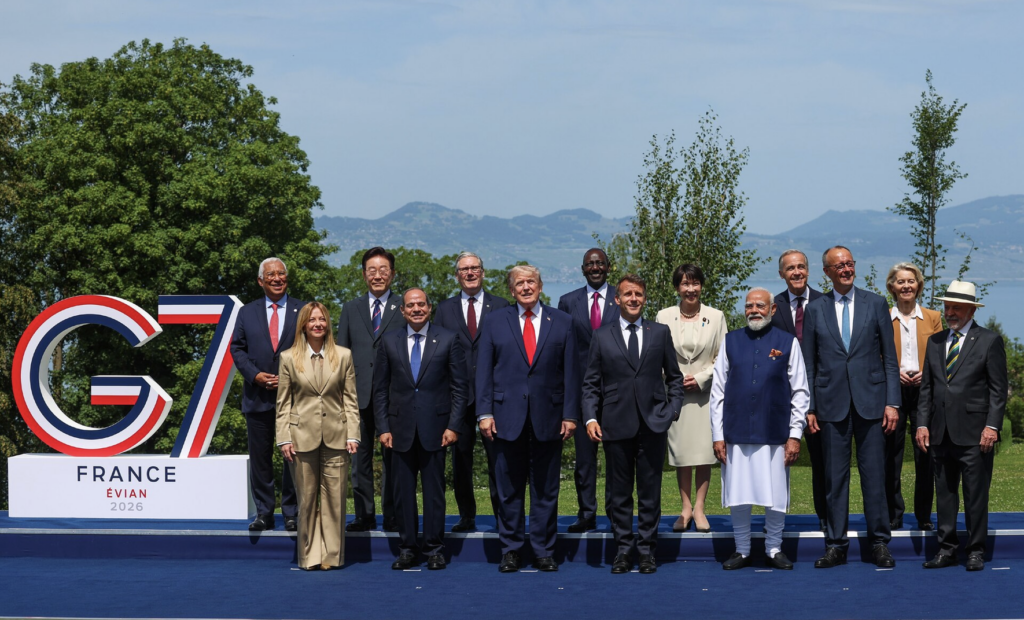
The 2026 G7 family photo/GODL
The 52nd G7 summit unfolded in Évian from June 15th-17th amid a state of ongoing geopolitical transformation not seen since the Cold War. The summit was less a clash of world orders than a melding of them, with a range of leadership styles represented in the family photo from full democracy to flawed democracy to authoritarian, per their Economist Democracy Index tags. President Donald Trump showed up this time with a tentative deal to end the war he started against Iran on February 28th and signed it at Versailles as a coup de grâce. Prime Minister Mark Carney spoke with Trump in a number of pull-asides but there was no official bilateral, which spared both a barrage of CUSMA questions during the requisite pool spray. As the dust settles, we open our package with Prime Minister Mark Carney’s G7 closing newser from Évian.
In post-Évian pieces:
Once again this year, Ukrainian President Volodymyr Zelensky was at the G7 leaders meeting, though his role has arguably evolved since 2022 from petitioner to statesman. Policy Columnist and McGill University Political Science Professor Maria Popova notes in her G7/Ukraine takeaways piece that even Trump is acknowledging that Vladimir Putin’s illegal war has failed. “For four years,” writes Popova, “Moscow’s strategy relied on two pillars: the historical axiom that attrition favors the larger demographic mass, and the cynical wager that Western democratic resolve would inevitably fracture. Both pillars have crumbled.” Here’s Maria Popova with One Marquee G7 Takeaway: The Beginning of the End for Russia’s War.
In May, the Montreal Institute for Global Security dropped the report, Guarding the G7: Countering Beijing’s Influence Operations. Policy contributor and MIGS Executive Director Kyle Matthews co-authored that report. In his post-G7 piece, Matthews exhorts the grouping of democracies to counter China’s systemic attacks with unity. “Despite President Donald Trump’s transactional and belligerent approach to foreign policy and his frequent criticism of America’s closest allies,” writes Matthews, “the G7 cannot afford to fracture.” Here’s Kyle Matthews with The G7 Must Remain United.
While Carney and Trump had no official bilat in Évian, a hot-mic moment between the two during which Carney explained Canada’s 49,000-vehicle import cap on Chinese EVs made headlines. Policy Contributing Writer Vina Nadjibulla, VP research at the Asia Pacific Foundation of Canada, banged out a comprehensive dissection of Industry Minister Mélanie Joly’s four conditions for Chinese EV manufacturers ahead of her meetings with them in China., providing a helpful briefing on how they can be improved upon. Here’s Vina Nadjibulla with Beyond Joly’s Four Conditions: Canada Needs a Strategy for Chinese EVs.
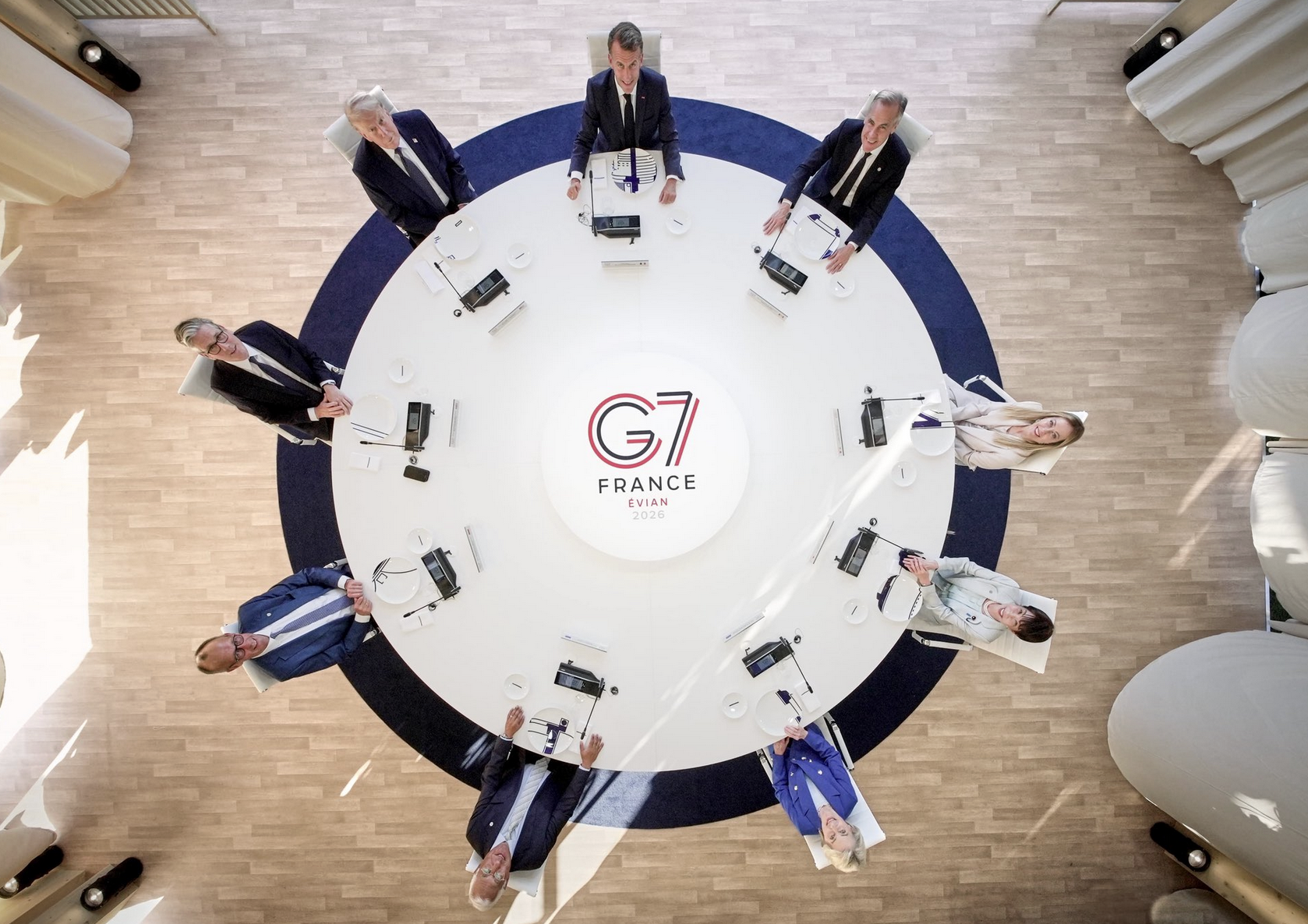 The core G7/EU family photo/G7 France
Pre-Évian pieces:
We have the latest of our annual pre-G7 Q&As with Policy Contributing Writer, six-time Sherpa and chair of the Standing Senate Committee on Foreign Affairs and International Trade, Sen. Peter Boehm. “Considering that Trump has berated, insulted and/or praised almost all of his participating colleagues, it is difficult for me to imagine how a conversation between leaders could flourish along traditional lines,” Boehm tells Policy Editor and Publisher Lisa Van Dusen. “It will be up to President Macron, with his 10 years of experience leading his country (and having been a Sherpa before that — great credentials) to steer the discussion away from any policy shoals but still cover the essential points.” Here are Peter Boehm and Lisa Van Dusen with Policy Q&A: Peter Boehm on the Evian G7.
From longtime Policy Contributing Writer, former career diplomat, and Global Exchange podcast host Colin Robertson, we have a look at the evolving world order and where the G7 and NATO summits fit into Mark Carney’s vision for a middle-power arrangement that can counter-ballast the predatory hegemons. “This year, more than in the past decade, they are a test of whether like-minded democracies can adapt multilateralism to a world in which great-power rivalry is back, economic interdependence is increasingly weaponized, and American leadership can no longer be taken for granted,” writes Robertson. “For Canada, the stakes are especially high.” Here’s Colin Robertson with The Summer Summits: Canada and the New Multilateralism.
Former Canadian High Commissioner to the United Kingdom and Ambassador to the European Union, Russia, and Italy Jeremy Kinsman, prolific Policy columnist and co-host of the Red Passport podcast, explores the history of the G7 and the role Donald Trump has played in its recent evolution. “Macron will no doubt try to steer the Evian Summit, for as long as Trump stays, as courteously as possible,” writes Kinsman. “The French-authored agenda covers the gamut of 18 issues, within a generalized conference framework of ‘security, economic resilience, social cohesion, in a more fragmented world’ — all global features that Trump undermines every day.” Here’s Jeremy Kinsman with Another G7, Another Bout of Anticipatory Anxiety.
In background on this year’s G7, here’s our Policy Series on the Kananaskis G7 from last year.
And, your G7/pop-culture bonus link, Peter Boehm’s 2024 review of the G7 horror/spoof Rumours, starring Cate Blanchett, Charles Dance, and Roy Dupuis. Here’s ‘Rumours’ as a Multilateral Morality Tale: Sherpas Really do Matter, and Canada Saves the Day.
With many thanks to all our Policy writers, readers, sponsors, and donors.
Visit us at Policy, where you’ll find our latest Policy Specials, Columns, Dispatches, Analysis, Book Reviews and Verbatim sections, plus The Week in Policy and all our posted print issues.