
Policy Q&A: Sen. Peter Boehm on Carney, Trump, Trade, the Midterms, and Netflix Imitating Life
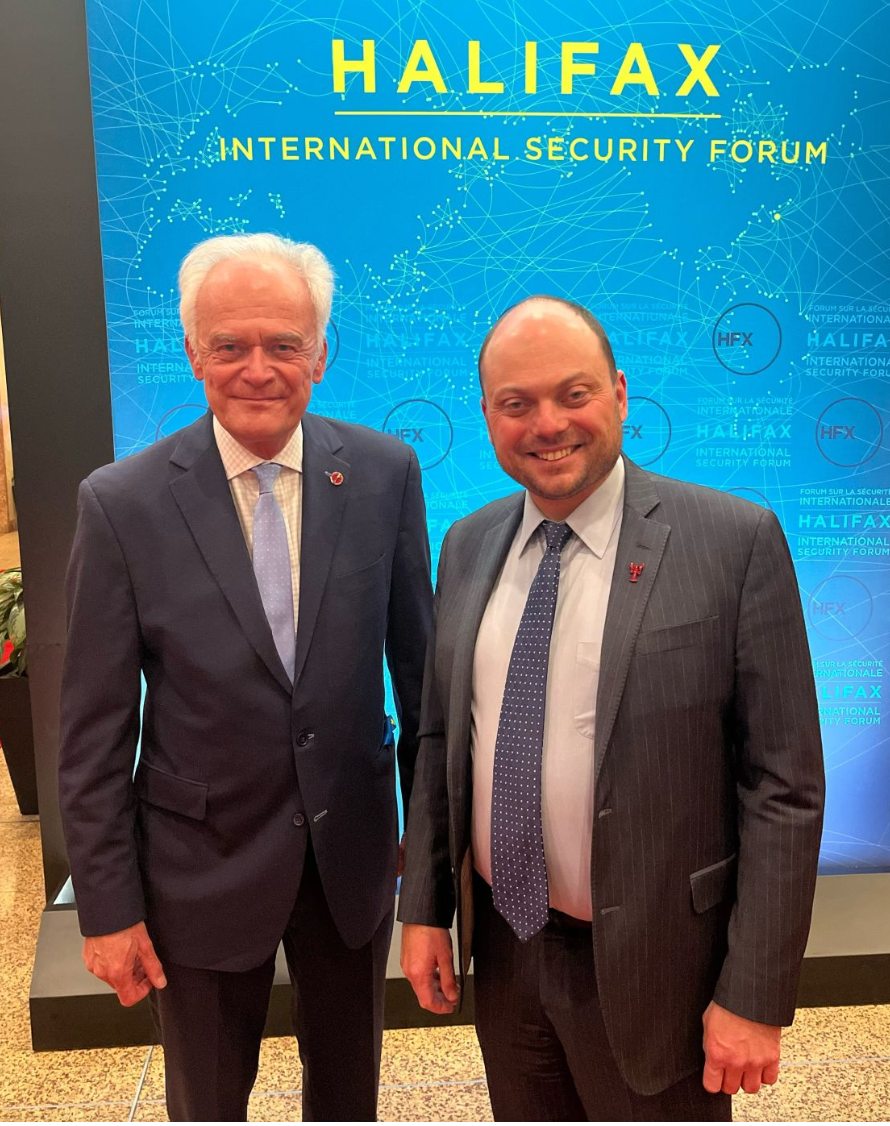
Sen. Peter Boehm with Russian dissident Vladimir Kara-Murza at the 2026
Halifax Security Forum, November 21, 2026/Courtesy
Prime Minister Mark Carney has been implementing variable geometry at summit tables across the world, including, in the past three weeks, the Canada-European Union Summit, the Commonwealth Heads of Government Meeting (CHOGM), the European Political Community Summit, the ASEAN, La Francophonie, and APEC. Meanwhile, the US midterm elections recalibrated Washington’s domestic power dynamic at home and Donald Trump sought the solace of autocrats abroad.
As chair of the Standing Senate Committee on Foreign Affairs and International Trade, Policy Contributing Writer Peter M. Boehm has held regular email Q&As with Policy Editor Lisa Van Dusen for the past five years. This is their latest exchange, including from the 2026 Halifax International Security Forum wrapping at publication.
November 22, 2026
Lisa Van Dusen: Let’s begin with the Shenzhen Three Amigos — the Xi Jinping-Donald Trump-Vladimir Putin meeting. Was it a geopolitical hinge moment or a photo-op?
Sen. Peter Boehm: Whether the vague precepts of the “Peace Declaration” from the Shenzhen meeting result in some multilateral coordination among the three or not, the imagery may give greater currency to the dangers of hegemony that Carney expressed in his Davos speech and underscores the importance of the Partners for Multilateralism (P4M) initiative he launched at the UN this year. Trump has invited Putin to the G20 meeting in Miami next month (Russia is a member in any event but Putin is a pariah, who has in recent years avoided these gatherings). Will Trump make good on his oft-stated wish to have Putin join the G7 leaders when the US hosts that summit next June?
One would hope that in geopolitical terms the world has moved on beyond the establishment of spheres of influence and international boundaries that characterized Yalta in 1945. Amid such concerns, Canada, through its prime minister, is projecting a reasonable, calm “sorry, but” approach that others admire and may try to emulate.
LVD: What’s your read on the Democratic sweep in the midterms and how it will affect bilateral relations, including Canada’s leverage in trade negotiations? The Prime Minister has said that Donald Trump remains the principal actor on the US side of this file…does that mean irrationality remains the order of the day, Congress notwithstanding?
Sen. Peter Boehm: The midterms allowed Americans to express their concerns about affordability, the war in Iran and their views of the performance of President Donald Trump and his administration. By extension, they also voted for change and expressed their disapproval of the Republican party, creating a political earthquake in what had been the party’s historical redoubts. The tariff issue loomed large in these concerns, with the tariffs on Canada forming a visible part of the electoral battle in northern states.
The new Congress will be sworn in on January 3rd. Whether the president doubles down or changes tack is anyone’s guess. There will be flailing about, and the blame game will continue on Truth Social and elsewhere. Congress will need to find its rhythm and set its priorities.
In speaking with US senators in Halifax, I am left with the impression that the new year may see a Congress pushing to reduce but not entirely eliminate tariffs. Events and distractions may intervene.
This plays into Prime Minister Carney’s assertion that President Trump remains the principal actor on the direction of the trade war. The tariffs were his idea, after all. Informal talks are ongoing; the Prime Minister is playing a role and there may very well be some sort of agreement before January that will head off the tariffs on the automotive sector. Our negotiators might produce a solution that will leave a certain tariff level on some sectors, recognizing that returning to the status quo ante might be one Gordie Howe bridge too far.
Going back to the way things were and agreeing to maintain the CUSMA without major tinkering would be the ideal. It may however prove to be politically impossible. On the other hand, Trump’s auto tariffs have raised the price of vehicles produced by American companies and the chief export market (us) has shown a decline of almost 25 per cent. In terms of tactics, this is taking close aim to fire at your foot and if the 50 per cent tariffs are indeed implemented in January, a spectacular own goal that will likely benefit China above all.
The challenge will be to ensure the durability of any interim agreement (will Trump change his mind?), and selling the solution to Canadians as the best deal under the circumstances. Larger CUSMA discussions among all three member states would follow. One presumes that with a new Democrat-led Congress, the Trump administration will have greater challenges than before and doubling down (as is Trump’s wont) may also have implications for the 2028 election.
LVD: Meanwhile, trade with China hit record levels in Q3, Prime Minister Carney’s meeting with Xi Jinping at the Shenzhen APEC produced a whole new suite of strategic partnership elements and initiatives as well as a warning that Canada could turn to Chinese automakers if US trade talks fail. Are you concerned at all that we’re jumping from the tariff frying pan into a whole other dependency fire?
SPB: I am not. China is our second largest trading partner, and both countries would benefit from stability and predictability in the trading relationship as it expands. The suite of recent agreements underscores this wish, but falls short of a Free Trade Agreement, which would not work politically in terms of our relationship with the US, and is pointedly excluded from the CUSMA; that is, no free trade agreements with non-market economies.
The Mexicans are in the same position: Chinese EVs but no production facilities. If we look at our earlier ban on the import of electric vehicles (EVs) from China, pushed by the Biden administration, the sensitivity of the North American automobile industry is clear. On the other hand, offering tariff-reduced access to 49,000 Chinese EVs, when our own industry is being threatened with extinction seems reasonable, especially when seen in the light of “normalizing” our bilateral relationship.
Continued access for our canola under favourable terms to the Chinese market stands as an example. China is again involved in a dialogue with Canada through high-level visits and discussions. There are themes that are still sensitive for China (sovereignty of the straits, minorities, human rights) but that should also form part of the ongoing conversation. The essential element is to keep an open channel for increased trade and investment and to navigate the difficult points.
This is Carney’s “pragmatic and principled” diplomacy. It would also help tremendously to appoint an ambassador to Beijing, as that position has been vacant for some time.
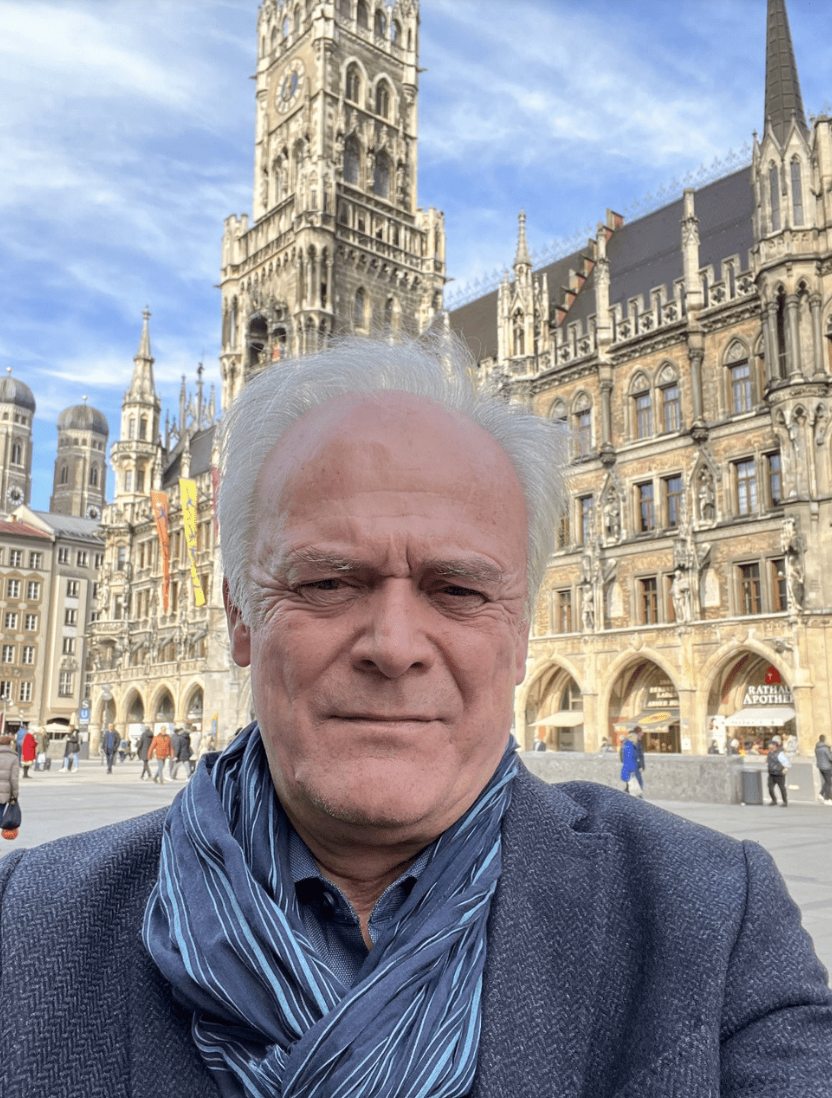
Former Ambassador to Germany Peter Boehm in Munich in 2023, from
the Policy Dispatch ‘From Weltschmerz to Hope on a Return to Munich’
LVD: Moving to the Canada-EU bilateral intensification and the “Associate Member” process agreed in Montreal: it seems at this stage to be a win-win evolution in the relationship. You know these files, you’ve been Ambassador to Germany…is there anything about it that keeps you up at night?
SPB: The Canada/EU intensification is welcome, despite the creative ambiguity about “associate member” status. Ardent historians can go back to 1973, when Prime Minister Pierre Trudeau was equally ambiguous about “the third option” or a “contractual link” with the then European Economic Community. Diplomats, in their quest for clarity, may spend too much time in defining what associate membership means since it does not appear in the Treaty of Rome or any EU treaty instruments since. It is highly unlikely that Canada would curtail its sovereignty to follow the conditions that Norway and Switzerland have agreed to in their European Economic Area connection to the European Union.
The process agreed to in Montreal in the “Alliance for the Future” declaration assumes a continued elevated level of ambition from both sides to show tangible results over the next six months. I find the aspects related to digital trade, critical minerals, Arctic cooperation, people-to-people ties (Erasmus+) and foreign policy coordination particularly encouraging. The endgame may very well be a close linkage, still seeking an understandable definition that works for everyone. The level of ambition is certainly there from the Canadian side, driven by the Prime Minister and his crack PMO/PCO team and an internal redirection of Global Affairs Canada’s policy making and missions abroad assets. Our Senate committee heard as much from our ambassador to the EU, Jonathan Wilkinson, following the Montreal summit.
Contrary to my experience as ambassador to Germany, when the two-way investment door was unlatched but not exactly open (I had tried but failed to persuade German automakers to set up a plant in Ontario but had fun testing their vehicles on the speed limit-less Autobahn), it seems that European interest now matches our own. Thank you, Donald J Trump.
Recognizing the “church vs state” relationships that exist between legislatures and the executive branch of governments, it would be an encouraging signal to see the remaining third of EU member states ratify the Canada/Europe Comprehensive Trade and Economic Agreement (CETA). I am thinking particularly of France and Italy. EU ambassador to Canada Geneviève Tuts noted in testimony to our committee this past week that Brussels was very engaged on the ratification file. This would be more than just symbolism, an assurance that the CETA is here to stay, but also a tangible commitment to our relationship, despite electoral clouds on the European horizon.
LVD: We’re closing in on a year in January since Mark Carney’s Davos speech. What’s your sense of how what some have described as the most significant shift in Canadian foreign policy since the 1950s is registering in the real world, both in Ottawa at Global Affairs and in foreign capitals?
SPB: Canada with Carney has quickly become a global brand. I never thought I would see a Canadian prime minister gracing the covers of The Economist and Der Spiegel in the same week. The Davos speech started it, and in the European context, the prime minister’s address to the European Parliament in September confirmed it. The tearing away at the fabric of both the multilateral system and of global informal institutional summitry, aided and abetted by a United States government that has weaponized trade and cast doubt on venerable global institutions has set the conditions for a rethink among “middle powers” (not an easily definable term).
I have written in Policy about the possible return of the “functional principle,” and we may be witnessing an updated version. Carney is engaging in high-level personal diplomacy as no Canadian leader has before him, attending summits, working the phone, putting pay to his variable geometry diplomacy and supporting an enhanced multilateralism as Canada’s best counterweight to our own large, complex relationship with our southern neighbour.
Delegates to the Halifax International Security Forum this weekend often cited both Carney’s Davos speech and the address to the European Parliament. Indeed, the Forum featured a panel on the middle power/variable geometry initiative. In my view, the big challenge for us is to see whether Global Affairs Canada and our missions abroad can implement the policy initiatives launched by the prime minister with consistent alacrity, particularly in receiving buy-in from other governments.
LVD: On a lighter note, you’ve kindly embraced your role as Policy’s diplomatic cultural critic — reviewing the G7 horror/comedy Rumours in 2024 and the third season of The Diplomat last year. The folks who produce The Diplomat at Netflix seem to have adopted you as an éminence grise — they invited you to the DC premiere of the fourth season, and kindly responded to your recent review of it, ‘The Diplomat’ Does the G7: An Abundance of Intrigue, a Regrettable Shortage of Sherpas. Can we get you cast as a polite, apologetic, but emboldened Canadian ambassador who saves America with variable geometry 2.0?
SPB: I am informed that the idea of a cameo appearance in season five is under consideration. Whom I would play is apparently an open question, but hopefully not a villain. There is a scene in season four in a summit context that the Canadians carry the moral authority. Should there be a walk on, I would want to be one of the good guys.
Thank you for your time, Senator.
Senator Peter M. Boehm, a regular contributor to Policy magazine, is chair of the Standing Senate Committee on Foreign Affairs and International Trade. He served in a number of senior diplomatic postings, as a deputy minister, and as Canada’s Sherpa for six G7 summits.
Policy Magazine Editor Lisa Van Dusen has served as a senior writer at Maclean’s, Washington columnist for the Ottawa Citizen and Sun Media, international writer for Peter Jennings at ABC News and an editor at AP National in New York and UPI in Washington.