
The Big Xi-Trump-Putin Polycule Reveal
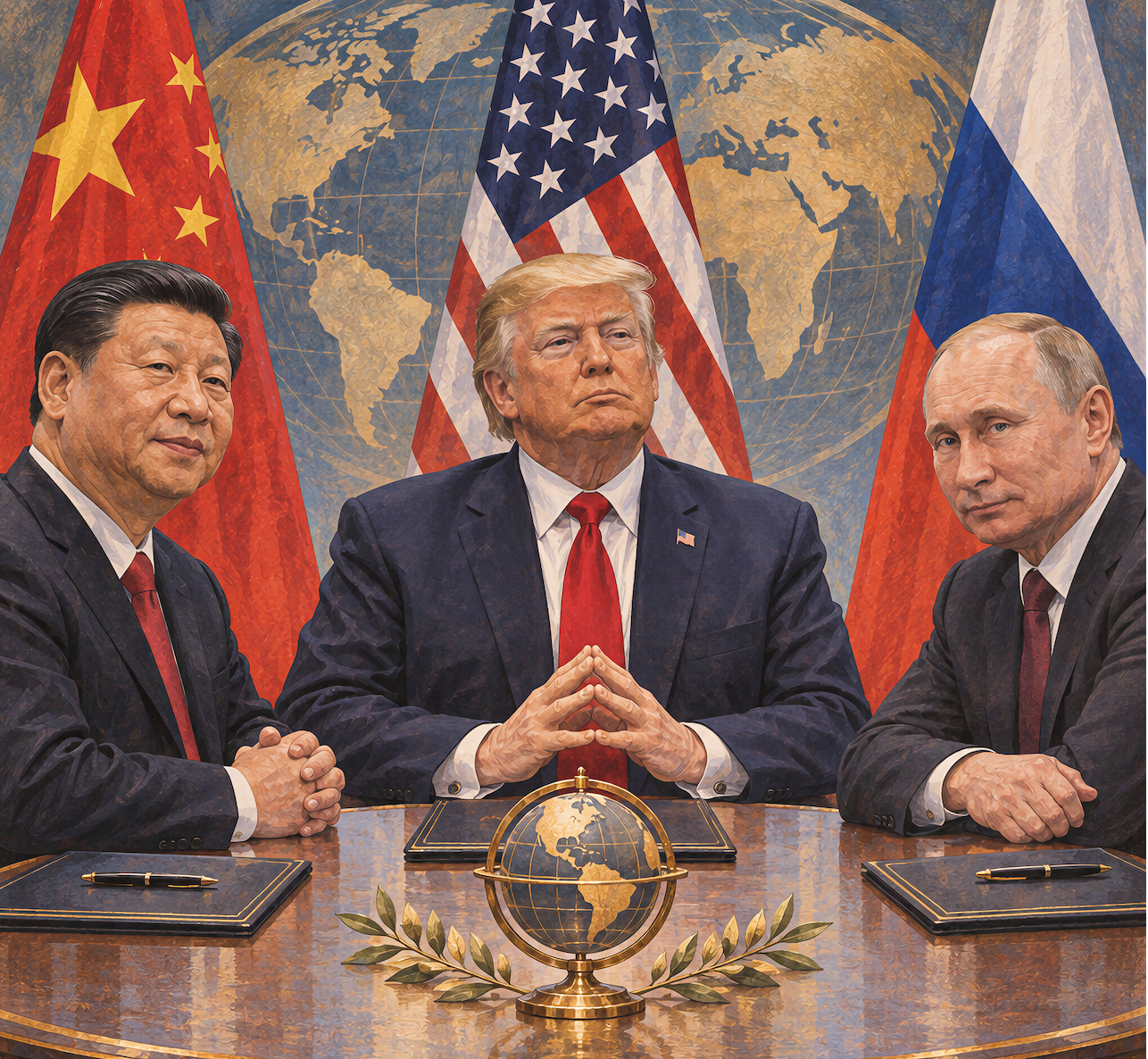 A fittingly misrepresentational AI depiction of Donald Trump as the dominant partner in the China-Russia-America geopolitical thruple/Shutterstock
November 15, 2026
On the sidelines of the Asia-Pacific Cooperation (APEC) Summit in Shenzhen on November 19th, Donald Trump, Xi Jinping and Vladimir Putin are set to hold their first trilateral meeting.
This meeting has been billed by some news organizations as an unprecedented gathering of the heads of the world’s biggest nuclear powers for a denuclearization discussion.
But the meeting’s real propaganda value is related to an entirely different shared status.
To the extent that the Xi-Trump-Putin Shenzhen trilat will seem disconcerting in real time, it will be because we’re not used to seeing the President of the United States included in a pool spray of assorted dictators (as opposed to his solo ones in the Oval Office).
The propaganda troll at play in this set piece will be that — a quarter-century after new technology, intelligence corruption, and political and geopolitical score-settling catalyzed this far-off third-act climax (not to be confused with the spectacular finale yet to come) — America is no longer a democratic superpower.
In the wake of stunning, trend-bucking midterm election results that have swung Washington’s political power pendulum back toward sanity, that may change.
But at this writing, Donald Trump’s presidency has succeeded in its overwhelmingly apparent raison d’être of rendering plausible America’s forfeiture of its leadership of the rules-based international order in the only manner possible, via performative insanity.
Which makes any Trump trilateral with Xi Jinping and Vladimir Putin — no matter what the chyron says — invisibly subtitled as his most overt embrace yet of the world order that is anything but rules-based.
In other words, this is not Reagan and Gorbachev at Reykjavik. It is more akin to, as some other news organizations have billed it, Yalta 2.0.
In practical terms, this historically evocative label is based on the concern, including on the part of Volodymyr Zelensky, that Donald Trump’s next cunning stunt will be to double down on his brazen anti-democracy conflict of interest in presiding over Russia-Ukraine “peace negotiations” by selling out Ukraine as the Poland of the piece.
As we’ve been writing over the past decade, Donald Trump isn’t just an anomalous president of the United States because of his adversarial relationship with the truth, his flamboyant disrespect for his fellow citizens, or his daily degradation of the office he occupies.
Trump’s most important contribution to 21st-century history — hijacked, fictionalized, operationalized, and otherwise — has been the incalculable value he has provided to the aspiring world order represented by Xi and Putin as an accelerant and amplifier of a systemic shift that has gradually redefined global power since the waning days of the Clinton presidency.
What we’ll really be witnessing in Shenzhen is the big, belated reveal of a geopolitical polycule that has existed since Trump I, and whose core affinities and democracy degrading Venn overlaps have been evident in a series of bilateral previews.
So, as we enter the second quarter-century of that process, which has seen the selling-out of humanity for power across the map of the world and replaced self-government with corruption captured and operationalized renditions of authoritarianism from America to Afghanistan to Zimbabwe and back again, the real question about the Trump-Xi-Putin trilateral is “What took you kids so long?”
What we’ll really be witnessing in Shenzhen is the big, belated reveal of a geopolitical polycule that has existed since Trump I, and whose core affinities and democracy degrading Venn overlaps have been evident in a series of bilateral previews from the Trump-Putin Helsinki bilat of 2019 to the Xi-Putin pre-Ukraine Beijing bilat of 2022 to the Trump-Putin Anchorage bilat of 2025 to the Trump-Xi Beijing and Washington bilats of 2026.
Donald Trump has been an instrument of the war on democracy and the aspiring post-democracy world order benefiting from its narrative warfare stylings (including the enthusiastic use of honey-trapping) since long before his presidential encore began to multiply that destruction to the global geopolitical and economic status quo by several orders of magnitude.
That damage includes: the tariff-enabled hacking of the treaty codified, World Trade Organization (WTO)-regulated global trade regime; the relentless tactical degradation and discrediting of America as the democratic superpower; the disruption of global energy and food supply through a (publicly) unjustified and profitably intractable Middle East war; the endangerment of European security through his backing of an unjustified, failed, and corruptly sustained Russian war of aggression on a neighbouring democracy; and his norm-breaking, mendacious targeting of his own neighbouring democracy, Canada.
Because the war on democracy routinely takes the form of a frog-boiling incrementalism adapted to transformations of far greater consequence than the demise of an unwitting amphibian, it is frequently camouflaged by misdirection, misrepresentation and other varieties of BS, industrialized as propaganda.
Hence Donald Trump’s occasional claims of being tough on China or tough on Russia and other token acts of distance delineation that have caused such cognitive dissonance among people who know enough not to believe a word he says about any other subject — from the nastiness of Canadians to the time of day — and whose perception of the overwhelming preponderance of anecdotal evidence tells them otherwise.
It has been roughly 25 years since the degradation of democracy and the colonization of human life by technology — from the wonders of “You’ve Got Mail!” to the current threat of an “AI genocide” — began sharing the storyboard of 21st-century power consolidation stylings.
During that time, China has been — country by country, supply chain by supply chain, institution by institution — replacing the United States in global influence and economic power, with anti-democracy instead of pro-democracy strings attached; a transition that has accelerated and secured the decimation of democracy across the globe at a time when humanity needs its protections more than ever.
When Xi Jinping references the Thucydides Trap — Harvard Professor Graham Allison’s excavation for the US-China rivalry of novelist Herman Wouk’s Spartan framing of US-Soviet Cold War competition — he knows that the misdirection in that reference lies in the notion that when a rising power usurps an existing superpower the result is often war. China’s astonishing rise since 2000 has been accomplished without a single shot fired.
And, unless Xi’s aversion to public displays of swaggering overreach defines the day, it is that epic geopolitical melodrama — that quarter-century parade of America-discrediting, China-elevating, Putin-protecting hinge moments — that will be the operational Bayeux Tapestry expanded and elaborated in Shenzhen. And it’s not a narrative catalyst, it’s a culmination.
Policy Editor and Publisher Lisa Van Dusen has served as Washington bureau chief for Sun Media, as Washington Columnist for the Ottawa Citizen, as international writer for Peter Jennings at ABC News, and as an editor at AP National in New York and UPI in Washington.