
Our Policy Series on the Canada-EU Relationship
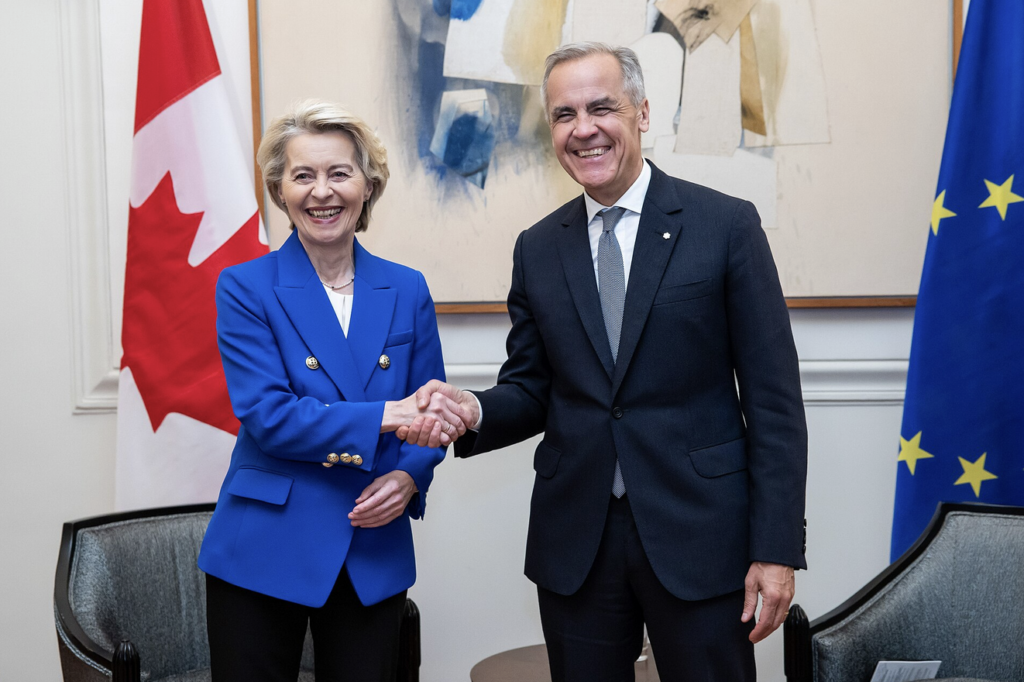
Prime Minister Mark Carney and European Commission President Ursula von der Leyen/EU image
On June 23, 2025, at the Canada-European Union Summit in Brussels, Prime Minister Mark Carney reiterated his view that Canada is “the most European of non-European countries.” That day, Canada and the EU signed an enhanced Strategic Partnership and a new Security and Defence Partnership. In January, 2026, when Carney unfurled his case for a concerted, middle-power response to the seismic, hegemonic shift in the postwar global order, he delivered it in Davos. On May 4, 2026, in Yerevan, Carney was the first non-European head of government to attend the European Political Community Summit. “It is my strong personal view that the international order will be rebuilt,” he said, “but it will be rebuilt out of Europe.” In response to Donald Trump’s trade, security, and rhetorical alienation of both parties, the Canada-EU relationship is becoming closer. Welcome to our Policy package of Canada-EU insight, analysis, and opinion. We will be updating as the story unfolds.
For the many Canadians who work in Brussels and whose days are defined by the state of the Canada-EU bilateral relationship, September 2026 will go down as a re-defining month. European Commission President Ursula von der Leyen’s State of the European Union (SOTEU) on the 16th and Mark Carney’s speech to the EU Parliament on the 17th launched an “Alliance for the Future”, but Brussels-based Canadian trade lawyer and Business Council of Canada EU Advisor Mark Camilleri sees the Carney speech as the third in a “Europe Trilogy”: Davos, Yerevan, and Strasbourg. Here’s Policy Contributing Writer Mark Camilleri with Mark Carney’s ‘Europe Trilogy’: Mapping an Alliance for the Future.
While the new Canada-EU alliance has been envisioned to create a transatlantic bulwark against Donald Trump’s predatory protectionism, the deepening bilateral trade relationship is also nuanced by pre-existing protectionist measures of its own, notably the “Buy Canadian” and “Made in Europe” policies. “The Carney government has to decide whether it is willing to soften its Buy Canadian policy after resisting similar US demands,” writes Norman Paterson School MA candidate and Policy contributor Brian Wu. To achieve an “alliance for the future,” the two sides must find a way to meet in the middle.” Here’s Brian Wu with Can Canada and the EU reconcile ‘Buy Canadian’ with ‘Made in Europe’?
In September, as Prime Minister Mark Carney prepared to attend the State of the European Union and address the European Parliament in Strasbourg, Canada’s former Ambassador to the EU, Ailish Campbell, looked at five areas for deepening Canada-EU cooperation immediately. “This moment is a political test, not only a policy one,” writes Campbell. “New institutions and instruments will need to be forged. The EU and Canada’s capacity for action will be tested.” Here’s former Ambassador Ailish Campbell with Elevating Europe: Canada and the EU’s New Ambition.
As Prime Minister Mark Carney has prioritized Europe in his government’s trade and security diversification push, Brussels-based Canadian trade lawyer, Business Council of Canada EU Advisor and Policy Contributing Writer Mark Camilleri has filed excellent insight pieces from the EU capital on the changing relationship. “This shift has prompted considerable debate about what Canada wants from Europe,” Camilleri wrote in August. “But what does Europe want from Canada?” Here’s Mark Camilleri on August 7th with The Indispensable Ally: Why Europe Needs Canada Now.
In an excellent cross-post from our Policy-Asia Pacific Foundation of Canada Series on Canada’s Critical Minerals Advantage, we have the definitive piece on the critical minerals element of the Canada-EU trade and security relationship. As head of unit and deputy director in the European Commission’s Directorate General for the Internal Market, Industry, Entrepreneurship and SMEs, Peter Handley negotiated the 2021 EU-Canada Strategic Partnership on Critical Raw Materials as well as the 2024 Critical Raw Materials Act. Handley is now a strategic advisor with the Hague Centre for Strategic Studies. On August 5th, he filed the must-read On Critical Minerals, Canada and Europe Meet in the Midstream.
Following the 2026 NATO Summit in Ankara, Columnist Jeremy Kinsman — former Canadian Ambassador to the EU, to Russia, and to Italy, and former High Commissioner to the UK — filed the big-picture takeaways piece. “Convinced that the multipolar world needs cooperation to meet governance challenges posed by climate change, artificial intelligence, migration, and financial instability,” wrote Kinsman, “Canada and Europe sense that the cartoon of corruption that is Trump’s presidency reflects a larger problem, and that America has lost belief in the common good, domestically and internationally, privileging profit above all else.” Here’s Jeremy Kinsman on July 11th with Unpacking Ankara: Can the New ‘Hour of Europe’ Forestall a New Age of War?
In April, McGill University Political Scientist and Policy Columnist Maria Popova and her McGill colleague Dietlind Stolle filed new research on Europe’s evolving political fault lines — notably on the question of whether to appease Russia or fortify against it. “This matters for Canada,” write the authors. “The EU-Canadian alignment on the need to counter Russian aggression is one part of the reason there has been widening discussion of deeper institutional ties between the EU and Canada (the other part being the increasingly problematic and adversarial stance of the Trump administration towards both Canada and the EU).” Here are Popova and Stolle on April 22nd with Europe’s New Political Divide isn’t Left-Right, it’s About Russia.
The story of Ukraine resistance has shifted in 2026 as Volodymyr Zelensky has segued his status from freedom fighter to statesman and that of his country from aid petitioner to security provider, writes McGill University politcial scientist and Policy Columnist Maria Popova. “By aligning closely with Kyiv to bolster European security and contain Russia,” writes Popova, “Canada is not only protecting its own national interest but is also positioning itself as a key pillar of the coalition on the right side of history.” Here’s Maria Popova on May 14th with As the War Narrative Shifts, Ottawa and Kyiv Join Forces on European Security.
The new level of engagement between Canada and the European Union has been called many things, including, by the New York Times, love. “The love story metaphor reflects the emotionalization of foreign policy more broadly since Donald Trump careened onto the world stage in 2017 and began to provoke and harangue America’s allies based on a range of emotional justifications,” writes Policy Editor, Publisher, and Columnist Lisa Van Dusen. “It also makes for a refreshing break from geopolitical horror stories.” From May 12th, here’s Lisa Van Dusen with The Canada-EU Romance: Friends with Benefits or Cautionary Fairy Tale?
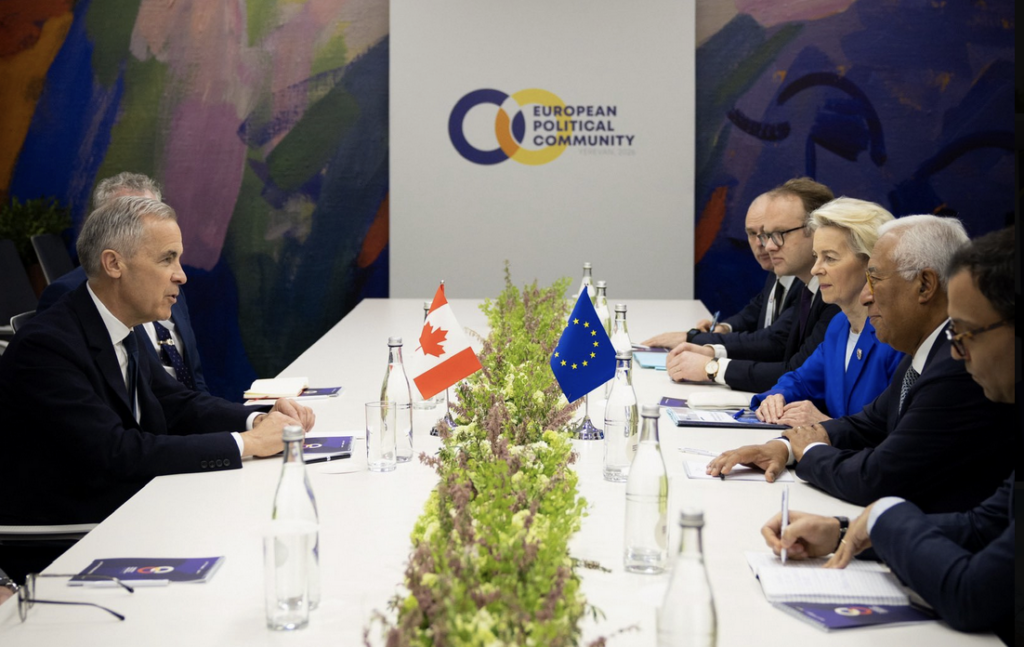
Prime Minister Mark Carney and EU Commission President Ursula von der Leyen in Yerevan, May 4, 2026/PMO
As the terms and conditions of Canada’s warming relationship with Europe begin to take shape, Policy Contributing Writer Colin Robertson looks at the context and consequences, pros and cons of the new dynamic. “The gains could be substantial,” writes Robertson. “There is logic to this strategy, but there are also limits. The first is geography.” Here’s Colin Robertson on May 11th with Carney’s Tilt Toward Europe is not Nostalgia, It’s Foresight.
From Policy Columnist Jeremy Kinsman, who has served as Canada’s ambassador to the European Union, to Italy, to Russia and as high commissioner to the United Kingdom, a look at the evolution in bilateral relations. “In the face of America’s alienation from the rules-based international order that Washington helped build and led for eight decades,” writes Kinsman in his post-Yerevan column. “Canada — what might now be known fondly across the Atlantic as ‘the other North America’ — is shifting more closely into the EU’s orbit.” Here’s Contributing Writer Jeremy Kinsman with Canada’s Changing Relationship Status with Europe.
To mark the 50th anniversary of Canada-EU diplomatic relations, the McGill University Jean Monnet debate, hosted by the Jean Monnet Centre Montreal and the McGill Institute for the Study of Canada, featured a keynote by former Foreign Affairs Minister and former Ambassador to France and to the EU Stéphane Dion. From April 27th at McGill University, here’s our Policy Verbatim post of that keynote, Canada and the European Union: Growing Closer Without Merging.
Even before French Foreign Minister Jean-Noël Barrot’s tease in March that perhaps Canada should join the European Union, we had our own Policy Canada-EU accession debate underway. In January, Augusto Lopez-Claros, director of the Geneva-based Global Governance Forum, filed a piece arguing for Canada’s eventual EU membership. “The time has come to think of Europe less in terms of physical proximity, and more in the language of the 21st century,” writes Lopez-Claros, “an era in which institutions transcend borders, and shared rules and values, not maps, define the boundaries of political community.” From January 28, here’s View from Europe: The Increasingly Convincing Case for Canada Joining the EU.
Meanwhile in Brussels, Canadian trade attorney and Business Council of Canada EU Advisor Mark Camilleri read the Lopez-Claros piece above and filed a friendly counter-argument against Canada joining the EU. “However intriguing — and, for some, enticing — the idea of EU membership may be, it defies Canada’s economic reality,” wrote Camilleri. “In today’s world, geography does still matter, and Canada is deeply embedded in the North American economy.” From February 12, here’s Beyond Eurovision: Why Joining the EU Would Defy Canada’s Economic Reality.
In response to the Camilleri piece, Lopez-Claros counter-countered. “The core issue is not whether Canada could or should begin accession negotiations tomorrow,” he wrote. “Nor is it whether such a process would be politically arduous and technically complex. It would be both. The real question is what long-term institutional alignment best secures Canada’s prosperity, sovereignty, and influence in a rapidly changing global order.” From March 11th, here’s the latest instalment of our Canada-EU accession point-counterpoint, from Augusto Lopez-Claros with Beyond Geography: Canada, the EU and Strategic Diversification. We look forward to continuing the conversation.
From 2025, ahead of the June Canada-EU Summit in Brussels, Mark Camilleri filed an excellent advance piece laying out both the agenda and the mood. “This moment of realignment has created a rare opportunity for deeper and more strategic Canada-EU cooperation that both Canada and the EU are keen to embrace,” Camilleri wrote. “And while talk of closer ties has long been part of the transatlantic ‘summit script’, the disruptions to the global order have turned talk into action.” Here’s Mark Camilleri with A Next-Level Strategic Partnership.
With many thanks to all our Policy writers, readers, sponsors and supporters.
Visit us at Policy, where you’ll find our latest Policy Specials, Columns, Dispatches, Analysis, Book Reviews and Verbatim sections, plus The Week in Policy and all our posted print issues.