
Our Policy Series on the 2026 NATO Summit
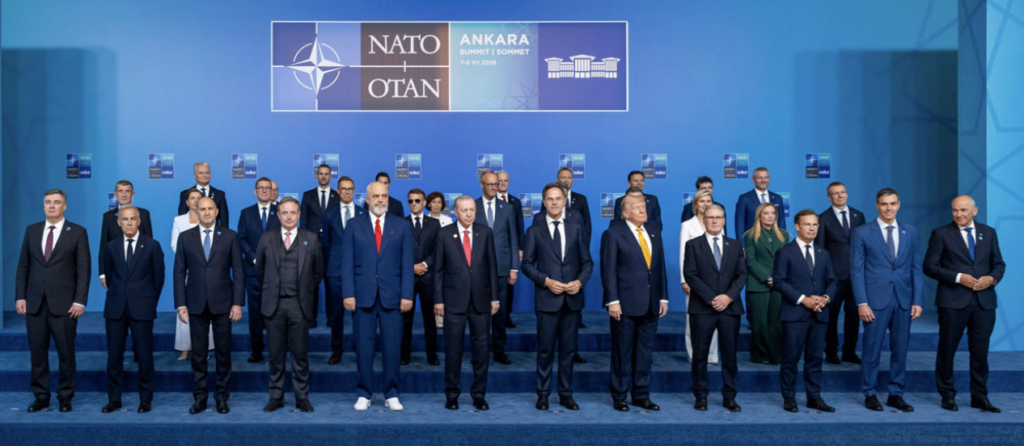 The 2026 NATO Summit group photo/NATO image
The leaders of the 32 North Atlantic Treaty Organization (NATO) member countries met in Ankara, Turkey, July 7-8. The security, political, and geopolitical narratives advanced during the summit contained some familiar elements, as well as some unexpected twists. With many thanks to our Policy contributors, welcome to our coverage of the 2026 NATO Summit.
As the dust settled on events in Ankara, Policy Columnist Jeremy Kinsman — former Canadian Ambassador to the EU, to Russia, and to Italy, and former High Commissioner to the UK — was busy writing the must-read, big-picture tour d’horizon on the fallout, takeaways and knock-ons. “Convinced that the multipolar world needs cooperation to meet governance challenges posed by climate change, artificial intelligence, migration, and financial instability,” writes Kinsman, “Canada and Europe sense that the cartoon of corruption that is Trump’s presidency reflects a larger problem, and that America has lost belief in the common good, domestically and internationally, privileging profit above all else.” Here’s Jeremy Kinsman on July 11th with Unpacking Ankara: Can the New ‘Hour of Europe’ Forestall a New Age of War?
Among the noteworthy takeaways from Ankara was a series of developments on Ukraine that amounted to much more than a tacit recognition of the evolution in Russia’s war against its democratic neighbour. Donald Trump’s tone toward Volodymyr Zelensky was more respectful, and Zelensky left with $80 billion in new NATO assistance and a pledge from Trump that Patriot missiles can be manufactured on Ukrainian soil. “The summit declaration certified something that officials in Kyiv, Brussels, and Warsaw have been saying quietly for a while,” writes Policy Columnist Maria Popova. “Ukraine is no longer merely a recipient of Western security assistance, it is a provider of it, contributing battlefield expertise, drone technology, and intelligence that European militaries now draw on.” Here’s Maria Popova with In Ankara, NATO Prevailed Over Both Trump and Putin.
From the Conference of Defence Associations Institute’s Kevin Budning and Lilit Klein, a look at Canada’s cards in Ankara, including a Carney-led re-branding that has re-positioned Ottawa as a serious defence and security player. “What distinguishes Canada lies beyond spending,” Budning and Klein write, “deep expertise, strategic geography, abundant natural resource, and a stable democracy, now finally matched by political will and economic incentives that put real skin in the game.” Here are Kevin Budning and Lilit Klein with Salt and Sizzle: Canada’s Mission at the 36th NATO Summit.
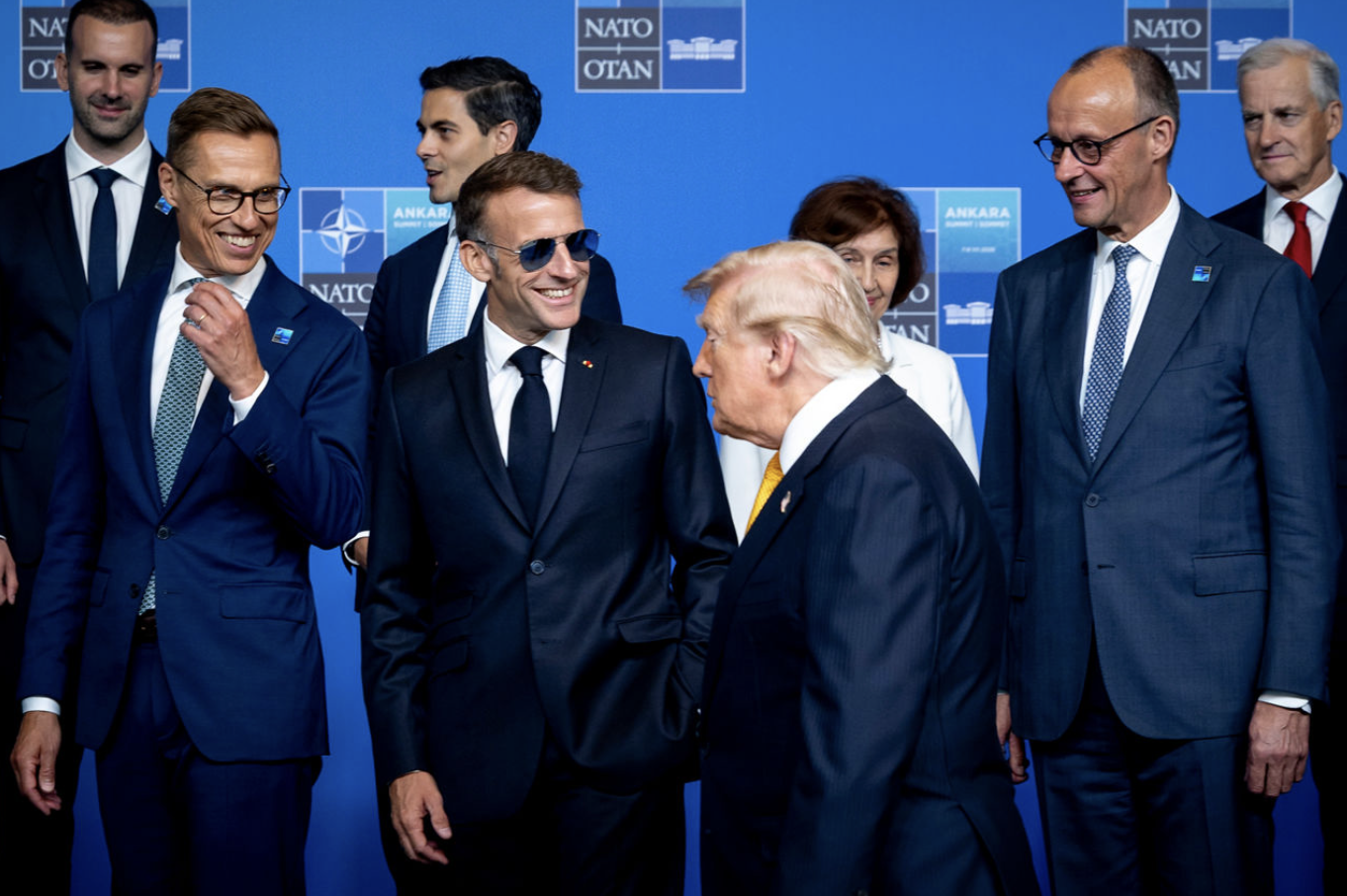 European leaders observe Donald Trump during the group photo set-up/NATO
On his way from Ottawa to Ankara on July 6th, Mark Carney stopped in Halifax to make the long-awaited announcement of which bidder — Germany’s TKMS or South Korea’s Hanwha — had won the contract to build up to 12 new submarines for the Royal Canadian Navy. The timing alone was a dead giveaway, with the bid going to TKMS’s joint proposal with Norway, both furthering Carney’s focus on greater defence and security cooperation with Europe and solidifying Canada’s investment in NATO. “The new submarines will be interoperable with other NATO fleets,” writes Policy Columnist Don Newman. “But as the Prime Minister also said, the submarine decision will strengthen the Atlantic alliance at a crucial moment.” Here’s Don Newman with En Route to NATO, Carney Doubles Down on NATO.
Because all economics is geopolitical these days, Carney’s choice of a European/NATO-partner consortium for the most lucrative procurement contract in Canadian history raised the question of Canada-South Korea bilateral vigour. There is no better writer in Canada to clarify this for our readers than Asia Pacific Foundation of Canada VP and Policy Contributing Writer Vina Nadjibulla. “Hanwha’s campaign helped move South Korea in Canadian eyes from an important economic partner to a serious strategic and defence-industrial partner,” writes Nadjibulla. “Within Carney’s ‘variable geometry’, Canada’s Atlantic, Arctic and Pacific interests share a rapidly expanding Venn overlap. South Korea is central to these calculations.” Here’s Vina Nadjibulla with Canada Chose NATO on Submarines. Now, it Must Keep South Korea Close.
In their advance piece on Ankara, longtime Policy contributor and former Canadian Defence Minister Perrin Beatty, and Carleton University professor of International Affairs and Policy Columnist Fen Osler Hampson argued that Donald Trump could be upstaged this year by another chaos actor. “Many European leaders are now convinced that Putin,” write the authors, “having been bloodied in an unpopular war that increasingly threatens his grip on power, will take a run at the Baltics in his determination to rebuild the old Soviet empire.” Here are Perrin Beatty and Fen Osler Hampson with In Ankara, Trump May Not be NATO’s Biggest Problem.
In further background and context, our Policy 2025 NATO Summit Series and, from 2024, our Policy Package on NATO at 75.
We’ll be adding new pieces to this series during and after the summit.
Policy magazine serves as an independent, nonpartisan platform for insight and analysis on Canadian, U.S. and international politics and public policy, written by policy and political professionals.