Our Policy Special Series: The UNGA 80
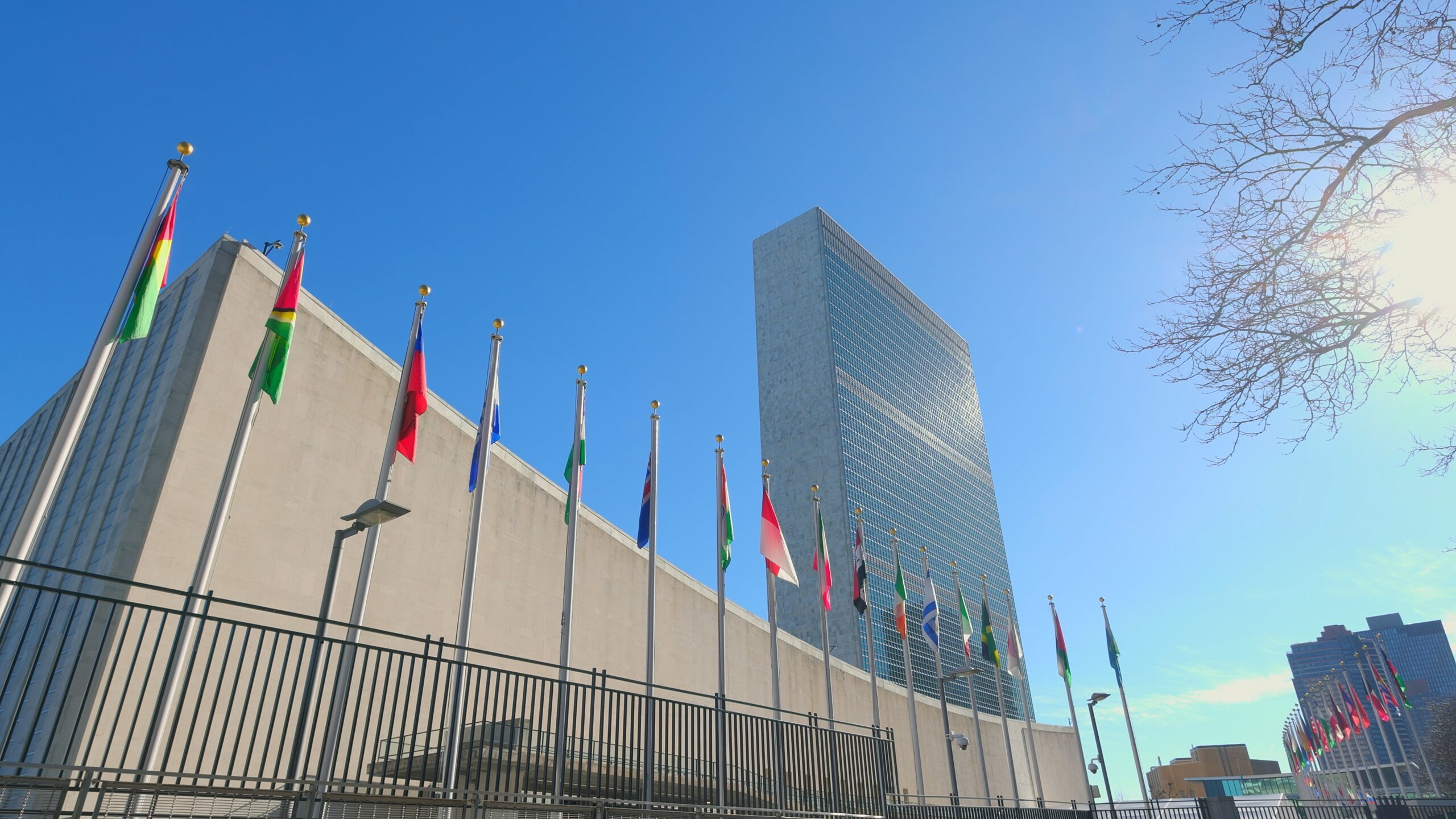 Shutterstock
The United Nations 80th General Assembly is unfolding amid a systemic clash of values not seen since the Second World War. The collective response to the unprecedented crimes against humanity that defined that war, formulated between April and June of 1945 during the United Nations Conference on International Organization (UNCIO) in San Francisco, was the United Nations Charter. This year, with an American president actively shifting the world’s democratic superpower from its role as the linchpin of one world order to the enabler of another, that tension will play out during the UNGA. Welcome to our Policy UNGA 80 series, with many thanks to all our contributors.
We open with a scene-setting speech delivered at the United Nations on June 26th by Policy contributing writer and Canada’s current ambassador to the UN, Bob Rae. Here’s Ambassador Bob Rae’s Address to the United Nations on the 80th Anniversary of the Signing of the UN Charter. In related recommended reading, Ambassador Rae’s Policy piece from 2022 about serving in the same diplomatic role as his father, UN Ambassador Saul Rae, Memories of My Father: Sharing a Mission, 50 Years Apart. And, every other piece Bob Rae has filed from New York since 2021, here at his Policy author page.
From former UN Ambassador Yves Fortier, we have a look back at a time — Fortier’s term at the UN from 1988 to 1992 — when the world was very different. “It was an exciting time for humanity; in many ways the opposite of the negative drama and upheaval we’re experiencing today in international relations,” writes Yves. “Overnight, it seemed, the Berlin Wall fell, the Cold War ended, freedom prevailed, and the Soviet Union was Russia again.” Here’s Yves Fortier with Notes from a UN Mission When the Drama was Good.
This crucial year for the UN coincides with an equally crucial moment in Prime Minister Mark Carney’s management of a drastically altered bilateral relationship with the United States and its implications for economic, domestic and foreign policy. Former career diplomat and Policy Contributing Writer Colin Robertson has filed an indispensable look at Carney’s foreign policy heading into the UNGA. “The underlying shift in Carney’s worldview is the recognition that alliances and trading relationships can no longer rely on the benevolence of a U.S.-led order,” writes Colin. “Instead, he is promoting strategic realism.” Here’s Colin Robertson with From Reliance to Resilience: Mark Carney’s Foreign Policy.
In January, 1998, former United Nations Ambassador Louise Fréchette was appointed by Secretary-General Kofi Annan to serve as the UN’s first deputy secretary-general. In her piece for our UNGA 80 series, Les Nations Unies à la Croisée des Chemins, Fréchette explores in French the unique challenges of this moment and the epic context that produced it, including a Cold War whose systemic rivalries continue to define international relations.
In the hierarchy of catastrophes preoccupying the UNGA, Ukraine and Gaza are top of mind for most delegates and observers. But on September 30th, the day after the UNGA wraps, a high-level conference will address Southeast Asia’s Rohingya refugee crisis. “Myanmar remains caught in a war of attrition produced by China’s role as a regional power,” writes Policy Columnist Anil Wasif. “Beijing’s bet-hedging engagement with all sides…has frozen the conflict in a devastating deadlock that serves its own strategic interests.” Here’s Anil Wasif with Can a Besieged UN Forge a Breakthrough in the Rohingya Crisis?
As the head of Amnesty International Canada, Alex Neve spent 20 years immersed in the evolution of 21st-century human rights norms. Since stepping down from that role in 2020, Neve has been teaching law and, most recently, writing the book Universal: Renewing Human Rights in a Fractured World, the basis for his 2025 CBC Massey Lecture Series. He generously filed a piece for this series on the eve of his lecture tour. Here’s Alex Neve with, Imagine, If You Will: At UNGA 80, Canada Re-Commits to Universal Human Rights.
Montreal Institute for Global Security Director Kyle Matthews provides a must-read look at the impact of America’s massive funding cuts to the UN. “By stepping back, America leaves a vacuum,” writes Matthews. “China is particularly eager to rewrite international norms to suit authoritarian interests and is more than happy to see the U.S. pull back its political and economic support of the UN. Every dollar the U.S. cuts weakens its leverage and strengthens China’s.” Here’s Kyle Matthews with More than Money: America’s UN Retreat is Costing Lives.
In his first piece filed from the UNGA, which he is attending as the co-owner of the global non-profit BacharLorai, Anil Wasif reports on the scene in Assembly Hall, and what Canadian diplomacy under Mark Carney can achieve amid today’s geopolitical turmoil. “It is precisely this volatility that will frame Canada’s re-engagement at the UN,” writes Anil, “starting with our shift in policy on the Israeli-Palestinian conflict, confirmed by Prime Minister Mark Carney as Canada joined the UK and France in officially recognizing the State of Palestine.” Here’s Anil Wasif with Repositioning Canada at the UNGA 80.
As the former G7 Sherpa who was on duty during the 2018 Charlevoix Summit where Donald Trump’s approach to multilateralism was on full, disruptive display, Policy Contributing Writer Peter Boehm has ideas about how Canada and the world should proceed. “If allies can assemble a ‘coalition of the willing’ to deal with the war in Ukraine,” writes Boehm, “why not a similar one to rescue and repurpose our most venerable global institution, the United Nations?” Here’s Sen. Peter Boehm with Amid the Multilateral Chaos, is it Time to Resurrect the ‘Functional Principle’?
And, in our series bonus piece from Sen. Boehm, a look back at how Canada has approached the internal politics of the UN, notably in recent campaigns for a non-permanent member seat on the UN Security Council, for which he acted as a different sort of Sherpa. “The ground we staked out as the darling of multilateralism — everyone’s party, interlocutor and candidate of least resistance — was not without hubris,” he writes. “Our competitions for elected international office have often been framed by the assumption that we should simply stand on a combination of our good intentions and our proudly inoffensive reputation, like a hothouse flower at a cotillion.” Here’s Peter Boehm with Canada’s Approach to UN Politics: Hothouse Flower No More?
Visit us at Policy, where you’ll find our latest Policy Specials, Columns, Dispatches, Analysis, Book Reviews andVerbatim sections, plus The Week in Policy and our archived print issues.