
Our Policy Budget 2026 Series
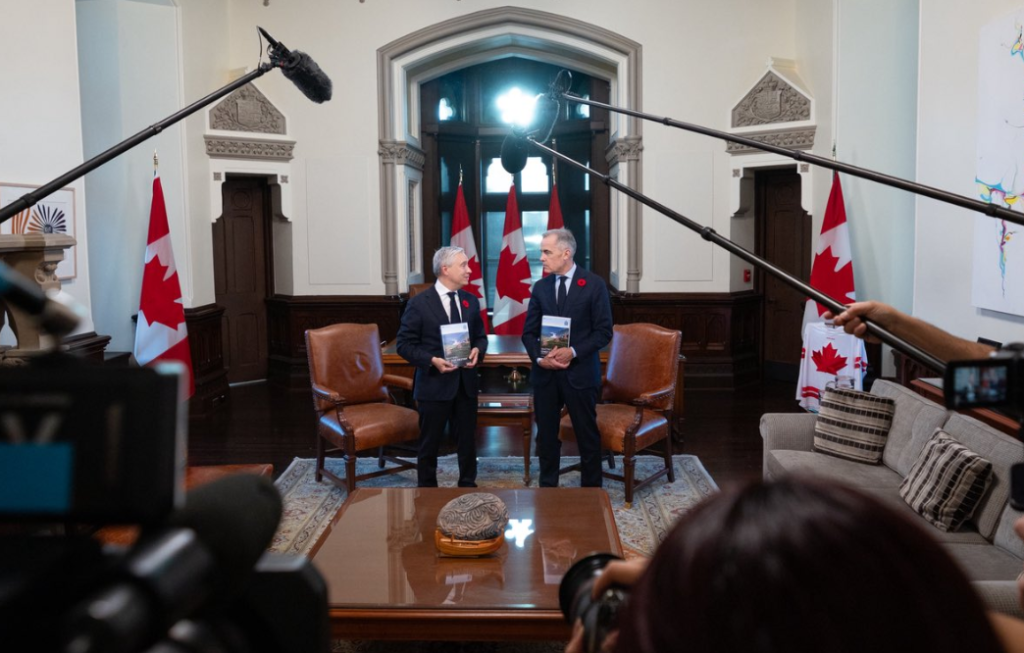
Finance Minister François Philippe Champagne and Prime Minister Mark Carney unveiling the 2026 federal budget on November 5th/FPC X
The second Mark Carney budget, titled Masters of our Destiny, was tabled by Finance Minister François-Philippe Champagne on Thursday, November 5th, 2026. It includes $142.1 billion in total new spending and tax breaks, a projected 2026‑27 federal deficit of $62.3 million, a 40% federal debt‑to‑GDP ratio, and public debt charges expected to reach $83 billion annually by 2030‑31. Welcome to our Policy Magazine Budget 2026 series.
In post-budget opinion and analysis:
The Carney government’s sophomore budget, argues Counsel Public Affairs Senior VP and Policy Contributing Writer John Delacourt, reveals more than its freshman effort. “Crucial conversations on the art of the possible are approached with a new realism – and pragmatism regarding the timelines for project approval,” writes Delacourt, “and a stronger, clearer style of governing has emerged.” Here’s John Delacourt with Mark Carney’s Second Budget Reimagines Canada’s Place in the Global Economy.
Per the title of this year’s federal budget, sovereignty was a running theme of the Carney government’s fiscal curation. Forum of Federations President and Policy Contributing Writer Rupak Chattopadhyay, who knows much about the principles of sovereignty, provides an assessment of Budget 2026 through its lens. “Sovereignty rhetoric in Canada often leads to one of two dead ends: autarky or nostalgia for a protected domestic market,” writes Chattopadhyay. “The Carney government has taken neither route.” Here’s Rupak Chattopadhyay with Budget 2026: Canada’s Turn to Economic Sovereignty.
From our friends at the Institute of Fiscal Studies and Democracy, an excellent quick-take brief that includes the post-budget episode of the IFSD Politics of Money podcast, From Borrowing to Growth: IFSD Tests Budget 2026. And, from IFSD President, former Parliamentary Budget Officer and longtime Policy Contributing Writer Kevin Page, Budget 2026: Masters of Our Destiny. “In different times, fiscal observers and governments would be celebrating a budgetary deficit that dramatically beat estimates,” writes Page. “Times have changed. The priority is building capacity in Canada to better control its future. We are at the beginning of the journey. It is going to be difficult, expensive and risky.”
In our immediate, post-lockup analysis, BMO Senior Economists and Policy Contributors Robert Kavcic and Shelly Kaushik filed the wrap-up piece, Budget 2026 Takeaways: All the Small (and Mega) Things. “This is a big budget that continues to run substantial deficits, but nothing beyond the scope of what has already been long known in the market,” write Kavcic and Kaushik. “Importantly, the policy underlying these deficits is more palatable than those of the past decade, built less on social spending and bigger government, and more (but not entirely) on pro-growth measures that could have some longer-term payoff.”
And, from BMO Chief Economist and Policy Contributing Writer Doug Porter, A Decade in a Week. “For a document that arrived with little fanfare, it was actually quite meaty,” writes Porter in his day-after Talking Points Memo. “In a nutshell, the government was handed yet another large revenue windfall—this time from the oil price surge—and promptly turned around and found lots of priorities on which to spend almost all of it.”
In pre-budget opinion and analysis:
Prime Minister Mark Carney’s second budget should get a soft political landing amid the former central banker’s record-high approval ratings, writes Policy columnist Don Newman. But it could also be a catalyst, to use a Carney word, for the depletion of that political capital. “With time served in office comes political exposure,” writes Newman, “and federal budgets can serve as target ranges for opposition and special interests.” Here’s Don Newman with The Importance of Mark Carney’s Second Budget.
Amid the fiscal evolution from 10 years of Justin Trudeau’s prime ministership to Mark Carney’s, McGill Institute for the Study of Canada Director and Policy Columnist Daniel Béland explores the classic guns-vs-butter de-prioritization of social policy in the face of increased defence and infrastructure spending. “Prime Minister Carney, in contrast to Trudeau, has not emphasized social policy expansion,” writes Béland. “This is related to the current international context, as the trade war between Canada and the United States has fostered much uncertainty and the sense that Canada must strengthen its economic sovereignty, secure its self-defence capabilities, and diversity its trade alliances.” Here’s Daniel Béland with Social Policy and the Federal Budget.
Former Parliamentary Budget Officer and current president of the Institute of Fiscal Studies and Democracy Kevin Page and University of Ottawa economics student Abigail Sampson have filed two essential preview pieces for Budget 2026. “The Carney narrative begins with economic stabilization, but it succeeds or fails on whether that stabilization translates into measurable gains in productivity, investment, and living standards,” write the authors in the first, big-picture look at the economic context. “The central challenge for Budget 2026 is that the economy is no longer weak enough to justify broad stabilization measures, but not strong enough to make difficult fiscal and productivity choices unnecessary.” Here are Kevin Page and Abigail Sampson with Budget 2026 Preview: From Stabilization to Transformation.
In their second preview piece on Budget 2026, Page and Sampson argue that more transparency, understanding and debate on key fiscal indicators like public debt charges and non-budgetary transactions are needed “to bolster credibility and trust”. Here are Kevin Page and Abigail Sampson with Budget 2026 Preview: Guardrails and Blind Spots.
In budget-ask pieces, this was the first year we’ve ever posted an early one to coincide with the August 28th anniversary of the March on Washington and it’s a must-read. “We saw the Black Justice Strategy as a promissory note that would help remove an unjust burden from our children’s future,” writes Black Opportunity Fund CEO Craig Wellington. “Unfortunately, the government can’t live up to that promise under its current funding scheme. Canada’s Black Justice Strategy is a 10-year plan, yet the federal government has committed only two years of funding.” Here’s Craig Wellington with In the Spirit of Dr. King: Making Good on the Promissory Note of Canada’s Black Justice Strategy.
Visit us at Policy, where you’ll find our latest Policy Specials, Columns, Dispatches, Analysis, Book Reviews and Verbatim sections, plus The Week in Policy and our archived print issues.